

4 Impact and Fate of Microplastics in the Riverine …
99
dn k
dt
=
1
2
i= j−1
i+ j→k
i=1
k i j n i n j − n k
∞
k=1
k i,k n i
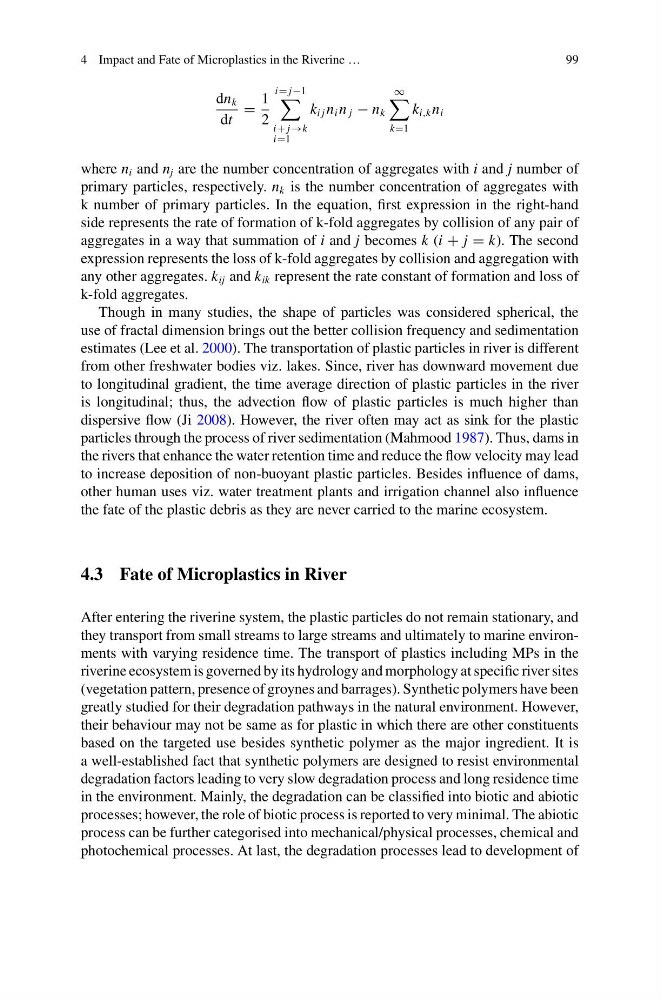
where n i and n j are the number concentration of aggregates with i and j number of
primary particles, respectively. n k is the number concentration of aggregates with
k number of primary particles. In the equation, first expression in the right-hand
side represents the rate of formation of k-fold aggregates by collision of any pair of
aggregates in a way that summation of i and j becomes k (i + j = k). The second
expression represents the loss of k-fold aggregates by collision and aggregation with
any other aggregates. k ij and k ik represent the rate constant of formation and loss of
k-fold aggregates.
Though in many studies, the shape of particles was considered spherical, the
use of fractal dimension brings out the better collision frequency and sedimentation
estimates (Lee et al. 2000). The transportation of plastic particles in river is different
from other freshwater bodies viz. lakes. Since, river has downward movement due
to longitudinal gradient, the time average direction of plastic particles in the river
is longitudinal; thus, the advection flow of plastic particles is much higher than
dispersive flow (Ji 2008). However, the river often may act as sink for the plastic
particles through the process of river sedimentation (Mahmood 1987). Thus, dams in
the rivers that enhance the water retention time and reduce the flow velocity may lead
to increase deposition of non-buoyant plastic particles. Besides influence of dams,
other human uses viz. water treatment plants and irrigation channel also influence
the fate of the plastic debris as they are never carried to the marine ecosystem.
4.3 Fate of Microplastics in River
After entering the riverine system, the plastic particles do not remain stationary, and
they transport from small streams to large streams and ultimately to marine environments with varying residence time. The transport of plastics including MPs in the
riverine ecosystem is governed by its hydrology and morphology at specific river sites
(vegetation pattern, presence of groynes and barrages). Synthetic polymers have been
greatly studied for their degradation pathways in the natural environment. However,
their behaviour may not be same as for plastic in which there are other constituents
based on the targeted use besides synthetic polymer as the major ingredient. It is
a well-established fact that synthetic polymers are designed to resist environmental
degradation factors leading to very slow degradation process and long residence time
in the environment. Mainly, the degradation can be classified into biotic and abiotic
processes; however, the role of biotic process is reported to very minimal. The abiotic
process can be further categorised into mechanical/physical processes, chemical and
photochemical processes. At last, the degradation processes lead to development of
99
dn k
dt
=
1
2
i= j−1
i+ j→k
i=1
k i j n i n j − n k
∞
k=1
k i,k n i
where n i and n j are the number concentration of aggregates with i and j number of
primary particles, respectively. n k is the number concentration of aggregates with
k number of primary particles. In the equation, first expression in the right-hand
side represents the rate of formation of k-fold aggregates by collision of any pair of
aggregates in a way that summation of i and j becomes k (i + j = k). The second
expression represents the loss of k-fold aggregates by collision and aggregation with
any other aggregates. k ij and k ik represent the rate constant of formation and loss of
k-fold aggregates.
Though in many studies, the shape of particles was considered spherical, the
use of fractal dimension brings out the better collision frequency and sedimentation
estimates (Lee et al. 2000). The transportation of plastic particles in river is different
from other freshwater bodies viz. lakes. Since, river has downward movement due
to longitudinal gradient, the time average direction of plastic particles in the river
is longitudinal; thus, the advection flow of plastic particles is much higher than
dispersive flow (Ji 2008). However, the river often may act as sink for the plastic
particles through the process of river sedimentation (Mahmood 1987). Thus, dams in
the rivers that enhance the water retention time and reduce the flow velocity may lead
to increase deposition of non-buoyant plastic particles. Besides influence of dams,
other human uses viz. water treatment plants and irrigation channel also influence
the fate of the plastic debris as they are never carried to the marine ecosystem.
4.3 Fate of Microplastics in River
After entering the riverine system, the plastic particles do not remain stationary, and
they transport from small streams to large streams and ultimately to marine environments with varying residence time. The transport of plastics including MPs in the
riverine ecosystem is governed by its hydrology and morphology at specific river sites
(vegetation pattern, presence of groynes and barrages). Synthetic polymers have been
greatly studied for their degradation pathways in the natural environment. However,
their behaviour may not be same as for plastic in which there are other constituents
based on the targeted use besides synthetic polymer as the major ingredient. It is
a well-established fact that synthetic polymers are designed to resist environmental
degradation factors leading to very slow degradation process and long residence time
in the environment. Mainly, the degradation can be classified into biotic and abiotic
processes; however, the role of biotic process is reported to very minimal. The abiotic
process can be further categorised into mechanical/physical processes, chemical and
photochemical processes. At last, the degradation processes lead to development of