

98
D. J. Sarkar et al.
aggregated buoyant plastic particles can be described by the Stokes law (Brown and
Lawler 2003; Kowalski et al. 2016). The settled plastic particles can also come back
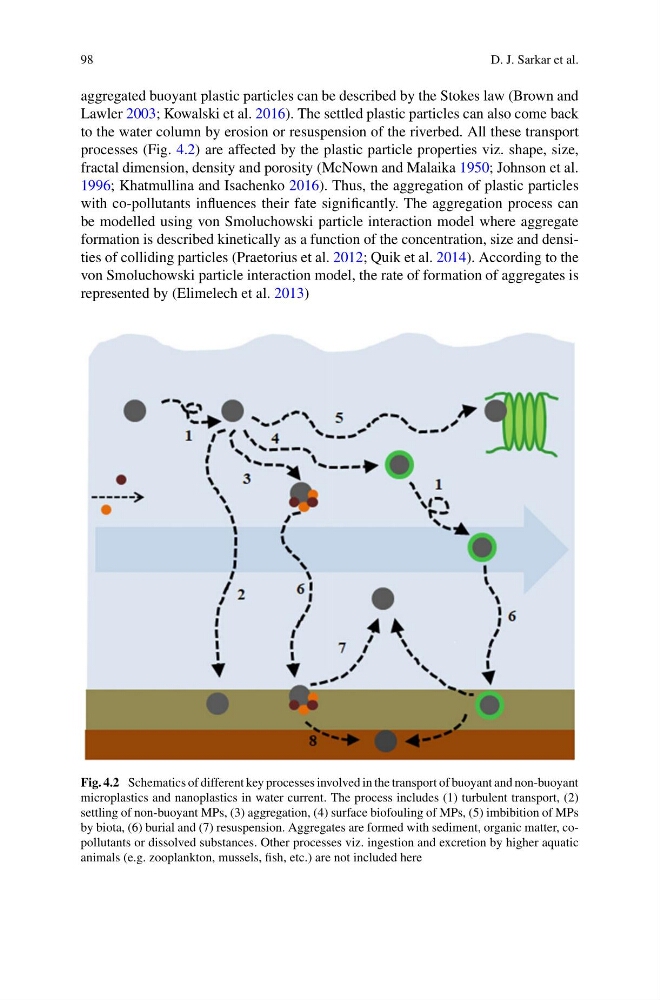
to the water column by erosion or resuspension of the riverbed. All these transport
processes (Fig. 4.2) are affected by the plastic particle properties viz. shape, size,
fractal dimension, density and porosity (McNown and Malaika 1950; Johnson et al.
1996; Khatmullina and Isachenko 2016). Thus, the aggregation of plastic particles
with co-pollutants influences their fate significantly. The aggregation process can
be modelled using von Smoluchowski particle interaction model where aggregate
formation is described kinetically as a function of the concentration, size and densities of colliding particles (Praetorius et al. 2012; Quik et al. 2014). According to the
von Smoluchowski particle interaction model, the rate of formation of aggregates is
represented by (Elimelech et al. 2013)
Fig. 4.2 Schematics of different key processes involved in the transport of buoyant and non-buoyant
microplastics and nanoplastics in water current. The process includes (1) turbulent transport, (2)
settling of non-buoyant MPs, (3) aggregation, (4) surface biofouling of MPs, (5) imbibition of MPs
by biota, (6) burial and (7) resuspension. Aggregates are formed with sediment, organic matter, copollutants or dissolved substances. Other processes viz. ingestion and excretion by higher aquatic
animals (e.g. zooplankton, mussels, fish, etc.) are not included here
D. J. Sarkar et al.
aggregated buoyant plastic particles can be described by the Stokes law (Brown and
Lawler 2003; Kowalski et al. 2016). The settled plastic particles can also come back
to the water column by erosion or resuspension of the riverbed. All these transport
processes (Fig. 4.2) are affected by the plastic particle properties viz. shape, size,
fractal dimension, density and porosity (McNown and Malaika 1950; Johnson et al.
1996; Khatmullina and Isachenko 2016). Thus, the aggregation of plastic particles
with co-pollutants influences their fate significantly. The aggregation process can
be modelled using von Smoluchowski particle interaction model where aggregate
formation is described kinetically as a function of the concentration, size and densities of colliding particles (Praetorius et al. 2012; Quik et al. 2014). According to the
von Smoluchowski particle interaction model, the rate of formation of aggregates is
represented by (Elimelech et al. 2013)
Fig. 4.2 Schematics of different key processes involved in the transport of buoyant and non-buoyant
microplastics and nanoplastics in water current. The process includes (1) turbulent transport, (2)
settling of non-buoyant MPs, (3) aggregation, (4) surface biofouling of MPs, (5) imbibition of MPs
by biota, (6) burial and (7) resuspension. Aggregates are formed with sediment, organic matter, copollutants or dissolved substances. Other processes viz. ingestion and excretion by higher aquatic
animals (e.g. zooplankton, mussels, fish, etc.) are not included here