

4 Impact and Fate of Microplastics in the Riverine …
97
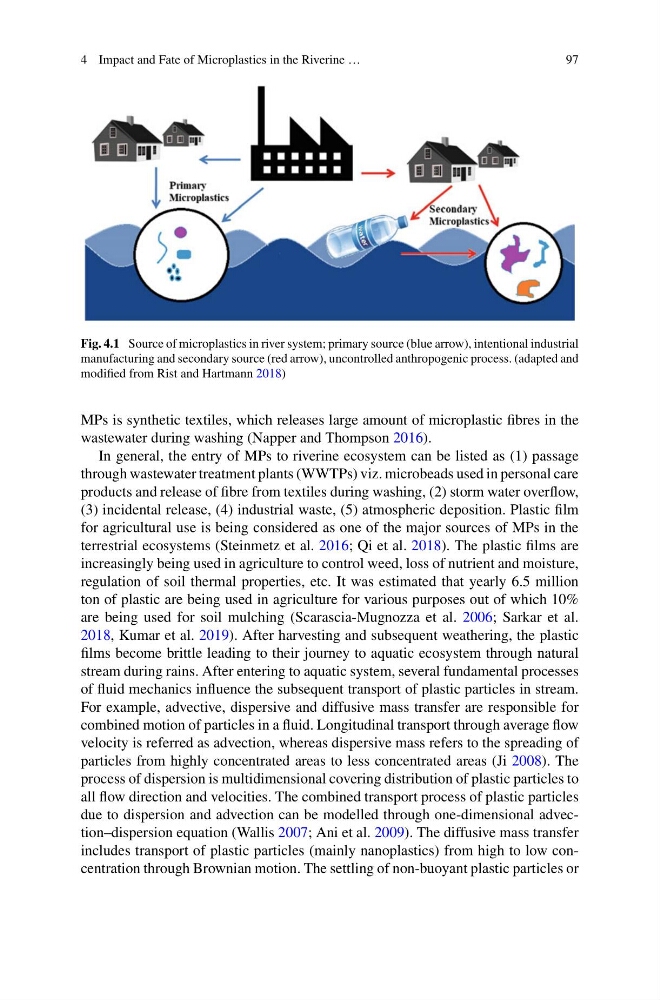
Fig. 4.1 Source of microplastics in river system; primary source (blue arrow), intentional industrial
manufacturing and secondary source (red arrow), uncontrolled anthropogenic process. (adapted and
modified from Rist and Hartmann 2018)
MPs is synthetic textiles, which releases large amount of microplastic fibres in the
wastewater during washing (Napper and Thompson 2016).
In general, the entry of MPs to riverine ecosystem can be listed as (1) passage
through wastewater treatment plants (WWTPs) viz. microbeads used in personal care
products and release of fibre from textiles during washing, (2) storm water overflow,
(3) incidental release, (4) industrial waste, (5) atmospheric deposition. Plastic film
for agricultural use is being considered as one of the major sources of MPs in the
terrestrial ecosystems (Steinmetz et al. 2016; Qi et al. 2018). The plastic films are
increasingly being used in agriculture to control weed, loss of nutrient and moisture,
regulation of soil thermal properties, etc. It was estimated that yearly 6.5 million
ton of plastic are being used in agriculture for various purposes out of which 10%
are being used for soil mulching (Scarascia-Mugnozza et al. 2006; Sarkar et al.
2018, Kumar et al. 2019). After harvesting and subsequent weathering, the plastic
films become brittle leading to their journey to aquatic ecosystem through natural
stream during rains. After entering to aquatic system, several fundamental processes
of fluid mechanics influence the subsequent transport of plastic particles in stream.
For example, advective, dispersive and diffusive mass transfer are responsible for
combined motion of particles in a fluid. Longitudinal transport through average flow
velocity is referred as advection, whereas dispersive mass refers to the spreading of
particles from highly concentrated areas to less concentrated areas (Ji 2008). The
process of dispersion is multidimensional covering distribution of plastic particles to
all flow direction and velocities. The combined transport process of plastic particles
due to dispersion and advection can be modelled through one-dimensional advection–dispersion equation (Wallis 2007; Ani et al. 2009). The diffusive mass transfer
includes transport of plastic particles (mainly nanoplastics) from high to low concentration through Brownian motion. The settling of non-buoyant plastic particles or
97
Fig. 4.1 Source of microplastics in river system; primary source (blue arrow), intentional industrial
manufacturing and secondary source (red arrow), uncontrolled anthropogenic process. (adapted and
modified from Rist and Hartmann 2018)
MPs is synthetic textiles, which releases large amount of microplastic fibres in the
wastewater during washing (Napper and Thompson 2016).
In general, the entry of MPs to riverine ecosystem can be listed as (1) passage
through wastewater treatment plants (WWTPs) viz. microbeads used in personal care
products and release of fibre from textiles during washing, (2) storm water overflow,
(3) incidental release, (4) industrial waste, (5) atmospheric deposition. Plastic film
for agricultural use is being considered as one of the major sources of MPs in the
terrestrial ecosystems (Steinmetz et al. 2016; Qi et al. 2018). The plastic films are
increasingly being used in agriculture to control weed, loss of nutrient and moisture,
regulation of soil thermal properties, etc. It was estimated that yearly 6.5 million
ton of plastic are being used in agriculture for various purposes out of which 10%
are being used for soil mulching (Scarascia-Mugnozza et al. 2006; Sarkar et al.
2018, Kumar et al. 2019). After harvesting and subsequent weathering, the plastic
films become brittle leading to their journey to aquatic ecosystem through natural
stream during rains. After entering to aquatic system, several fundamental processes
of fluid mechanics influence the subsequent transport of plastic particles in stream.
For example, advective, dispersive and diffusive mass transfer are responsible for
combined motion of particles in a fluid. Longitudinal transport through average flow
velocity is referred as advection, whereas dispersive mass refers to the spreading of
particles from highly concentrated areas to less concentrated areas (Ji 2008). The
process of dispersion is multidimensional covering distribution of plastic particles to
all flow direction and velocities. The combined transport process of plastic particles
due to dispersion and advection can be modelled through one-dimensional advection–dispersion equation (Wallis 2007; Ani et al. 2009). The diffusive mass transfer
includes transport of plastic particles (mainly nanoplastics) from high to low concentration through Brownian motion. The settling of non-buoyant plastic particles or