

46
D. Kirschke et al.
Biodiversity and landscape quality
Index 2030 = 100
Index, total
Subindex farmland
Subindex forests
Subindex selements
Subindex inland water
Subindex seaside
Target:100
*The values for 1970 and 1975 have been reconstructed.
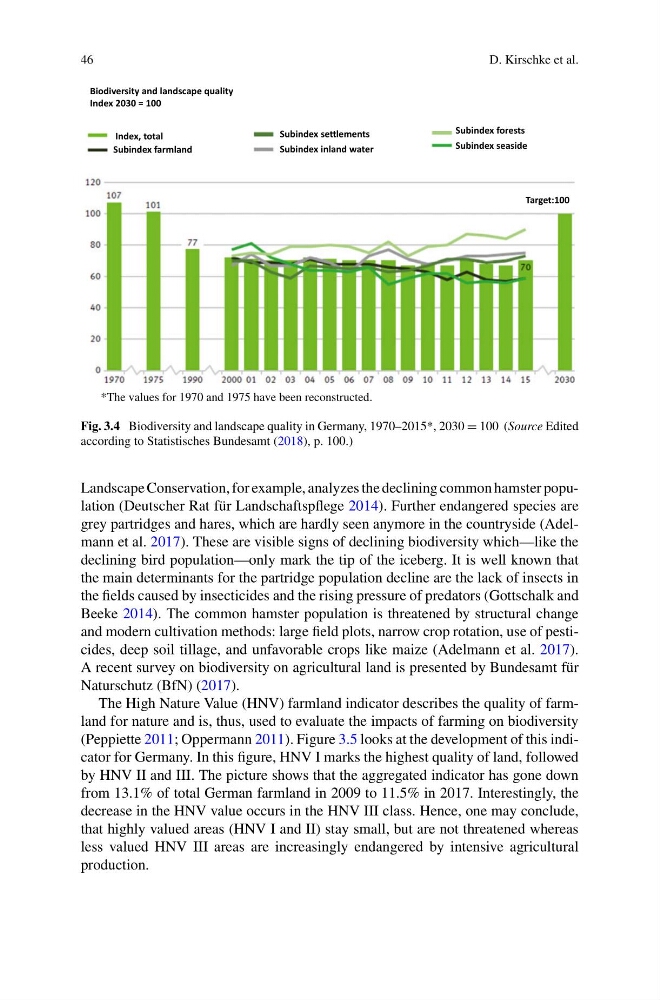
Fig. 3.4 Biodiversity and landscape quality in Germany, 1970–2015*, 2030 = 100 (Source Edited
according to Statistisches Bundesamt (2018), p. 100.)
Landscape Conservation, for example, analyzes the declining common hamster population (Deutscher Rat für Landschaftspflege 2014). Further endangered species are
grey partridges and hares, which are hardly seen anymore in the countryside (Adelmann et al. 2017). These are visible signs of declining biodiversity which—like the
declining bird population—only mark the tip of the iceberg. It is well known that
the main determinants for the partridge population decline are the lack of insects in
the fields caused by insecticides and the rising pressure of predators (Gottschalk and
Beeke 2014). The common hamster population is threatened by structural change
and modern cultivation methods: large field plots, narrow crop rotation, use of pesticides, deep soil tillage, and unfavorable crops like maize (Adelmann et al. 2017).
A recent survey on biodiversity on agricultural land is presented by Bundesamt für
Naturschutz (BfN) (2017).
The High Nature Value (HNV) farmland indicator describes the quality of farmland for nature and is, thus, used to evaluate the impacts of farming on biodiversity
(Peppiette 2011; Oppermann 2011). Figure 3.5 looks at the development of this indicator for Germany. In this figure, HNV I marks the highest quality of land, followed
by HNV II and III. The picture shows that the aggregated indicator has gone down
from 13.1% of total German farmland in 2009 to 11.5% in 2017. Interestingly, the
decrease in the HNV value occurs in the HNV III class. Hence, one may conclude,
that highly valued areas (HNV I and II) stay small, but are not threatened whereas
less valued HNV III areas are increasingly endangered by intensive agricultural
production.
D. Kirschke et al.
Biodiversity and landscape quality
Index 2030 = 100
Index, total
Subindex farmland
Subindex forests
Subindex selements
Subindex inland water
Subindex seaside
Target:100
*The values for 1970 and 1975 have been reconstructed.
Fig. 3.4 Biodiversity and landscape quality in Germany, 1970–2015*, 2030 = 100 (Source Edited
according to Statistisches Bundesamt (2018), p. 100.)
Landscape Conservation, for example, analyzes the declining common hamster population (Deutscher Rat für Landschaftspflege 2014). Further endangered species are
grey partridges and hares, which are hardly seen anymore in the countryside (Adelmann et al. 2017). These are visible signs of declining biodiversity which—like the
declining bird population—only mark the tip of the iceberg. It is well known that
the main determinants for the partridge population decline are the lack of insects in
the fields caused by insecticides and the rising pressure of predators (Gottschalk and
Beeke 2014). The common hamster population is threatened by structural change
and modern cultivation methods: large field plots, narrow crop rotation, use of pesticides, deep soil tillage, and unfavorable crops like maize (Adelmann et al. 2017).
A recent survey on biodiversity on agricultural land is presented by Bundesamt für
Naturschutz (BfN) (2017).
The High Nature Value (HNV) farmland indicator describes the quality of farmland for nature and is, thus, used to evaluate the impacts of farming on biodiversity
(Peppiette 2011; Oppermann 2011). Figure 3.5 looks at the development of this indicator for Germany. In this figure, HNV I marks the highest quality of land, followed
by HNV II and III. The picture shows that the aggregated indicator has gone down
from 13.1% of total German farmland in 2009 to 11.5% in 2017. Interestingly, the
decrease in the HNV value occurs in the HNV III class. Hence, one may conclude,
that highly valued areas (HNV I and II) stay small, but are not threatened whereas
less valued HNV III areas are increasingly endangered by intensive agricultural
production.