

314
D. Haase
Urban Green
Infrastructure
Tree
Urban Green
Infrastructure
Tree
Urban Ecosystem
Services (supply)
Evapotranspiraon
Carbon sequestraon
Parcle filtering
Urban Ecosystem
Services (supply)
Evapotranspiraon
Carbon sequestraon
Parcle filtering
Urban Ecosystem
Services (flow)
CC adaptaon
Air cooling (cool air)
Air quality (fresh air)
Urban Ecosystem
Services (flow)
CC adaptaon
Air cooling (cool air)
Air quality (fresh air)
Urban Ecosystem
Services (demand)
Less air cond. Costs
CO 2 market: net win
Less health costs
Urban Ecosystem
Services (demand)
Less air cond. Costs
CO 2 market: net win
Less health costs
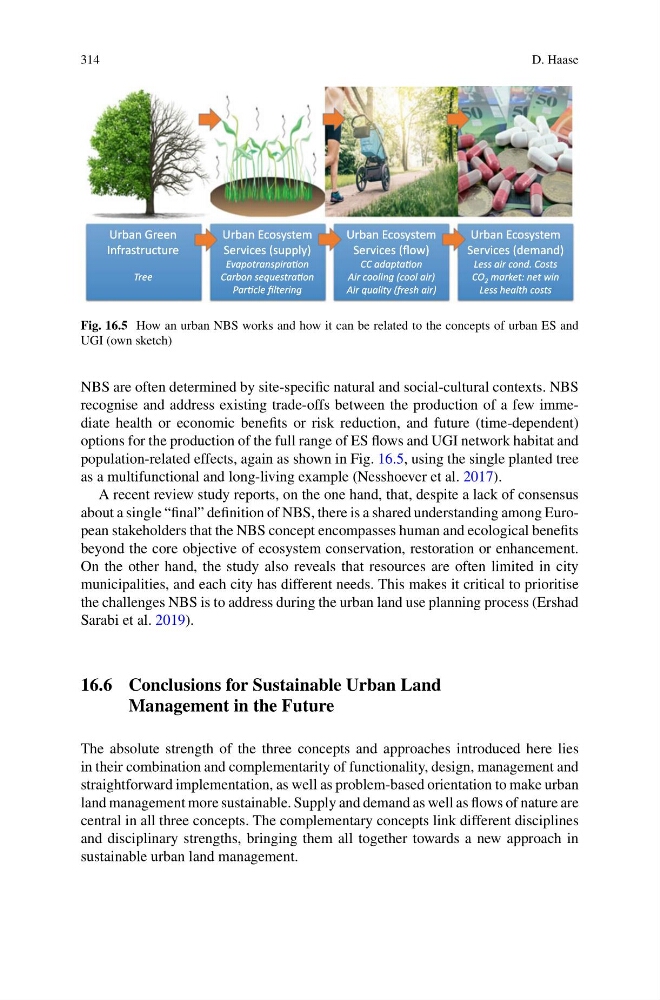
Fig. 16.5 How an urban NBS works and how it can be related to the concepts of urban ES and
UGI (own sketch)
NBS are often determined by site-specific natural and social-cultural contexts. NBS
recognise and address existing trade-offs between the production of a few immediate health or economic benefits or risk reduction, and future (time-dependent)
options for the production of the full range of ES flows and UGI network habitat and
population-related effects, again as shown in Fig. 16.5, using the single planted tree
as a multifunctional and long-living example (Nesshoever et al. 2017).
A recent review study reports, on the one hand, that, despite a lack of consensus
about a single “final” definition of NBS, there is a shared understanding among European stakeholders that the NBS concept encompasses human and ecological benefits
beyond the core objective of ecosystem conservation, restoration or enhancement.
On the other hand, the study also reveals that resources are often limited in city
municipalities, and each city has different needs. This makes it critical to prioritise
the challenges NBS is to address during the urban land use planning process (Ershad
Sarabi et al. 2019).
16.6 Conclusions for Sustainable Urban Land
Management in the Future
The absolute strength of the three concepts and approaches introduced here lies
in their combination and complementarity of functionality, design, management and
straightforward implementation, as well as problem-based orientation to make urban
land management more sustainable. Supply and demand as well as flows of nature are
central in all three concepts. The complementary concepts link different disciplines
and disciplinary strengths, bringing them all together towards a new approach in
sustainable urban land management.
D. Haase
Urban Green
Infrastructure
Tree
Urban Green
Infrastructure
Tree
Urban Ecosystem
Services (supply)
Evapotranspiraon
Carbon sequestraon
Parcle filtering
Urban Ecosystem
Services (supply)
Evapotranspiraon
Carbon sequestraon
Parcle filtering
Urban Ecosystem
Services (flow)
CC adaptaon
Air cooling (cool air)
Air quality (fresh air)
Urban Ecosystem
Services (flow)
CC adaptaon
Air cooling (cool air)
Air quality (fresh air)
Urban Ecosystem
Services (demand)
Less air cond. Costs
CO 2 market: net win
Less health costs
Urban Ecosystem
Services (demand)
Less air cond. Costs
CO 2 market: net win
Less health costs
Fig. 16.5 How an urban NBS works and how it can be related to the concepts of urban ES and
UGI (own sketch)
NBS are often determined by site-specific natural and social-cultural contexts. NBS
recognise and address existing trade-offs between the production of a few immediate health or economic benefits or risk reduction, and future (time-dependent)
options for the production of the full range of ES flows and UGI network habitat and
population-related effects, again as shown in Fig. 16.5, using the single planted tree
as a multifunctional and long-living example (Nesshoever et al. 2017).
A recent review study reports, on the one hand, that, despite a lack of consensus
about a single “final” definition of NBS, there is a shared understanding among European stakeholders that the NBS concept encompasses human and ecological benefits
beyond the core objective of ecosystem conservation, restoration or enhancement.
On the other hand, the study also reveals that resources are often limited in city
municipalities, and each city has different needs. This makes it critical to prioritise
the challenges NBS is to address during the urban land use planning process (Ershad
Sarabi et al. 2019).
16.6 Conclusions for Sustainable Urban Land
Management in the Future
The absolute strength of the three concepts and approaches introduced here lies
in their combination and complementarity of functionality, design, management and
straightforward implementation, as well as problem-based orientation to make urban
land management more sustainable. Supply and demand as well as flows of nature are
central in all three concepts. The complementary concepts link different disciplines
and disciplinary strengths, bringing them all together towards a new approach in
sustainable urban land management.