

16 Integrating Ecosystem Services, Green Infrastructure and Nature-Based …
313
ably manage, and restore natural or modified ecosystems, that address societal challenges effectively and adaptively, simultaneously providing human well-being and
biodiversity benefits” (Cohen-Shacham et al. 2016). NBS are intended to support
attaining society’s development goals and safeguarding human well-being in ways
that (a) reflect the cultural and societal values of a multi-origin urban society, and
(b) enhance the resilience of urban ecosystems, and their capacity to provide the
aforementioned ES (Kabisch et al. 2016a, b). NBS are designed nature—similar to
UGI—that are implemented to address the urban challenges listed in the introduction of this chapter: food security, climate change, water shortage, human health, and
disaster risk (Nesshoever et al. 2017).
NBS are based on both the ES and UGI concepts, but are novel in that they
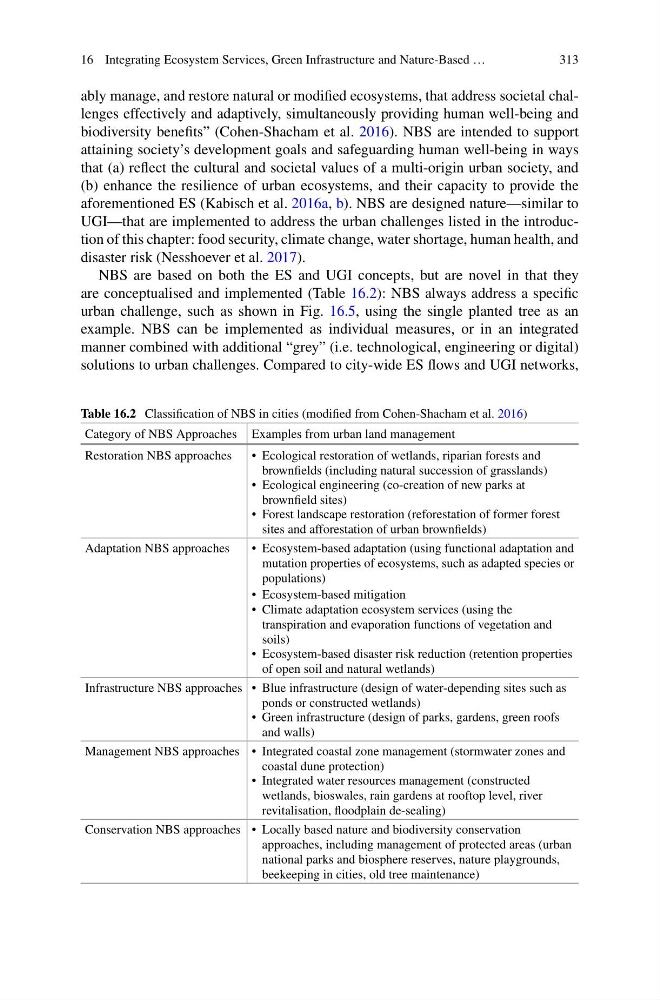
are conceptualised and implemented (Table 16.2): NBS always address a specific
urban challenge, such as shown in Fig. 16.5, using the single planted tree as an
example. NBS can be implemented as individual measures, or in an integrated
manner combined with additional “grey” (i.e. technological, engineering or digital)
solutions to urban challenges. Compared to city-wide ES flows and UGI networks,
Table 16.2 Classification of NBS in cities (modified from Cohen-Shacham et al. 2016)
Category of NBS Approaches Examples from urban land management
Restoration NBS approaches
• Ecological restoration of wetlands, riparian forests and
brownfields (including natural succession of grasslands)
• Ecological engineering (co-creation of new parks at
brownfield sites)
• Forest landscape restoration (reforestation of former forest
sites and afforestation of urban brownfields)
Adaptation NBS approaches
• Ecosystem-based adaptation (using functional adaptation and
mutation properties of ecosystems, such as adapted species or
populations)
• Ecosystem-based mitigation
• Climate adaptation ecosystem services (using the
transpiration and evaporation functions of vegetation and
soils)
• Ecosystem-based disaster risk reduction (retention properties
of open soil and natural wetlands)
Infrastructure NBS approaches • Blue infrastructure (design of water-depending sites such as
ponds or constructed wetlands)
• Green infrastructure (design of parks, gardens, green roofs
and walls)
Management NBS approaches • Integrated coastal zone management (stormwater zones and
coastal dune protection)
• Integrated water resources management (constructed
wetlands, bioswales, rain gardens at rooftop level, river
revitalisation, floodplain de-sealing)
Conservation NBS approaches • Locally based nature and biodiversity conservation
approaches, including management of protected areas (urban
national parks and biosphere reserves, nature playgrounds,
beekeeping in cities, old tree maintenance)
313
ably manage, and restore natural or modified ecosystems, that address societal challenges effectively and adaptively, simultaneously providing human well-being and
biodiversity benefits” (Cohen-Shacham et al. 2016). NBS are intended to support
attaining society’s development goals and safeguarding human well-being in ways
that (a) reflect the cultural and societal values of a multi-origin urban society, and
(b) enhance the resilience of urban ecosystems, and their capacity to provide the
aforementioned ES (Kabisch et al. 2016a, b). NBS are designed nature—similar to
UGI—that are implemented to address the urban challenges listed in the introduction of this chapter: food security, climate change, water shortage, human health, and
disaster risk (Nesshoever et al. 2017).
NBS are based on both the ES and UGI concepts, but are novel in that they
are conceptualised and implemented (Table 16.2): NBS always address a specific
urban challenge, such as shown in Fig. 16.5, using the single planted tree as an
example. NBS can be implemented as individual measures, or in an integrated
manner combined with additional “grey” (i.e. technological, engineering or digital)
solutions to urban challenges. Compared to city-wide ES flows and UGI networks,
Table 16.2 Classification of NBS in cities (modified from Cohen-Shacham et al. 2016)
Category of NBS Approaches Examples from urban land management
Restoration NBS approaches
• Ecological restoration of wetlands, riparian forests and
brownfields (including natural succession of grasslands)
• Ecological engineering (co-creation of new parks at
brownfield sites)
• Forest landscape restoration (reforestation of former forest
sites and afforestation of urban brownfields)
Adaptation NBS approaches
• Ecosystem-based adaptation (using functional adaptation and
mutation properties of ecosystems, such as adapted species or
populations)
• Ecosystem-based mitigation
• Climate adaptation ecosystem services (using the
transpiration and evaporation functions of vegetation and
soils)
• Ecosystem-based disaster risk reduction (retention properties
of open soil and natural wetlands)
Infrastructure NBS approaches • Blue infrastructure (design of water-depending sites such as
ponds or constructed wetlands)
• Green infrastructure (design of parks, gardens, green roofs
and walls)
Management NBS approaches • Integrated coastal zone management (stormwater zones and
coastal dune protection)
• Integrated water resources management (constructed
wetlands, bioswales, rain gardens at rooftop level, river
revitalisation, floodplain de-sealing)
Conservation NBS approaches • Locally based nature and biodiversity conservation
approaches, including management of protected areas (urban
national parks and biosphere reserves, nature playgrounds,
beekeeping in cities, old tree maintenance)