

16 Integrating Ecosystem Services, Green Infrastructure and Nature-Based …
311
Ecosystem services
(process outcomes)
SUPPLY
Ecosystem services
(process outcomes)
SUPPLY
Ecosystem services
(linkage, transport, access)
FLOW
Ecosystem services
(linkage, transport, access)
FLOW
Society system
(benefits and values)
DEMAND
Society system
(benefits and values)
DEMAND
Urban policy and decision-making
MANAGEMENT AND PLANNING
Ecosystem services
(mis-)matches
Ecosystem services
NONSUSTAINABILITY
Capacity < Flow
Ecosystem services
SUSTAINABILITY
Capacity =/> Flow
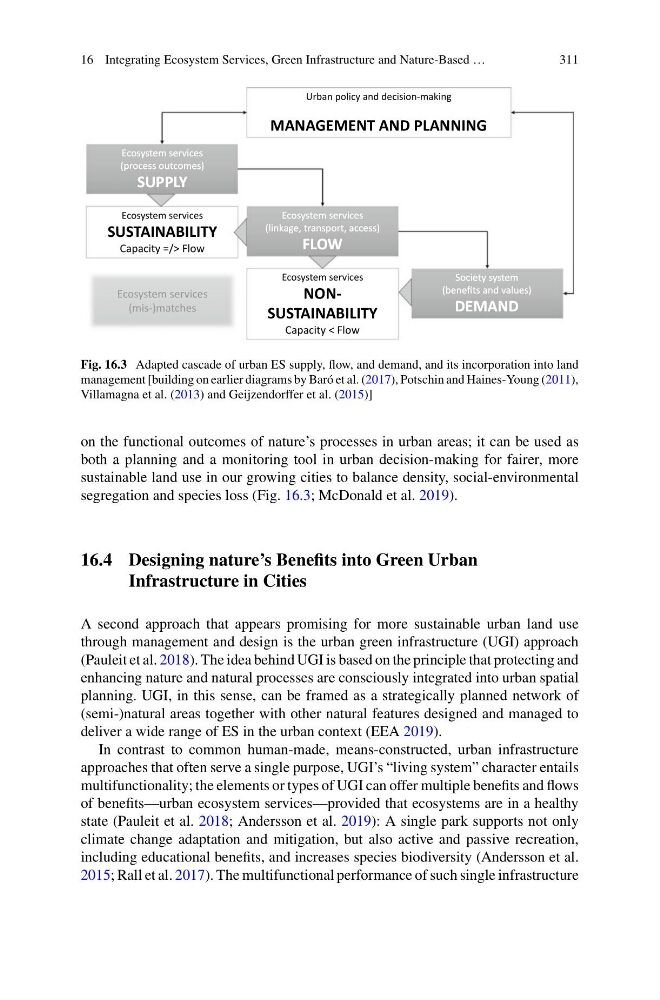
Fig. 16.3 Adapted cascade of urban ES supply, flow, and demand, and its incorporation into land
management [building on earlier diagrams by Baró et al. (2017), Potschin and Haines-Young (2011),
Villamagna et al. (2013) and Geijzendorffer et al. (2015)]
on the functional outcomes of nature’s processes in urban areas; it can be used as
both a planning and a monitoring tool in urban decision-making for fairer, more
sustainable land use in our growing cities to balance density, social-environmental
segregation and species loss (Fig. 16.3; McDonald et al. 2019).
16.4 Designing nature’s Benefits into Green Urban
Infrastructure in Cities
A second approach that appears promising for more sustainable urban land use
through management and design is the urban green infrastructure (UGI) approach
(Pauleit et al. 2018). The idea behind UGI is based on the principle that protecting and
enhancing nature and natural processes are consciously integrated into urban spatial
planning. UGI, in this sense, can be framed as a strategically planned network of
(semi-)natural areas together with other natural features designed and managed to
deliver a wide range of ES in the urban context (EEA 2019).
In contrast to common human-made, means-constructed, urban infrastructure
approaches that often serve a single purpose, UGI’s “living system” character entails
multifunctionality; the elements or types of UGI can offer multiple benefits and flows
of benefits—urban ecosystem services—provided that ecosystems are in a healthy
state (Pauleit et al. 2018; Andersson et al. 2019): A single park supports not only
climate change adaptation and mitigation, but also active and passive recreation,
including educational benefits, and increases species biodiversity (Andersson et al.
2015; Rall et al. 2017). The multifunctional performance of such single infrastructure
311
Ecosystem services
(process outcomes)
SUPPLY
Ecosystem services
(process outcomes)
SUPPLY
Ecosystem services
(linkage, transport, access)
FLOW
Ecosystem services
(linkage, transport, access)
FLOW
Society system
(benefits and values)
DEMAND
Society system
(benefits and values)
DEMAND
Urban policy and decision-making
MANAGEMENT AND PLANNING
Ecosystem services
(mis-)matches
Ecosystem services
NONSUSTAINABILITY
Capacity < Flow
Ecosystem services
SUSTAINABILITY
Capacity =/> Flow
Fig. 16.3 Adapted cascade of urban ES supply, flow, and demand, and its incorporation into land
management [building on earlier diagrams by Baró et al. (2017), Potschin and Haines-Young (2011),
Villamagna et al. (2013) and Geijzendorffer et al. (2015)]
on the functional outcomes of nature’s processes in urban areas; it can be used as
both a planning and a monitoring tool in urban decision-making for fairer, more
sustainable land use in our growing cities to balance density, social-environmental
segregation and species loss (Fig. 16.3; McDonald et al. 2019).
16.4 Designing nature’s Benefits into Green Urban
Infrastructure in Cities
A second approach that appears promising for more sustainable urban land use
through management and design is the urban green infrastructure (UGI) approach
(Pauleit et al. 2018). The idea behind UGI is based on the principle that protecting and
enhancing nature and natural processes are consciously integrated into urban spatial
planning. UGI, in this sense, can be framed as a strategically planned network of
(semi-)natural areas together with other natural features designed and managed to
deliver a wide range of ES in the urban context (EEA 2019).
In contrast to common human-made, means-constructed, urban infrastructure
approaches that often serve a single purpose, UGI’s “living system” character entails
multifunctionality; the elements or types of UGI can offer multiple benefits and flows
of benefits—urban ecosystem services—provided that ecosystems are in a healthy
state (Pauleit et al. 2018; Andersson et al. 2019): A single park supports not only
climate change adaptation and mitigation, but also active and passive recreation,
including educational benefits, and increases species biodiversity (Andersson et al.
2015; Rall et al. 2017). The multifunctional performance of such single infrastructure