

14 Small-Scale System Solutions—Material Flow Management …
275
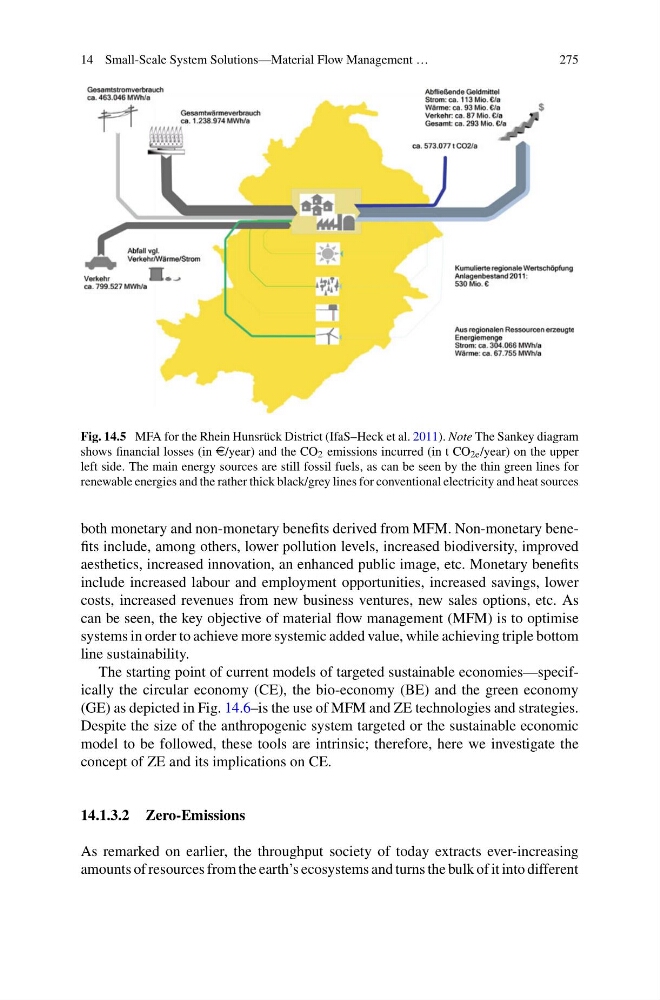
Fig. 14.5 MFA for the Rhein Hunsrück District (IfaS–Heck et al. 2011). Note The Sankey diagram
shows financial losses (in e/year) and the CO 2 emissions incurred (in t CO 2e /year) on the upper
left side. The main energy sources are still fossil fuels, as can be seen by the thin green lines for
renewable energies and the rather thick black/grey lines for conventional electricity and heat sources
both monetary and non-monetary benefits derived from MFM. Non-monetary benefits include, among others, lower pollution levels, increased biodiversity, improved
aesthetics, increased innovation, an enhanced public image, etc. Monetary benefits
include increased labour and employment opportunities, increased savings, lower
costs, increased revenues from new business ventures, new sales options, etc. As
can be seen, the key objective of material flow management (MFM) is to optimise
systems in order to achieve more systemic added value, while achieving triple bottom
line sustainability.
The starting point of current models of targeted sustainable economies—specifically the circular economy (CE), the bio-economy (BE) and the green economy
(GE) as depicted in Fig. 14.6–is the use of MFM and ZE technologies and strategies.
Despite the size of the anthropogenic system targeted or the sustainable economic
model to be followed, these tools are intrinsic; therefore, here we investigate the
concept of ZE and its implications on CE.
14.1.3.2 Zero-Emissions
As remarked on earlier, the throughput society of today extracts ever-increasing
amounts of resources from the earth’s ecosystems and turns the bulk of it into different
275
Fig. 14.5 MFA for the Rhein Hunsrück District (IfaS–Heck et al. 2011). Note The Sankey diagram
shows financial losses (in e/year) and the CO 2 emissions incurred (in t CO 2e /year) on the upper
left side. The main energy sources are still fossil fuels, as can be seen by the thin green lines for
renewable energies and the rather thick black/grey lines for conventional electricity and heat sources
both monetary and non-monetary benefits derived from MFM. Non-monetary benefits include, among others, lower pollution levels, increased biodiversity, improved
aesthetics, increased innovation, an enhanced public image, etc. Monetary benefits
include increased labour and employment opportunities, increased savings, lower
costs, increased revenues from new business ventures, new sales options, etc. As
can be seen, the key objective of material flow management (MFM) is to optimise
systems in order to achieve more systemic added value, while achieving triple bottom
line sustainability.
The starting point of current models of targeted sustainable economies—specifically the circular economy (CE), the bio-economy (BE) and the green economy
(GE) as depicted in Fig. 14.6–is the use of MFM and ZE technologies and strategies.
Despite the size of the anthropogenic system targeted or the sustainable economic
model to be followed, these tools are intrinsic; therefore, here we investigate the
concept of ZE and its implications on CE.
14.1.3.2 Zero-Emissions
As remarked on earlier, the throughput society of today extracts ever-increasing
amounts of resources from the earth’s ecosystems and turns the bulk of it into different