

274
P. Heck
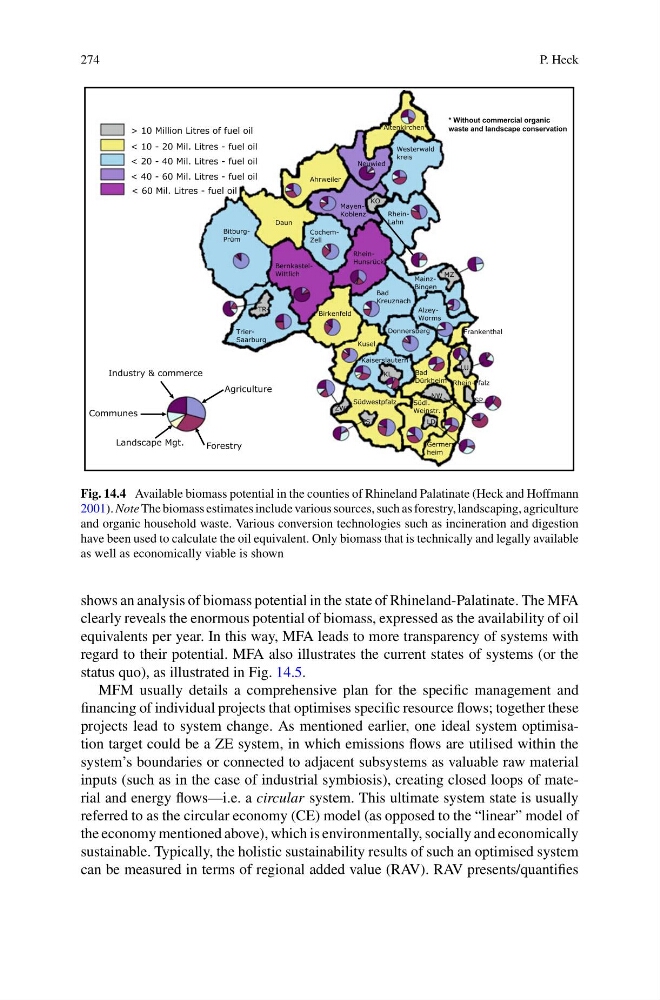
Fig. 14.4 Available biomass potential in the counties of Rhineland Palatinate (Heck and Hoffmann
2001). Note The biomass estimates include various sources, such as forestry, landscaping, agriculture
and organic household waste. Various conversion technologies such as incineration and digestion
have been used to calculate the oil equivalent. Only biomass that is technically and legally available
as well as economically viable is shown
shows an analysis of biomass potential in the state of Rhineland-Palatinate. The MFA
clearly reveals the enormous potential of biomass, expressed as the availability of oil
equivalents per year. In this way, MFA leads to more transparency of systems with
regard to their potential. MFA also illustrates the current states of systems (or the
status quo), as illustrated in Fig. 14.5.
MFM usually details a comprehensive plan for the specific management and
financing of individual projects that optimises specific resource flows; together these
projects lead to system change. As mentioned earlier, one ideal system optimisation target could be a ZE system, in which emissions flows are utilised within the
system’s boundaries or connected to adjacent subsystems as valuable raw material
inputs (such as in the case of industrial symbiosis), creating closed loops of material and energy flows—i.e. a circular system. This ultimate system state is usually
referred to as the circular economy (CE) model (as opposed to the “linear” model of
the economy mentioned above), which is environmentally, socially and economically
sustainable. Typically, the holistic sustainability results of such an optimised system
can be measured in terms of regional added value (RAV). RAV presents/quantifies
P. Heck
Fig. 14.4 Available biomass potential in the counties of Rhineland Palatinate (Heck and Hoffmann
2001). Note The biomass estimates include various sources, such as forestry, landscaping, agriculture
and organic household waste. Various conversion technologies such as incineration and digestion
have been used to calculate the oil equivalent. Only biomass that is technically and legally available
as well as economically viable is shown
shows an analysis of biomass potential in the state of Rhineland-Palatinate. The MFA
clearly reveals the enormous potential of biomass, expressed as the availability of oil
equivalents per year. In this way, MFA leads to more transparency of systems with
regard to their potential. MFA also illustrates the current states of systems (or the
status quo), as illustrated in Fig. 14.5.
MFM usually details a comprehensive plan for the specific management and
financing of individual projects that optimises specific resource flows; together these
projects lead to system change. As mentioned earlier, one ideal system optimisation target could be a ZE system, in which emissions flows are utilised within the
system’s boundaries or connected to adjacent subsystems as valuable raw material
inputs (such as in the case of industrial symbiosis), creating closed loops of material and energy flows—i.e. a circular system. This ultimate system state is usually
referred to as the circular economy (CE) model (as opposed to the “linear” model of
the economy mentioned above), which is environmentally, socially and economically
sustainable. Typically, the holistic sustainability results of such an optimised system
can be measured in terms of regional added value (RAV). RAV presents/quantifies