

formation. Generation of reactive molecules like hydrogen peroxide (H 2 O 2 ), superoxide ion radical (O
2À
) and hydroxyl radical (OH
. ) may be achieved by the migration of electron/hole pair to the photocatalyst surface followed by reaction of
absorbed pollutants (Gaya and Abdullah 2008; Thongsuriwong et al. 2012; Pare
et al. 2009). It is believed that photocatalysis may involve the following steps;
(i) formation of hole by the promotion of electron from valence band to conduction
band (ii) Migration of excited electron and hole towards the surface (Wang et al.
2014a, b). (iii) Reaction of electron and hole with the electron donor and electron
acceptor due to the fact that the chemical potential of electron is +0.5 to À1.5 V
w.r.t. NHE which exhibit a strong reductive potential while the chemical potential of
hole is +1.0 to +3 V w.r.t. NHE which exhibit strong oxidative potential. The species
formed are extremely reactive and may involve in degradation of different pollutants
into harmless products. To better increase the photocatalysis of various adsorbents
separation of electron/hole pair should be higher along with ease of the charge
transfer.
Recent investigation from the last few decades suggested that metal oxide or
sulphide semiconductors are the important photocatalysts among which titanium
dioxide has been widely studied. Titanium dioxide photocatalyst having the large
band gap energy of 3.2 eV excited to induce charge separation within the particles
under ultraviolet (UV) region. Titanium dioxide under UV irradiation leads to the
generation of reactive oxygen species that can degrade the contaminants completely
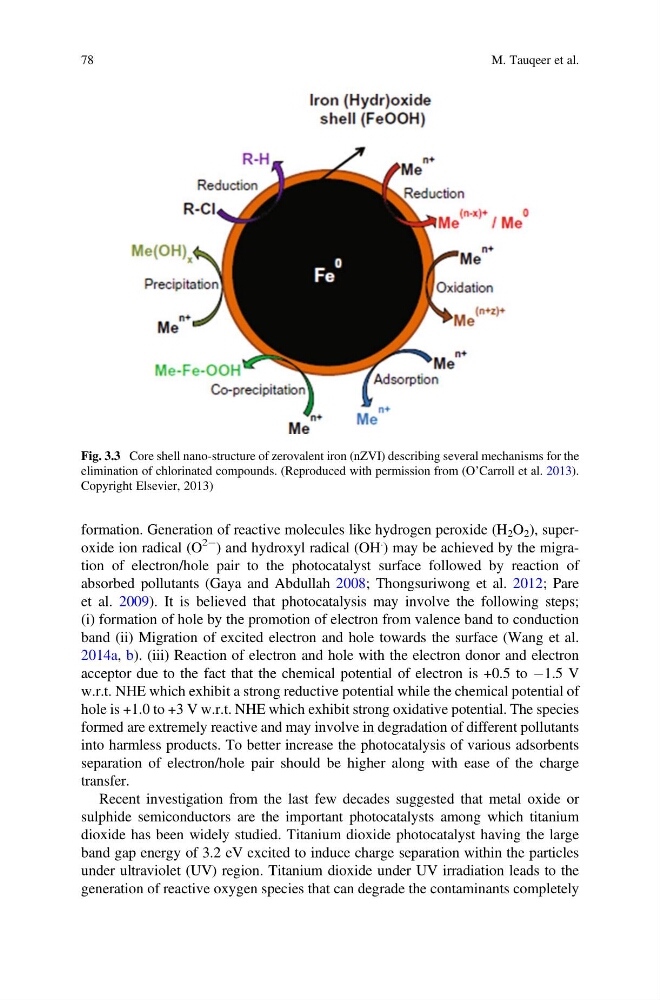
Fig. 3.3 Core shell nano-structure of zerovalent iron (nZVI) describing several mechanisms for the
elimination of chlorinated compounds. (Reproduced with permission from (O’Carroll et al. 2013).
Copyright Elsevier, 2013)
78
M. Tauqeer et al.
2À
) and hydroxyl radical (OH
. ) may be achieved by the migration of electron/hole pair to the photocatalyst surface followed by reaction of
absorbed pollutants (Gaya and Abdullah 2008; Thongsuriwong et al. 2012; Pare
et al. 2009). It is believed that photocatalysis may involve the following steps;
(i) formation of hole by the promotion of electron from valence band to conduction
band (ii) Migration of excited electron and hole towards the surface (Wang et al.
2014a, b). (iii) Reaction of electron and hole with the electron donor and electron
acceptor due to the fact that the chemical potential of electron is +0.5 to À1.5 V
w.r.t. NHE which exhibit a strong reductive potential while the chemical potential of
hole is +1.0 to +3 V w.r.t. NHE which exhibit strong oxidative potential. The species
formed are extremely reactive and may involve in degradation of different pollutants
into harmless products. To better increase the photocatalysis of various adsorbents
separation of electron/hole pair should be higher along with ease of the charge
transfer.
Recent investigation from the last few decades suggested that metal oxide or
sulphide semiconductors are the important photocatalysts among which titanium
dioxide has been widely studied. Titanium dioxide photocatalyst having the large
band gap energy of 3.2 eV excited to induce charge separation within the particles
under ultraviolet (UV) region. Titanium dioxide under UV irradiation leads to the
generation of reactive oxygen species that can degrade the contaminants completely
Fig. 3.3 Core shell nano-structure of zerovalent iron (nZVI) describing several mechanisms for the
elimination of chlorinated compounds. (Reproduced with permission from (O’Carroll et al. 2013).
Copyright Elsevier, 2013)
78
M. Tauqeer et al.