

of core shell structure in aqueous solution (Nurmi et al. 2005; Li and Zhang 2007;
Sun et al. 2006). The oxide layer may allow the electron transfer from the metal to
reduce the contaminants. The electron transfer process may be achieved indirectly by
various bands (conduction, impurity, localized), or directly through defect processes
or by sorption or structural Fe
2+ (Li et al. 2006a, b). The outer (hydroxide layer may
also function as an adsorbent for various contaminants,
Metal oxide based nonmaterial’s is found to be another important adsorbent used
for the decontamination of water/waste water due to their high removal efficiency
and selectivity. Manganese oxide-based nanomaterials with its high surface area
contributes high adsorption capacity and M–O
δ+ and M–O
δÀ units on manganese
oxide surface enhances the sorption of pollutants (Mukherjee et al. 2013).
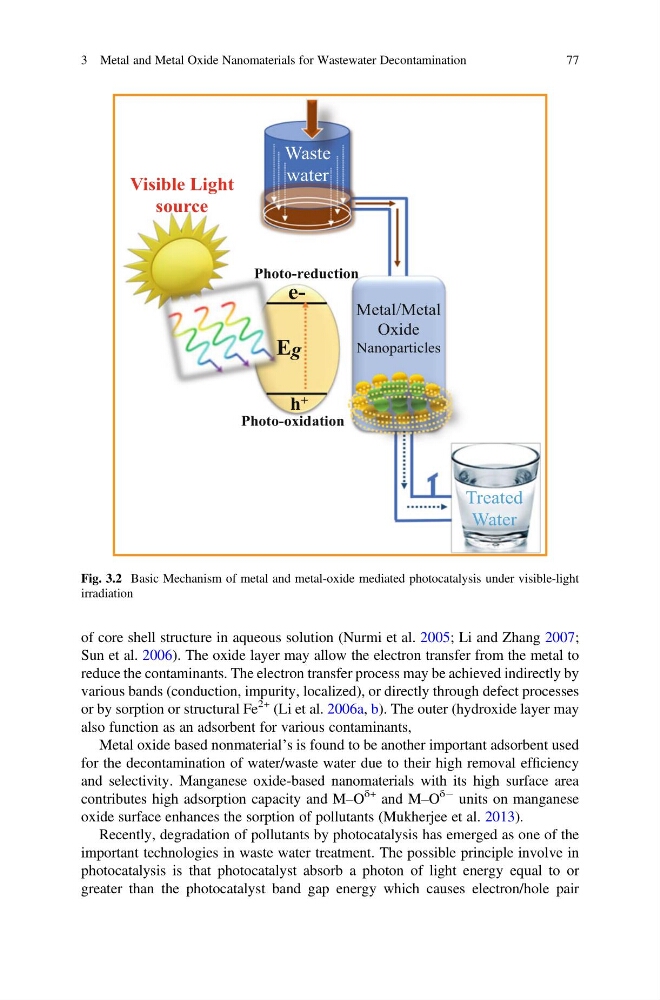
Recently, degradation of pollutants by photocatalysis has emerged as one of the
important technologies in waste water treatment. The possible principle involve in
photocatalysis is that photocatalyst absorb a photon of light energy equal to or
greater than the photocatalyst band gap energy which causes electron/hole pair
Waste
water
Treated
Water
Metal/Metal
Oxide
Nanoparticles
Visible Light
source
eh +
Eg
Photo-reduction
Photo-oxidation
Fig. 3.2 Basic Mechanism of metal and metal-oxide mediated photocatalysis under visible-light
irradiation
3 Metal and Metal Oxide Nanomaterials for Wastewater Decontamination
77
Sun et al. 2006). The oxide layer may allow the electron transfer from the metal to
reduce the contaminants. The electron transfer process may be achieved indirectly by
various bands (conduction, impurity, localized), or directly through defect processes
or by sorption or structural Fe
2+ (Li et al. 2006a, b). The outer (hydroxide layer may
also function as an adsorbent for various contaminants,
Metal oxide based nonmaterial’s is found to be another important adsorbent used
for the decontamination of water/waste water due to their high removal efficiency
and selectivity. Manganese oxide-based nanomaterials with its high surface area
contributes high adsorption capacity and M–O
δ+ and M–O
δÀ units on manganese
oxide surface enhances the sorption of pollutants (Mukherjee et al. 2013).
Recently, degradation of pollutants by photocatalysis has emerged as one of the
important technologies in waste water treatment. The possible principle involve in
photocatalysis is that photocatalyst absorb a photon of light energy equal to or
greater than the photocatalyst band gap energy which causes electron/hole pair
Waste
water
Treated
Water
Metal/Metal
Oxide
Nanoparticles
Visible Light
source
eh +
Eg
Photo-reduction
Photo-oxidation
Fig. 3.2 Basic Mechanism of metal and metal-oxide mediated photocatalysis under visible-light
irradiation
3 Metal and Metal Oxide Nanomaterials for Wastewater Decontamination
77