

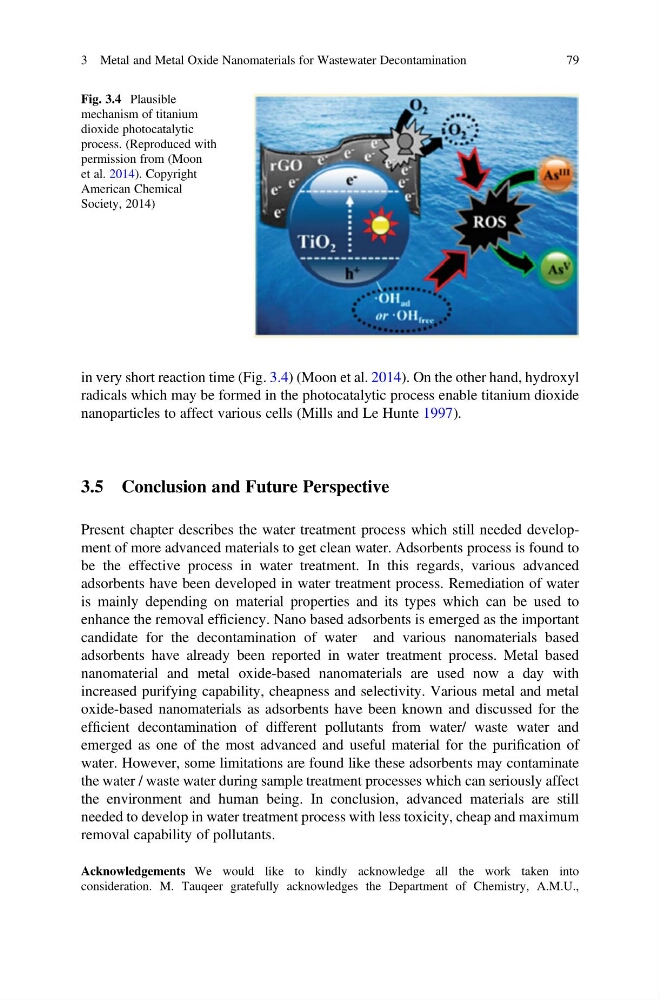
in very short reaction time (Fig. 3.4) (Moon et al. 2014). On the other hand, hydroxyl
radicals which may be formed in the photocatalytic process enable titanium dioxide
nanoparticles to affect various cells (Mills and Le Hunte 1997).
3.5 Conclusion and Future Perspective
Present chapter describes the water treatment process which still needed development of more advanced materials to get clean water. Adsorbents process is found to
be the effective process in water treatment. In this regards, various advanced
adsorbents have been developed in water treatment process. Remediation of water
is mainly depending on material properties and its types which can be used to
enhance the removal efficiency. Nano based adsorbents is emerged as the important
candidate for the decontamination of water and various nanomaterials based
adsorbents have already been reported in water treatment process. Metal based
nanomaterial and metal oxide-based nanomaterials are used now a day with
increased purifying capability, cheapness and selectivity. Various metal and metal
oxide-based nanomaterials as adsorbents have been known and discussed for the
efficient decontamination of different pollutants from water/ waste water and
emerged as one of the most advanced and useful material for the purification of
water. However, some limitations are found like these adsorbents may contaminate
the water / waste water during sample treatment processes which can seriously affect
the environment and human being. In conclusion, advanced materials are still
needed to develop in water treatment process with less toxicity, cheap and maximum
removal capability of pollutants.
Acknowledgements We would like to kindly acknowledge all the work taken into
consideration. M. Tauqeer gratefully acknowledges the Department of Chemistry, A.M.U.,
Fig. 3.4 Plausible
mechanism of titanium
dioxide photocatalytic
process. (Reproduced with
permission from (Moon
et al. 2014). Copyright
American Chemical
Society, 2014)
3 Metal and Metal Oxide Nanomaterials for Wastewater Decontamination
79
radicals which may be formed in the photocatalytic process enable titanium dioxide
nanoparticles to affect various cells (Mills and Le Hunte 1997).
3.5 Conclusion and Future Perspective
Present chapter describes the water treatment process which still needed development of more advanced materials to get clean water. Adsorbents process is found to
be the effective process in water treatment. In this regards, various advanced
adsorbents have been developed in water treatment process. Remediation of water
is mainly depending on material properties and its types which can be used to
enhance the removal efficiency. Nano based adsorbents is emerged as the important
candidate for the decontamination of water and various nanomaterials based
adsorbents have already been reported in water treatment process. Metal based
nanomaterial and metal oxide-based nanomaterials are used now a day with
increased purifying capability, cheapness and selectivity. Various metal and metal
oxide-based nanomaterials as adsorbents have been known and discussed for the
efficient decontamination of different pollutants from water/ waste water and
emerged as one of the most advanced and useful material for the purification of
water. However, some limitations are found like these adsorbents may contaminate
the water / waste water during sample treatment processes which can seriously affect
the environment and human being. In conclusion, advanced materials are still
needed to develop in water treatment process with less toxicity, cheap and maximum
removal capability of pollutants.
Acknowledgements We would like to kindly acknowledge all the work taken into
consideration. M. Tauqeer gratefully acknowledges the Department of Chemistry, A.M.U.,
Fig. 3.4 Plausible
mechanism of titanium
dioxide photocatalytic
process. (Reproduced with
permission from (Moon
et al. 2014). Copyright
American Chemical
Society, 2014)
3 Metal and Metal Oxide Nanomaterials for Wastewater Decontamination
79