

2.5.1.4 Metal Oxide-Based Composites of TiO 2
In order to enhance the antimicrobial activity of photocatalyst further, their composites with other semiconductor materials are developed. Panthi et al. (2013)
constructed Mn 2 O 3 -TiO 2 nano fiber composite by electrospinning route, where
TiO 2 was formed in the rutile phase. Prevention of colonization of gram positive
and gram negative bacteria was achieved by these composites, where the activity
was proposed to be mediated by Mn 2 O 3 phase. He et al. (2017) fabricated CuO-TiO 2
coating on Ti films by magnetron sputtering and annealing process. These films were
demonstrated to have improved antibacterial activity, biocompatibility and corrosion
resistance (Fig. 2.6A). He et al. (2019) developed reusable magnetic N-TiO 2 /
Fe 3 O 4 @SiO 2 photocatalyst for simultaneous degradation of E.Coli and bis phenol
A in sewage water under visible light irradiation. In their study, presence of
bisphenol A didn’t affect the destruction of E. coli but the degradation of former
decreased by 10% in presence of bacteria (Fig. 2.6B) due to the same reactive
oxygen species (
. O 2
À and H 2 O 2 ) to degrade the organic matter and microbes.
2.5.1.5 Carbon Nanostructure Based Composites of TiO 2
Carbon based nanostructures are an important class of materials which play a
significant role in photocatalysis by boosting the conductivity and electron transfer
in their composites with other semiconductor materials. The carbon-based
nanomaterials include carbon nanotubes, fullerene, carbon dots, graphene, graphene
oxide etc. Functionalizing TiO 2 with carbon materials is a promising approach for
cost effective and efficient antimicrobial activity. Koli et al. (2016) functionalized
TiO 2 with multi walled carbon nanotubes using a solution-based method. Multi
walled carbon nanotubes can improve/tune the optical band gap of TiO 2 for visible
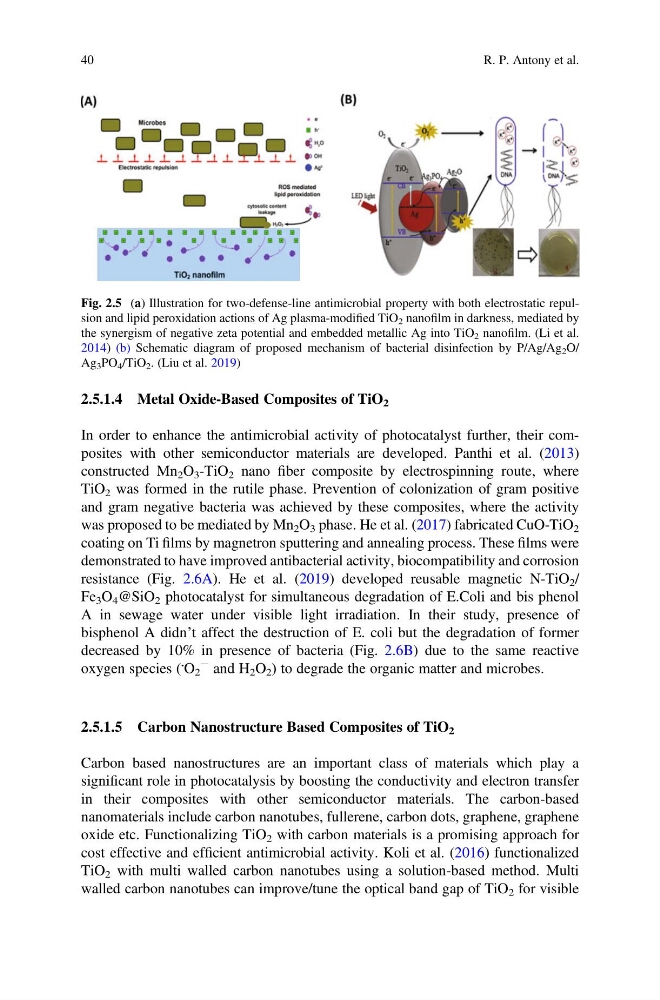
Fig. 2.5 (a) Illustration for two-defense-line antimicrobial property with both electrostatic repulsion and lipid peroxidation actions of Ag plasma-modified TiO 2 nanofilm in darkness, mediated by
the synergism of negative zeta potential and embedded metallic Ag into TiO 2 nanofilm. (Li et al.
2014) (b) Schematic diagram of proposed mechanism of bacterial disinfection by P/Ag/Ag 2 O/
Ag 3 PO 4 /TiO 2 . (Liu et al. 2019)
40
R. P. Antony et al.
In order to enhance the antimicrobial activity of photocatalyst further, their composites with other semiconductor materials are developed. Panthi et al. (2013)
constructed Mn 2 O 3 -TiO 2 nano fiber composite by electrospinning route, where
TiO 2 was formed in the rutile phase. Prevention of colonization of gram positive
and gram negative bacteria was achieved by these composites, where the activity
was proposed to be mediated by Mn 2 O 3 phase. He et al. (2017) fabricated CuO-TiO 2
coating on Ti films by magnetron sputtering and annealing process. These films were
demonstrated to have improved antibacterial activity, biocompatibility and corrosion
resistance (Fig. 2.6A). He et al. (2019) developed reusable magnetic N-TiO 2 /
Fe 3 O 4 @SiO 2 photocatalyst for simultaneous degradation of E.Coli and bis phenol
A in sewage water under visible light irradiation. In their study, presence of
bisphenol A didn’t affect the destruction of E. coli but the degradation of former
decreased by 10% in presence of bacteria (Fig. 2.6B) due to the same reactive
oxygen species (
. O 2
À and H 2 O 2 ) to degrade the organic matter and microbes.
2.5.1.5 Carbon Nanostructure Based Composites of TiO 2
Carbon based nanostructures are an important class of materials which play a
significant role in photocatalysis by boosting the conductivity and electron transfer
in their composites with other semiconductor materials. The carbon-based
nanomaterials include carbon nanotubes, fullerene, carbon dots, graphene, graphene
oxide etc. Functionalizing TiO 2 with carbon materials is a promising approach for
cost effective and efficient antimicrobial activity. Koli et al. (2016) functionalized
TiO 2 with multi walled carbon nanotubes using a solution-based method. Multi
walled carbon nanotubes can improve/tune the optical band gap of TiO 2 for visible
Fig. 2.5 (a) Illustration for two-defense-line antimicrobial property with both electrostatic repulsion and lipid peroxidation actions of Ag plasma-modified TiO 2 nanofilm in darkness, mediated by
the synergism of negative zeta potential and embedded metallic Ag into TiO 2 nanofilm. (Li et al.
2014) (b) Schematic diagram of proposed mechanism of bacterial disinfection by P/Ag/Ag 2 O/
Ag 3 PO 4 /TiO 2 . (Liu et al. 2019)
40
R. P. Antony et al.