

light activity, thereby making it suitable for commercial application. The
photocatalytic antimicrobial activity of multi walled carbon nanotubes -TiO 2
towards S. aureus and E. coli was found to be the highest for TC-0.5 composite
(labeling as per the carbon nanotubes loading on TiO 2 ) where smaller particle size
and higher surface area helped the inactivation process. Another study by Pant et al.
(2013) reported the antibacterial effect of carbon nanofibers modified TiO 2 -ZnO
composite towards E. coli under light irradiation containing 10% UV light. The
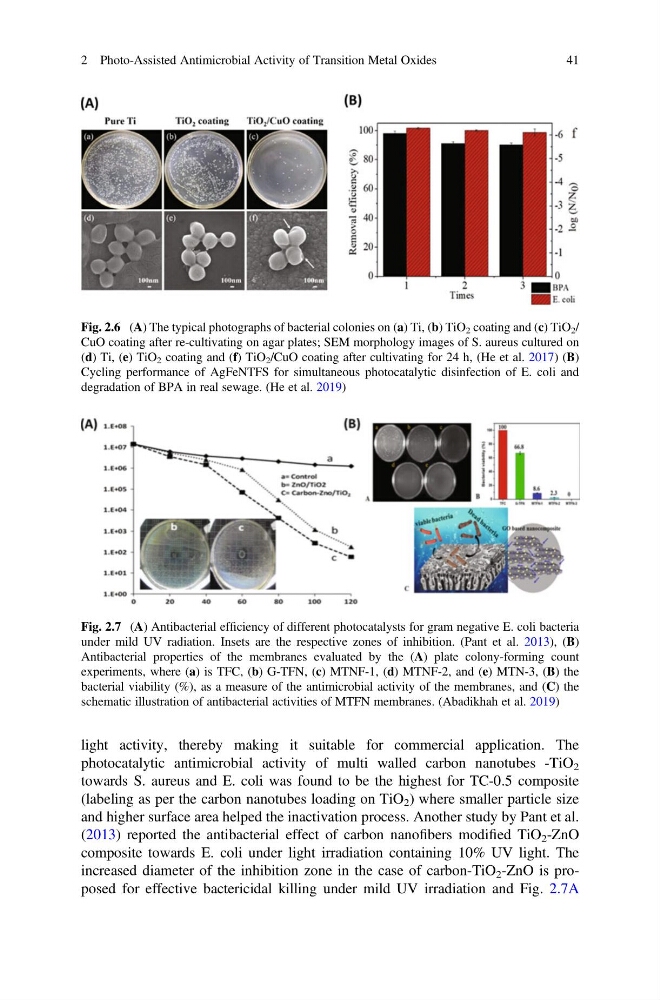
increased diameter of the inhibition zone in the case of carbon-TiO 2 -ZnO is proposed for effective bactericidal killing under mild UV irradiation and Fig. 2.7A
Fig. 2.6 (A) The typical photographs of bacterial colonies on (a) Ti, (b) TiO 2 coating and (c) TiO 2 /
CuO coating after re-cultivating on agar plates; SEM morphology images of S. aureus cultured on
(d) Ti, (e) TiO 2 coating and (f) TiO 2 /CuO coating after cultivating for 24 h, (He et al. 2017) (B)
Cycling performance of AgFeNTFS for simultaneous photocatalytic disinfection of E. coli and
degradation of BPA in real sewage. (He et al. 2019)
Fig. 2.7 (A) Antibacterial efficiency of different photocatalysts for gram negative E. coli bacteria
under mild UV radiation. Insets are the respective zones of inhibition. (Pant et al. 2013), (B)
Antibacterial properties of the membranes evaluated by the (A) plate colony-forming count
experiments, where (a) is TFC, (b) G-TFN, (c) MTNF-1, (d) MTNF-2, and (e) MTN-3, (B) the
bacterial viability (%), as a measure of the antimicrobial activity of the membranes, and (C) the
schematic illustration of antibacterial activities of MTFN membranes. (Abadikhah et al. 2019)
2 Photo-Assisted Antimicrobial Activity of Transition Metal Oxides
41
photocatalytic antimicrobial activity of multi walled carbon nanotubes -TiO 2
towards S. aureus and E. coli was found to be the highest for TC-0.5 composite
(labeling as per the carbon nanotubes loading on TiO 2 ) where smaller particle size
and higher surface area helped the inactivation process. Another study by Pant et al.
(2013) reported the antibacterial effect of carbon nanofibers modified TiO 2 -ZnO
composite towards E. coli under light irradiation containing 10% UV light. The
increased diameter of the inhibition zone in the case of carbon-TiO 2 -ZnO is proposed for effective bactericidal killing under mild UV irradiation and Fig. 2.7A
Fig. 2.6 (A) The typical photographs of bacterial colonies on (a) Ti, (b) TiO 2 coating and (c) TiO 2 /
CuO coating after re-cultivating on agar plates; SEM morphology images of S. aureus cultured on
(d) Ti, (e) TiO 2 coating and (f) TiO 2 /CuO coating after cultivating for 24 h, (He et al. 2017) (B)
Cycling performance of AgFeNTFS for simultaneous photocatalytic disinfection of E. coli and
degradation of BPA in real sewage. (He et al. 2019)
Fig. 2.7 (A) Antibacterial efficiency of different photocatalysts for gram negative E. coli bacteria
under mild UV radiation. Insets are the respective zones of inhibition. (Pant et al. 2013), (B)
Antibacterial properties of the membranes evaluated by the (A) plate colony-forming count
experiments, where (a) is TFC, (b) G-TFN, (c) MTNF-1, (d) MTNF-2, and (e) MTN-3, (B) the
bacterial viability (%), as a measure of the antimicrobial activity of the membranes, and (C) the
schematic illustration of antibacterial activities of MTFN membranes. (Abadikhah et al. 2019)
2 Photo-Assisted Antimicrobial Activity of Transition Metal Oxides
41