

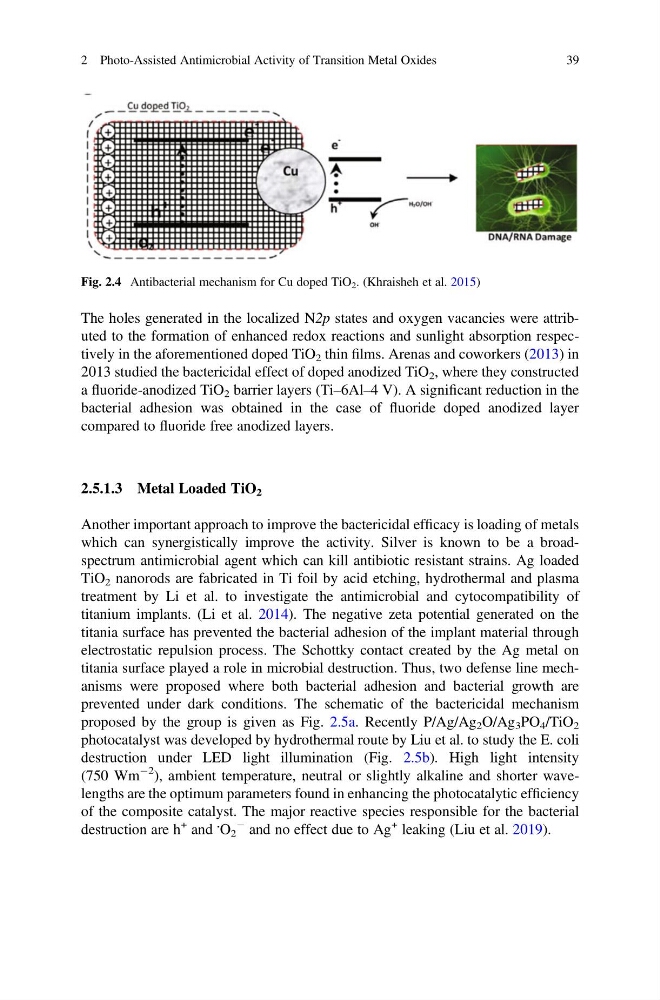
The holes generated in the localized N2p states and oxygen vacancies were attributed to the formation of enhanced redox reactions and sunlight absorption respectively in the aforementioned doped TiO 2 thin films. Arenas and coworkers (2013) in
2013 studied the bactericidal effect of doped anodized TiO 2 , where they constructed
a fluoride-anodized TiO 2 barrier layers (Ti–6Al–4 V). A significant reduction in the
bacterial adhesion was obtained in the case of fluoride doped anodized layer
compared to fluoride free anodized layers.
2.5.1.3 Metal Loaded TiO 2
Another important approach to improve the bactericidal efficacy is loading of metals
which can synergistically improve the activity. Silver is known to be a broadspectrum antimicrobial agent which can kill antibiotic resistant strains. Ag loaded
TiO 2 nanorods are fabricated in Ti foil by acid etching, hydrothermal and plasma
treatment by Li et al. to investigate the antimicrobial and cytocompatibility of
titanium implants. (Li et al. 2014). The negative zeta potential generated on the
titania surface has prevented the bacterial adhesion of the implant material through
electrostatic repulsion process. The Schottky contact created by the Ag metal on
titania surface played a role in microbial destruction. Thus, two defense line mechanisms were proposed where both bacterial adhesion and bacterial growth are
prevented under dark conditions. The schematic of the bactericidal mechanism
proposed by the group is given as Fig. 2.5a. Recently P/Ag/Ag 2 O/Ag 3 PO 4 /TiO 2
photocatalyst was developed by hydrothermal route by Liu et al. to study the E. coli
destruction under LED light illumination (Fig. 2.5b). High light intensity
(750 Wm
À2 ), ambient temperature, neutral or slightly alkaline and shorter wavelengths are the optimum parameters found in enhancing the photocatalytic efficiency
of the composite catalyst. The major reactive species responsible for the bacterial
destruction are h
+ and
. O 2
À and no effect due to Ag
+ leaking (Liu et al. 2019).
Fig. 2.4 Antibacterial mechanism for Cu doped TiO 2 . (Khraisheh et al. 2015)
2 Photo-Assisted Antimicrobial Activity of Transition Metal Oxides
39
2013 studied the bactericidal effect of doped anodized TiO 2 , where they constructed
a fluoride-anodized TiO 2 barrier layers (Ti–6Al–4 V). A significant reduction in the
bacterial adhesion was obtained in the case of fluoride doped anodized layer
compared to fluoride free anodized layers.
2.5.1.3 Metal Loaded TiO 2
Another important approach to improve the bactericidal efficacy is loading of metals
which can synergistically improve the activity. Silver is known to be a broadspectrum antimicrobial agent which can kill antibiotic resistant strains. Ag loaded
TiO 2 nanorods are fabricated in Ti foil by acid etching, hydrothermal and plasma
treatment by Li et al. to investigate the antimicrobial and cytocompatibility of
titanium implants. (Li et al. 2014). The negative zeta potential generated on the
titania surface has prevented the bacterial adhesion of the implant material through
electrostatic repulsion process. The Schottky contact created by the Ag metal on
titania surface played a role in microbial destruction. Thus, two defense line mechanisms were proposed where both bacterial adhesion and bacterial growth are
prevented under dark conditions. The schematic of the bactericidal mechanism
proposed by the group is given as Fig. 2.5a. Recently P/Ag/Ag 2 O/Ag 3 PO 4 /TiO 2
photocatalyst was developed by hydrothermal route by Liu et al. to study the E. coli
destruction under LED light illumination (Fig. 2.5b). High light intensity
(750 Wm
À2 ), ambient temperature, neutral or slightly alkaline and shorter wavelengths are the optimum parameters found in enhancing the photocatalytic efficiency
of the composite catalyst. The major reactive species responsible for the bacterial
destruction are h
+ and
. O 2
À and no effect due to Ag
+ leaking (Liu et al. 2019).
Fig. 2.4 Antibacterial mechanism for Cu doped TiO 2 . (Khraisheh et al. 2015)
2 Photo-Assisted Antimicrobial Activity of Transition Metal Oxides
39