

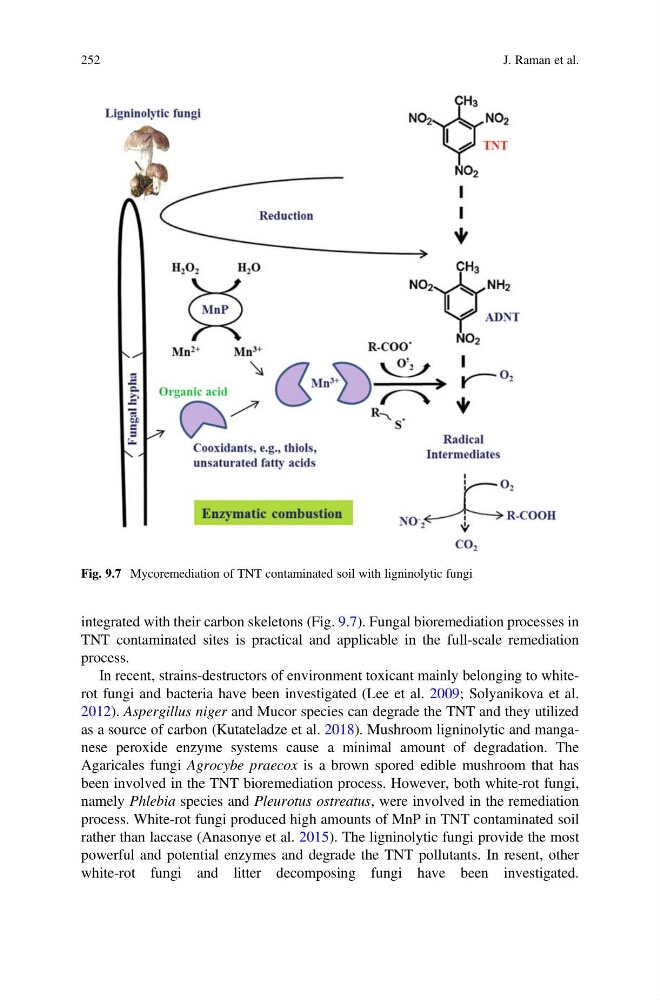
integrated with their carbon skeletons (Fig. 9.7). Fungal bioremediation processes in
TNT contaminated sites is practical and applicable in the full-scale remediation
process.
In recent, strains-destructors of environment toxicant mainly belonging to whiterot fungi and bacteria have been investigated (Lee et al. 2009; Solyanikova et al.
2012). Aspergillus niger and Mucor species can degrade the TNT and they utilized
as a source of carbon (Kutateladze et al. 2018). Mushroom ligninolytic and manganese peroxide enzyme systems cause a minimal amount of degradation. The
Agaricales fungi Agrocybe praecox is a brown spored edible mushroom that has
been involved in the TNT bioremediation process. However, both white-rot fungi,
namely Phlebia species and Pleurotus ostreatus, were involved in the remediation
process. White-rot fungi produced high amounts of MnP in TNT contaminated soil
rather than laccase (Anasonye et al. 2015). The ligninolytic fungi provide the most
powerful and potential enzymes and degrade the TNT pollutants. In resent, other
white-rot fungi and litter decomposing fungi have been investigated.
Fig. 9.7 Mycoremediation of TNT contaminated soil with ligninolytic fungi
252
J. Raman et al.
TNT contaminated sites is practical and applicable in the full-scale remediation
process.
In recent, strains-destructors of environment toxicant mainly belonging to whiterot fungi and bacteria have been investigated (Lee et al. 2009; Solyanikova et al.
2012). Aspergillus niger and Mucor species can degrade the TNT and they utilized
as a source of carbon (Kutateladze et al. 2018). Mushroom ligninolytic and manganese peroxide enzyme systems cause a minimal amount of degradation. The
Agaricales fungi Agrocybe praecox is a brown spored edible mushroom that has
been involved in the TNT bioremediation process. However, both white-rot fungi,
namely Phlebia species and Pleurotus ostreatus, were involved in the remediation
process. White-rot fungi produced high amounts of MnP in TNT contaminated soil
rather than laccase (Anasonye et al. 2015). The ligninolytic fungi provide the most
powerful and potential enzymes and degrade the TNT pollutants. In resent, other
white-rot fungi and litter decomposing fungi have been investigated.
Fig. 9.7 Mycoremediation of TNT contaminated soil with ligninolytic fungi
252
J. Raman et al.