

decomposing litter fungi, and the fungi exhibited high degradation capacity on PAH
(Steffen et al. 2007). The mechanism for PAHs degradation process has similar to
lignin degradation.
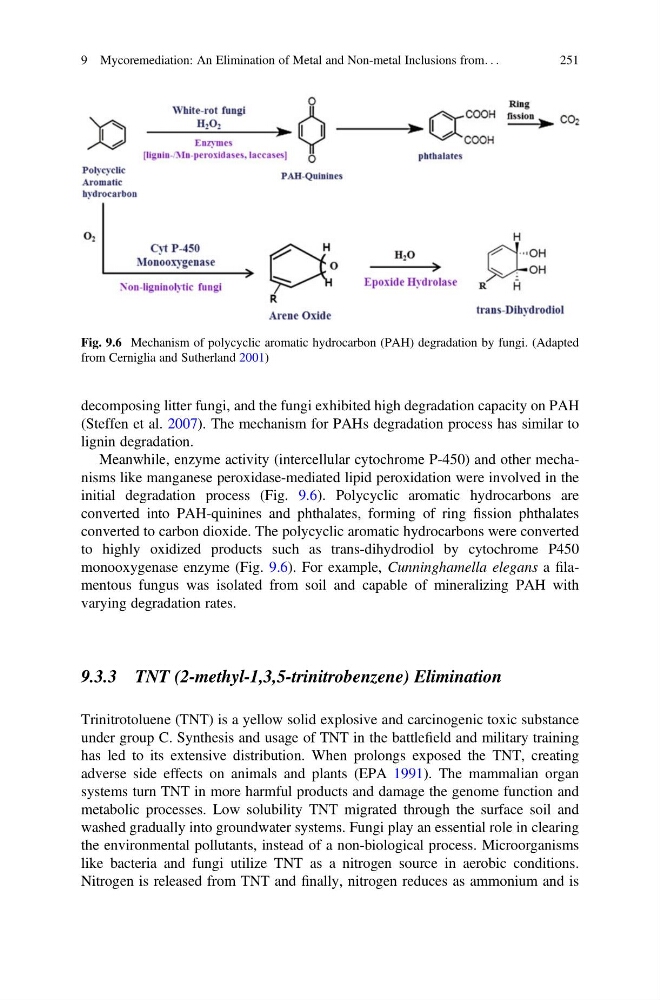
Meanwhile, enzyme activity (intercellular cytochrome P-450) and other mechanisms like manganese peroxidase-mediated lipid peroxidation were involved in the
initial degradation process (Fig. 9.6). Polycyclic aromatic hydrocarbons are
converted into PAH-quinines and phthalates, forming of ring fission phthalates
converted to carbon dioxide. The polycyclic aromatic hydrocarbons were converted
to highly oxidized products such as trans-dihydrodiol by cytochrome P450
monooxygenase enzyme (Fig. 9.6). For example, Cunninghamella elegans a filamentous fungus was isolated from soil and capable of mineralizing PAH with
varying degradation rates.
9.3.3 TNT (2-methyl-1,3,5-trinitrobenzene) Elimination
Trinitrotoluene (TNT) is a yellow solid explosive and carcinogenic toxic substance
under group C. Synthesis and usage of TNT in the battlefield and military training
has led to its extensive distribution. When prolongs exposed the TNT, creating
adverse side effects on animals and plants (EPA 1991). The mammalian organ
systems turn TNT in more harmful products and damage the genome function and
metabolic processes. Low solubility TNT migrated through the surface soil and
washed gradually into groundwater systems. Fungi play an essential role in clearing
the environmental pollutants, instead of a non-biological process. Microorganisms
like bacteria and fungi utilize TNT as a nitrogen source in aerobic conditions.
Nitrogen is released from TNT and finally, nitrogen reduces as ammonium and is
Fig. 9.6 Mechanism of polycyclic aromatic hydrocarbon (PAH) degradation by fungi. (Adapted
from Cerniglia and Sutherland 2001)
9 Mycoremediation: An Elimination of Metal and Non-metal Inclusions from. . .
251
(Steffen et al. 2007). The mechanism for PAHs degradation process has similar to
lignin degradation.
Meanwhile, enzyme activity (intercellular cytochrome P-450) and other mechanisms like manganese peroxidase-mediated lipid peroxidation were involved in the
initial degradation process (Fig. 9.6). Polycyclic aromatic hydrocarbons are
converted into PAH-quinines and phthalates, forming of ring fission phthalates
converted to carbon dioxide. The polycyclic aromatic hydrocarbons were converted
to highly oxidized products such as trans-dihydrodiol by cytochrome P450
monooxygenase enzyme (Fig. 9.6). For example, Cunninghamella elegans a filamentous fungus was isolated from soil and capable of mineralizing PAH with
varying degradation rates.
9.3.3 TNT (2-methyl-1,3,5-trinitrobenzene) Elimination
Trinitrotoluene (TNT) is a yellow solid explosive and carcinogenic toxic substance
under group C. Synthesis and usage of TNT in the battlefield and military training
has led to its extensive distribution. When prolongs exposed the TNT, creating
adverse side effects on animals and plants (EPA 1991). The mammalian organ
systems turn TNT in more harmful products and damage the genome function and
metabolic processes. Low solubility TNT migrated through the surface soil and
washed gradually into groundwater systems. Fungi play an essential role in clearing
the environmental pollutants, instead of a non-biological process. Microorganisms
like bacteria and fungi utilize TNT as a nitrogen source in aerobic conditions.
Nitrogen is released from TNT and finally, nitrogen reduces as ammonium and is
Fig. 9.6 Mechanism of polycyclic aromatic hydrocarbon (PAH) degradation by fungi. (Adapted
from Cerniglia and Sutherland 2001)
9 Mycoremediation: An Elimination of Metal and Non-metal Inclusions from. . .
251