

effectiveness, no adverse impact on the environment, and no health hazard for the
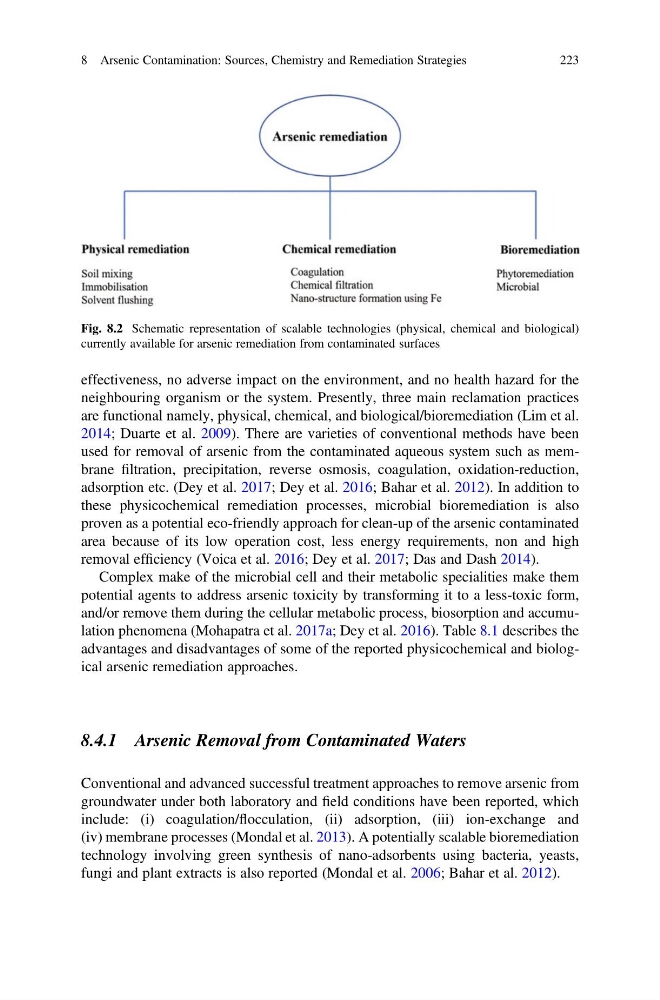
neighbouring organism or the system. Presently, three main reclamation practices
are functional namely, physical, chemical, and biological/bioremediation (Lim et al.
2014; Duarte et al. 2009). There are varieties of conventional methods have been
used for removal of arsenic from the contaminated aqueous system such as membrane filtration, precipitation, reverse osmosis, coagulation, oxidation-reduction,
adsorption etc. (Dey et al. 2017; Dey et al. 2016; Bahar et al. 2012). In addition to
these physicochemical remediation processes, microbial bioremediation is also
proven as a potential eco-friendly approach for clean-up of the arsenic contaminated
area because of its low operation cost, less energy requirements, non and high
removal efficiency (Voica et al. 2016; Dey et al. 2017; Das and Dash 2014).
Complex make of the microbial cell and their metabolic specialities make them
potential agents to address arsenic toxicity by transforming it to a less-toxic form,
and/or remove them during the cellular metabolic process, biosorption and accumulation phenomena (Mohapatra et al. 2017a; Dey et al. 2016). Table 8.1 describes the
advantages and disadvantages of some of the reported physicochemical and biological arsenic remediation approaches.
8.4.1 Arsenic Removal from Contaminated Waters
Conventional and advanced successful treatment approaches to remove arsenic from
groundwater under both laboratory and field conditions have been reported, which
include: (i) coagulation/flocculation, (ii) adsorption, (iii) ion-exchange and
(iv) membrane processes (Mondal et al. 2013). A potentially scalable bioremediation
technology involving green synthesis of nano-adsorbents using bacteria, yeasts,
fungi and plant extracts is also reported (Mondal et al. 2006; Bahar et al. 2012).
Fig. 8.2 Schematic representation of scalable technologies (physical, chemical and biological)
currently available for arsenic remediation from contaminated surfaces
8 Arsenic Contamination: Sources, Chemistry and Remediation Strategies
223
neighbouring organism or the system. Presently, three main reclamation practices
are functional namely, physical, chemical, and biological/bioremediation (Lim et al.
2014; Duarte et al. 2009). There are varieties of conventional methods have been
used for removal of arsenic from the contaminated aqueous system such as membrane filtration, precipitation, reverse osmosis, coagulation, oxidation-reduction,
adsorption etc. (Dey et al. 2017; Dey et al. 2016; Bahar et al. 2012). In addition to
these physicochemical remediation processes, microbial bioremediation is also
proven as a potential eco-friendly approach for clean-up of the arsenic contaminated
area because of its low operation cost, less energy requirements, non and high
removal efficiency (Voica et al. 2016; Dey et al. 2017; Das and Dash 2014).
Complex make of the microbial cell and their metabolic specialities make them
potential agents to address arsenic toxicity by transforming it to a less-toxic form,
and/or remove them during the cellular metabolic process, biosorption and accumulation phenomena (Mohapatra et al. 2017a; Dey et al. 2016). Table 8.1 describes the
advantages and disadvantages of some of the reported physicochemical and biological arsenic remediation approaches.
8.4.1 Arsenic Removal from Contaminated Waters
Conventional and advanced successful treatment approaches to remove arsenic from
groundwater under both laboratory and field conditions have been reported, which
include: (i) coagulation/flocculation, (ii) adsorption, (iii) ion-exchange and
(iv) membrane processes (Mondal et al. 2013). A potentially scalable bioremediation
technology involving green synthesis of nano-adsorbents using bacteria, yeasts,
fungi and plant extracts is also reported (Mondal et al. 2006; Bahar et al. 2012).
Fig. 8.2 Schematic representation of scalable technologies (physical, chemical and biological)
currently available for arsenic remediation from contaminated surfaces
8 Arsenic Contamination: Sources, Chemistry and Remediation Strategies
223