

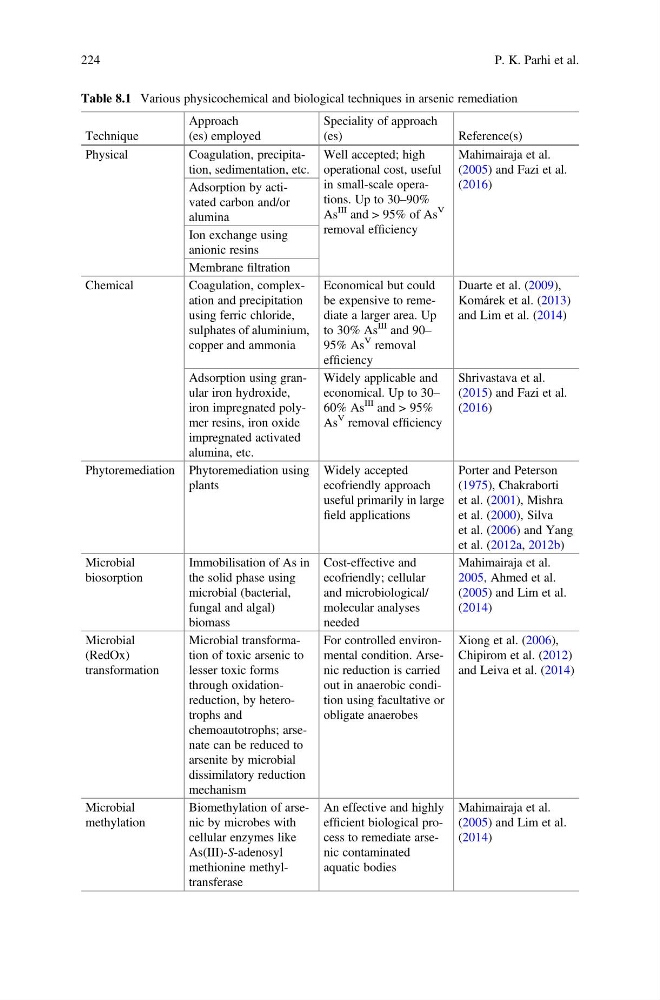
Table 8.1 Various physicochemical and biological techniques in arsenic remediation
Technique
Approach
(es) employed
Speciality of approach
(es)
Reference(s)
Physical
Coagulation, precipitation, sedimentation, etc.
Well accepted; high
operational cost, useful
in small-scale operations. Up to 30–90%
As
III and > 95% of As
V
removal efficiency
Mahimairaja et al.
(2005) and Fazi et al.
(2016)
Adsorption by activated carbon and/or
alumina
Ion exchange using
anionic resins
Membrane filtration
Chemical
Coagulation, complexation and precipitation
using ferric chloride,
sulphates of aluminium,
copper and ammonia
Economical but could
be expensive to remediate a larger area. Up
to 30% As
III and 90–
95% As
V removal
efficiency
Duarte et al. (2009),
Komárek et al. (2013)
and Lim et al. (2014)
Adsorption using granular iron hydroxide,
iron impregnated polymer resins, iron oxide
impregnated activated
alumina, etc.
Widely applicable and
economical. Up to 30–
60% As
III and > 95%
As
V removal efficiency
Shrivastava et al.
(2015) and Fazi et al.
(2016)
Phytoremediation Phytoremediation using
plants
Widely accepted
ecofriendly approach
useful primarily in large
field applications
Porter and Peterson
(1975), Chakraborti
et al. (2001), Mishra
et al. (2000), Silva
et al. (2006) and Yang
et al. (2012a, 2012b)
Microbial
biosorption
Immobilisation of As in
the solid phase using
microbial (bacterial,
fungal and algal)
biomass
Cost-effective and
ecofriendly; cellular
and microbiological/
molecular analyses
needed
Mahimairaja et al.
2005, Ahmed et al.
(2005) and Lim et al.
(2014)
Microbial
(RedOx)
transformation
Microbial transformation of toxic arsenic to
lesser toxic forms
through oxidationreduction, by heterotrophs and
chemoautotrophs; arsenate can be reduced to
arsenite by microbial
dissimilatory reduction
mechanism
For controlled environmental condition. Arsenic reduction is carried
out in anaerobic condition using facultative or
obligate anaerobes
Xiong et al. (2006),
Chipirom et al. (2012)
and Leiva et al. (2014)
Microbial
methylation
Biomethylation of arsenic by microbes with
cellular enzymes like
As(III)-S-adenosyl
methionine methyltransferase
An effective and highly
efficient biological process to remediate arsenic contaminated
aquatic bodies
Mahimairaja et al.
(2005) and Lim et al.
(2014)
224
P. K. Parhi et al.
Technique
Approach
(es) employed
Speciality of approach
(es)
Reference(s)
Physical
Coagulation, precipitation, sedimentation, etc.
Well accepted; high
operational cost, useful
in small-scale operations. Up to 30–90%
As
III and > 95% of As
V
removal efficiency
Mahimairaja et al.
(2005) and Fazi et al.
(2016)
Adsorption by activated carbon and/or
alumina
Ion exchange using
anionic resins
Membrane filtration
Chemical
Coagulation, complexation and precipitation
using ferric chloride,
sulphates of aluminium,
copper and ammonia
Economical but could
be expensive to remediate a larger area. Up
to 30% As
III and 90–
95% As
V removal
efficiency
Duarte et al. (2009),
Komárek et al. (2013)
and Lim et al. (2014)
Adsorption using granular iron hydroxide,
iron impregnated polymer resins, iron oxide
impregnated activated
alumina, etc.
Widely applicable and
economical. Up to 30–
60% As
III and > 95%
As
V removal efficiency
Shrivastava et al.
(2015) and Fazi et al.
(2016)
Phytoremediation Phytoremediation using
plants
Widely accepted
ecofriendly approach
useful primarily in large
field applications
Porter and Peterson
(1975), Chakraborti
et al. (2001), Mishra
et al. (2000), Silva
et al. (2006) and Yang
et al. (2012a, 2012b)
Microbial
biosorption
Immobilisation of As in
the solid phase using
microbial (bacterial,
fungal and algal)
biomass
Cost-effective and
ecofriendly; cellular
and microbiological/
molecular analyses
needed
Mahimairaja et al.
2005, Ahmed et al.
(2005) and Lim et al.
(2014)
Microbial
(RedOx)
transformation
Microbial transformation of toxic arsenic to
lesser toxic forms
through oxidationreduction, by heterotrophs and
chemoautotrophs; arsenate can be reduced to
arsenite by microbial
dissimilatory reduction
mechanism
For controlled environmental condition. Arsenic reduction is carried
out in anaerobic condition using facultative or
obligate anaerobes
Xiong et al. (2006),
Chipirom et al. (2012)
and Leiva et al. (2014)
Microbial
methylation
Biomethylation of arsenic by microbes with
cellular enzymes like
As(III)-S-adenosyl
methionine methyltransferase
An effective and highly
efficient biological process to remediate arsenic contaminated
aquatic bodies
Mahimairaja et al.
(2005) and Lim et al.
(2014)
224
P. K. Parhi et al.