

of rate of adsorption (85% of the dye in 30 min at room temperature) as well as
adsorption/removal capacity (68.4 mgg
À1 ), compared to the common adsorbents red
mud and MCM-22. The authors also made two important observations: (a) the
adsorbent can be reused for up to 3 times without significant reduction of its capacity
and (b) the adsorption capacity was independent of the specific surface area of the
adsorbent.
Oxides of iron are an important class of material primarily owing to their
magnetic attribute. This unique feature has been utilized for complete removal of
the adsorbent, with adsorbed pollutant materials, after completion of the adsorption
process by application of a magnetic field. In addition, iron oxides are also very good
adsorbents. Therefore, a combination of both of these features result in a superior
adsorbent material. In a typical study, Iram et al. (2010) synthesized hollow Fe 3 O 4
nanospheres for magnetically driven adsorption of neutral red dye from aqueous
solution. The authors achieved a 90% dye removal with a monolayer adsorption
capacity of 105 mgg
À1 at a pH value of 6 and a temperature of 25
C. The result was
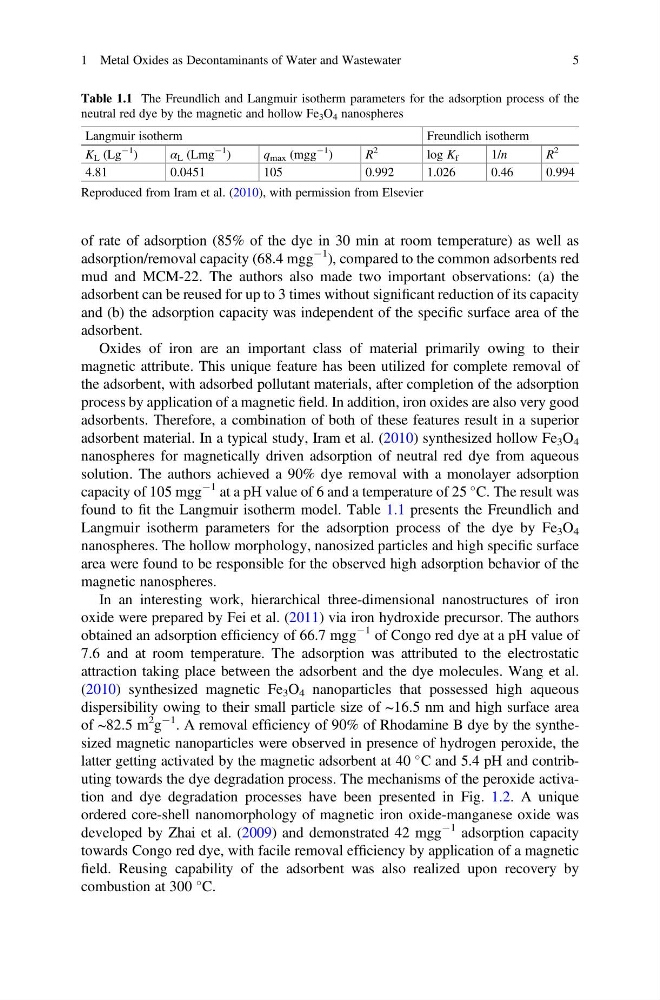
found to fit the Langmuir isotherm model. Table 1.1 presents the Freundlich and
Langmuir isotherm parameters for the adsorption process of the dye by Fe 3 O 4
nanospheres. The hollow morphology, nanosized particles and high specific surface
area were found to be responsible for the observed high adsorption behavior of the
magnetic nanospheres.
In an interesting work, hierarchical three-dimensional nanostructures of iron
oxide were prepared by Fei et al. (2011) via iron hydroxide precursor. The authors
obtained an adsorption efficiency of 66.7 mgg
À1 of Congo red dye at a pH value of
7.6 and at room temperature. The adsorption was attributed to the electrostatic
attraction taking place between the adsorbent and the dye molecules. Wang et al.
(2010) synthesized magnetic Fe 3 O 4 nanoparticles that possessed high aqueous
dispersibility owing to their small particle size of ~16.5 nm and high surface area
of ~82.5 m
2 g
À1 . A removal efficiency of 90% of Rhodamine B dye by the synthesized magnetic nanoparticles were observed in presence of hydrogen peroxide, the
latter getting activated by the magnetic adsorbent at 40
C and 5.4 pH and contributing towards the dye degradation process. The mechanisms of the peroxide activation and dye degradation processes have been presented in Fig. 1.2. A unique
ordered core-shell nanomorphology of magnetic iron oxide-manganese oxide was
developed by Zhai et al. (2009) and demonstrated 42 mgg
À1 adsorption capacity
towards Congo red dye, with facile removal efficiency by application of a magnetic
field. Reusing capability of the adsorbent was also realized upon recovery by
combustion at 300
C.
Table 1.1 The Freundlich and Langmuir isotherm parameters for the adsorption process of the
neutral red dye by the magnetic and hollow Fe 3 O 4 nanospheres
Langmuir isotherm
Freundlich isotherm
K L (Lg
À1
)
α L (Lmg
À1
)
q max (mgg
À1
)
R
2
log K f
1/n
R
2
4.81
0.0451
105
0.992
1.026
0.46
0.994
Reproduced from Iram et al. (2010), with permission from Elsevier
1 Metal Oxides as Decontaminants of Water and Wastewater
5
adsorption/removal capacity (68.4 mgg
À1 ), compared to the common adsorbents red
mud and MCM-22. The authors also made two important observations: (a) the
adsorbent can be reused for up to 3 times without significant reduction of its capacity
and (b) the adsorption capacity was independent of the specific surface area of the
adsorbent.
Oxides of iron are an important class of material primarily owing to their
magnetic attribute. This unique feature has been utilized for complete removal of
the adsorbent, with adsorbed pollutant materials, after completion of the adsorption
process by application of a magnetic field. In addition, iron oxides are also very good
adsorbents. Therefore, a combination of both of these features result in a superior
adsorbent material. In a typical study, Iram et al. (2010) synthesized hollow Fe 3 O 4
nanospheres for magnetically driven adsorption of neutral red dye from aqueous
solution. The authors achieved a 90% dye removal with a monolayer adsorption
capacity of 105 mgg
À1 at a pH value of 6 and a temperature of 25
C. The result was
found to fit the Langmuir isotherm model. Table 1.1 presents the Freundlich and
Langmuir isotherm parameters for the adsorption process of the dye by Fe 3 O 4
nanospheres. The hollow morphology, nanosized particles and high specific surface
area were found to be responsible for the observed high adsorption behavior of the
magnetic nanospheres.
In an interesting work, hierarchical three-dimensional nanostructures of iron
oxide were prepared by Fei et al. (2011) via iron hydroxide precursor. The authors
obtained an adsorption efficiency of 66.7 mgg
À1 of Congo red dye at a pH value of
7.6 and at room temperature. The adsorption was attributed to the electrostatic
attraction taking place between the adsorbent and the dye molecules. Wang et al.
(2010) synthesized magnetic Fe 3 O 4 nanoparticles that possessed high aqueous
dispersibility owing to their small particle size of ~16.5 nm and high surface area
of ~82.5 m
2 g
À1 . A removal efficiency of 90% of Rhodamine B dye by the synthesized magnetic nanoparticles were observed in presence of hydrogen peroxide, the
latter getting activated by the magnetic adsorbent at 40
C and 5.4 pH and contributing towards the dye degradation process. The mechanisms of the peroxide activation and dye degradation processes have been presented in Fig. 1.2. A unique
ordered core-shell nanomorphology of magnetic iron oxide-manganese oxide was
developed by Zhai et al. (2009) and demonstrated 42 mgg
À1 adsorption capacity
towards Congo red dye, with facile removal efficiency by application of a magnetic
field. Reusing capability of the adsorbent was also realized upon recovery by
combustion at 300
C.
Table 1.1 The Freundlich and Langmuir isotherm parameters for the adsorption process of the
neutral red dye by the magnetic and hollow Fe 3 O 4 nanospheres
Langmuir isotherm
Freundlich isotherm
K L (Lg
À1
)
α L (Lmg
À1
)
q max (mgg
À1
)
R
2
log K f
1/n
R
2
4.81
0.0451
105
0.992
1.026
0.46
0.994
Reproduced from Iram et al. (2010), with permission from Elsevier
1 Metal Oxides as Decontaminants of Water and Wastewater
5