

constitute a very important part owing to their semiconducting nature, easy availability, easy synthesis, low toxicity and high dye degradation and removal efficiencies (Chan et al. 2011). This section will deal with some of the important studies, and
will present the results obtained.
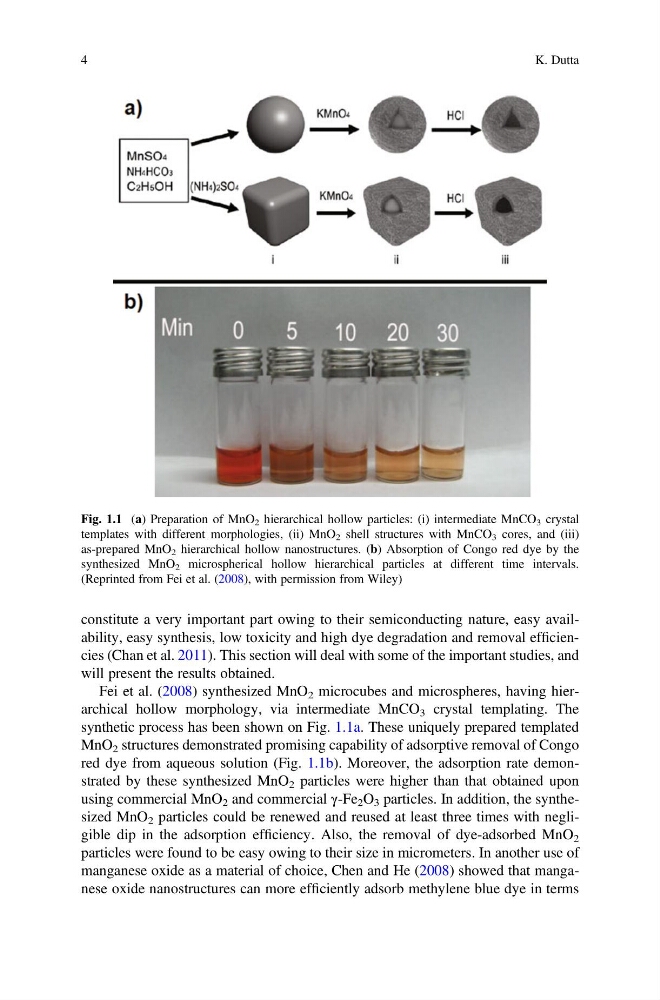
Fei et al. (2008) synthesized MnO 2 microcubes and microspheres, having hierarchical hollow morphology, via intermediate MnCO 3 crystal templating. The
synthetic process has been shown on Fig. 1.1a. These uniquely prepared templated
MnO 2 structures demonstrated promising capability of adsorptive removal of Congo
red dye from aqueous solution (Fig. 1.1b). Moreover, the adsorption rate demonstrated by these synthesized MnO 2 particles were higher than that obtained upon
using commercial MnO 2 and commercial γ-Fe 2 O 3 particles. In addition, the synthesized MnO 2 particles could be renewed and reused at least three times with negligible dip in the adsorption efficiency. Also, the removal of dye-adsorbed MnO 2
particles were found to be easy owing to their size in micrometers. In another use of
manganese oxide as a material of choice, Chen and He (2008) showed that manganese oxide nanostructures can more efficiently adsorb methylene blue dye in terms
Fig. 1.1 (a) Preparation of MnO 2 hierarchical hollow particles: (i) intermediate MnCO 3 crystal
templates with different morphologies, (ii) MnO 2 shell structures with MnCO 3 cores, and (iii)
as-prepared MnO 2 hierarchical hollow nanostructures. (b) Absorption of Congo red dye by the
synthesized MnO 2 microspherical hollow hierarchical particles at different time intervals.
(Reprinted from Fei et al. (2008), with permission from Wiley)
4
K. Dutta
will present the results obtained.
Fei et al. (2008) synthesized MnO 2 microcubes and microspheres, having hierarchical hollow morphology, via intermediate MnCO 3 crystal templating. The
synthetic process has been shown on Fig. 1.1a. These uniquely prepared templated
MnO 2 structures demonstrated promising capability of adsorptive removal of Congo
red dye from aqueous solution (Fig. 1.1b). Moreover, the adsorption rate demonstrated by these synthesized MnO 2 particles were higher than that obtained upon
using commercial MnO 2 and commercial γ-Fe 2 O 3 particles. In addition, the synthesized MnO 2 particles could be renewed and reused at least three times with negligible dip in the adsorption efficiency. Also, the removal of dye-adsorbed MnO 2
particles were found to be easy owing to their size in micrometers. In another use of
manganese oxide as a material of choice, Chen and He (2008) showed that manganese oxide nanostructures can more efficiently adsorb methylene blue dye in terms
Fig. 1.1 (a) Preparation of MnO 2 hierarchical hollow particles: (i) intermediate MnCO 3 crystal
templates with different morphologies, (ii) MnO 2 shell structures with MnCO 3 cores, and (iii)
as-prepared MnO 2 hierarchical hollow nanostructures. (b) Absorption of Congo red dye by the
synthesized MnO 2 microspherical hollow hierarchical particles at different time intervals.
(Reprinted from Fei et al. (2008), with permission from Wiley)
4
K. Dutta