

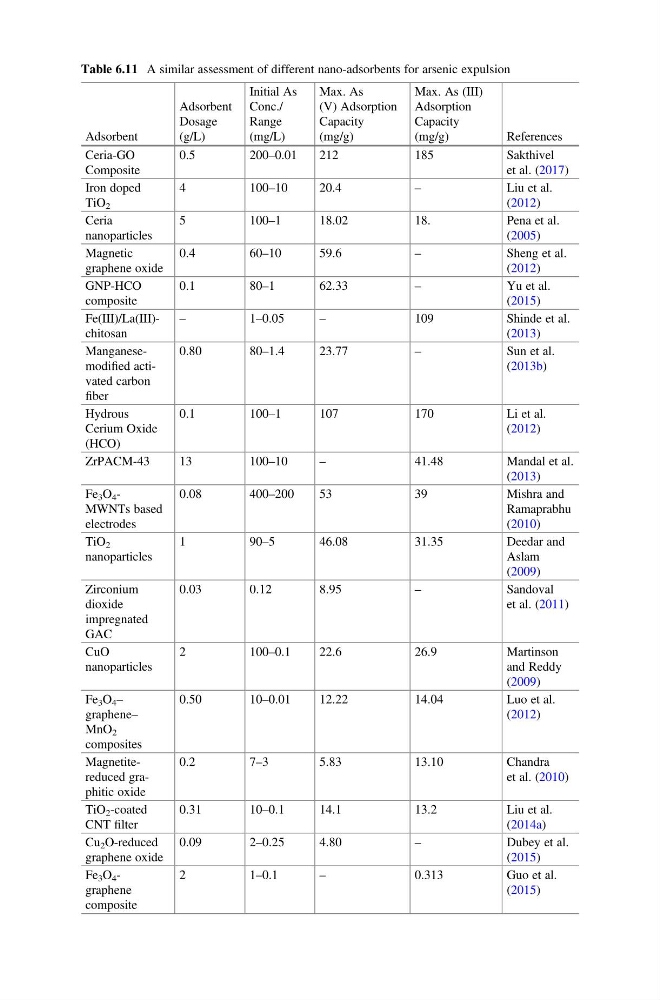
Table 6.11 A similar assessment of different nano-adsorbents for arsenic expulsion
Adsorbent
Adsorbent
Dosage
(g/L)
Initial As
Conc./
Range
(mg/L)
Max. As
(V) Adsorption
Capacity
(mg/g)
Max. As (III)
Adsorption
Capacity
(mg/g)
References
Ceria-GO
Composite
0.5
200–0.01
212
185
Sakthivel
et al. (2017)
Iron doped
TiO 2
4
100–10
20.4
–
Liu et al.
(2012)
Ceria
nanoparticles
5
100–1
18.02
18.
Pena et al.
(2005)
Magnetic
graphene oxide
0.4
60–10
59.6
–
Sheng et al.
(2012)
GNP-HCO
composite
0.1
80–1
62.33
–
Yu et al.
(2015)
Fe(III)/La(III)chitosan
–
1–0.05
–
109
Shinde et al.
(2013)
Manganesemodified activated carbon
fiber
0.80
80–1.4
23.77
–
Sun et al.
(2013b)
Hydrous
Cerium Oxide
(HCO)
0.1
100–1
107
170
Li et al.
(2012)
ZrPACM-43
13
100–10
–
41.48
Mandal et al.
(2013)
Fe 3 O 4 -
MWNTs based
electrodes
0.08
400–200
53
39
Mishra and
Ramaprabhu
(2010)
TiO 2
nanoparticles
1
9 0 –5
46.08
31.35
Deedar and
Aslam
(2009)
Zirconium
dioxide
impregnated
GAC
0.03
0.12
8.95
–
Sandoval
et al. (2011)
CuO
nanoparticles
2
100–0.1
22.6
26.9
Martinson
and Reddy
(2009)
Fe 3 O 4 –
graphene–
MnO 2
composites
0.50
10–0.01
12.22
14.04
Luo et al.
(2012)
Magnetitereduced graphitic oxide
0.2
7–3
5.83
13.10
Chandra
et al. (2010)
TiO 2 -coated
CNT filter
0.31
10–0.1
14.1
13.2
Liu et al.
(2014a)
Cu 2 O-reduced
graphene oxide
0.09
2–0.25
4.80
–
Dubey et al.
(2015)
Fe 3 O 4 -
graphene
composite
2
1 –0.1
–
0.313
Guo et al.
(2015)
Adsorbent
Adsorbent
Dosage
(g/L)
Initial As
Conc./
Range
(mg/L)
Max. As
(V) Adsorption
Capacity
(mg/g)
Max. As (III)
Adsorption
Capacity
(mg/g)
References
Ceria-GO
Composite
0.5
200–0.01
212
185
Sakthivel
et al. (2017)
Iron doped
TiO 2
4
100–10
20.4
–
Liu et al.
(2012)
Ceria
nanoparticles
5
100–1
18.02
18.
Pena et al.
(2005)
Magnetic
graphene oxide
0.4
60–10
59.6
–
Sheng et al.
(2012)
GNP-HCO
composite
0.1
80–1
62.33
–
Yu et al.
(2015)
Fe(III)/La(III)chitosan
–
1–0.05
–
109
Shinde et al.
(2013)
Manganesemodified activated carbon
fiber
0.80
80–1.4
23.77
–
Sun et al.
(2013b)
Hydrous
Cerium Oxide
(HCO)
0.1
100–1
107
170
Li et al.
(2012)
ZrPACM-43
13
100–10
–
41.48
Mandal et al.
(2013)
Fe 3 O 4 -
MWNTs based
electrodes
0.08
400–200
53
39
Mishra and
Ramaprabhu
(2010)
TiO 2
nanoparticles
1
9 0 –5
46.08
31.35
Deedar and
Aslam
(2009)
Zirconium
dioxide
impregnated
GAC
0.03
0.12
8.95
–
Sandoval
et al. (2011)
CuO
nanoparticles
2
100–0.1
22.6
26.9
Martinson
and Reddy
(2009)
Fe 3 O 4 –
graphene–
MnO 2
composites
0.50
10–0.01
12.22
14.04
Luo et al.
(2012)
Magnetitereduced graphitic oxide
0.2
7–3
5.83
13.10
Chandra
et al. (2010)
TiO 2 -coated
CNT filter
0.31
10–0.1
14.1
13.2
Liu et al.
(2014a)
Cu 2 O-reduced
graphene oxide
0.09
2–0.25
4.80
–
Dubey et al.
(2015)
Fe 3 O 4 -
graphene
composite
2
1 –0.1
–
0.313
Guo et al.
(2015)