

dq 1
dt
¼ k 1 q e À q t
ð
Þ
ð6:4Þ
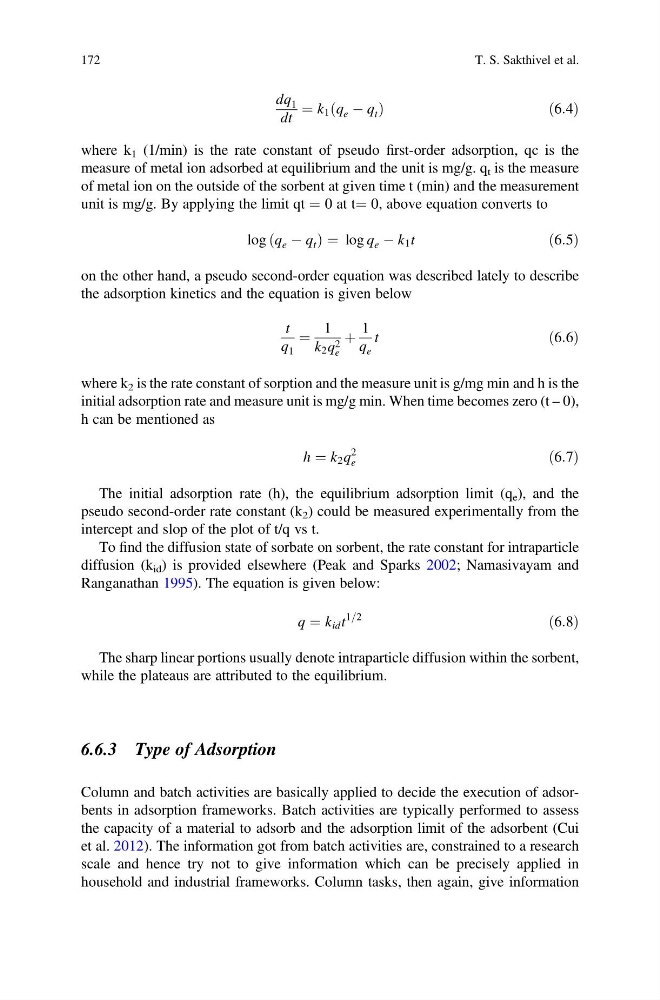
where k 1 (1/min) is the rate constant of pseudo first-order adsorption, qc is the
measure of metal ion adsorbed at equilibrium and the unit is mg/g. q t is the measure
of metal ion on the outside of the sorbent at given time t (min) and the measurement
unit is mg/g. By applying the limit qt ¼ 0 at t¼ 0, above equation converts to
log q e À q t
ð
Þ¼ log q e À k 1 t
ð6:5Þ
on the other hand, a pseudo second-order equation was described lately to describe
the adsorption kinetics and the equation is given below
t
q 1
¼
1
k 2 q 2
e
þ
1
q e
t
ð6:6Þ
where k 2 is the rate constant of sorption and the measure unit is g/mg min and h is the
initial adsorption rate and measure unit is mg/g min. When time becomes zero (t – 0),
h can be mentioned as
h ¼ k 2 q
2
e
ð6:7Þ
The initial adsorption rate (h), the equilibrium adsorption limit (q e ), and the
pseudo second-order rate constant (k 2 ) could be measured experimentally from the
intercept and slop of the plot of t/q vs t.
To find the diffusion state of sorbate on sorbent, the rate constant for intraparticle
diffusion (k id ) is provided elsewhere (Peak and Sparks 2002; Namasivayam and
Ranganathan 1995). The equation is given below:
q ¼ k id t
1=2
ð6:8Þ
The sharp linear portions usually denote intraparticle diffusion within the sorbent,
while the plateaus are attributed to the equilibrium.
6.6.3 Type of Adsorption
Column and batch activities are basically applied to decide the execution of adsorbents in adsorption frameworks. Batch activities are typically performed to assess
the capacity of a material to adsorb and the adsorption limit of the adsorbent (Cui
et al. 2012). The information got from batch activities are, constrained to a research
scale and hence try not to give information which can be precisely applied in
household and industrial frameworks. Column tasks, then again, give information
172
T. S. Sakthivel et al.
dt
¼ k 1 q e À q t
ð
Þ
ð6:4Þ
where k 1 (1/min) is the rate constant of pseudo first-order adsorption, qc is the
measure of metal ion adsorbed at equilibrium and the unit is mg/g. q t is the measure
of metal ion on the outside of the sorbent at given time t (min) and the measurement
unit is mg/g. By applying the limit qt ¼ 0 at t¼ 0, above equation converts to
log q e À q t
ð
Þ¼ log q e À k 1 t
ð6:5Þ
on the other hand, a pseudo second-order equation was described lately to describe
the adsorption kinetics and the equation is given below
t
q 1
¼
1
k 2 q 2
e
þ
1
q e
t
ð6:6Þ
where k 2 is the rate constant of sorption and the measure unit is g/mg min and h is the
initial adsorption rate and measure unit is mg/g min. When time becomes zero (t – 0),
h can be mentioned as
h ¼ k 2 q
2
e
ð6:7Þ
The initial adsorption rate (h), the equilibrium adsorption limit (q e ), and the
pseudo second-order rate constant (k 2 ) could be measured experimentally from the
intercept and slop of the plot of t/q vs t.
To find the diffusion state of sorbate on sorbent, the rate constant for intraparticle
diffusion (k id ) is provided elsewhere (Peak and Sparks 2002; Namasivayam and
Ranganathan 1995). The equation is given below:
q ¼ k id t
1=2
ð6:8Þ
The sharp linear portions usually denote intraparticle diffusion within the sorbent,
while the plateaus are attributed to the equilibrium.
6.6.3 Type of Adsorption
Column and batch activities are basically applied to decide the execution of adsorbents in adsorption frameworks. Batch activities are typically performed to assess
the capacity of a material to adsorb and the adsorption limit of the adsorbent (Cui
et al. 2012). The information got from batch activities are, constrained to a research
scale and hence try not to give information which can be precisely applied in
household and industrial frameworks. Column tasks, then again, give information
172
T. S. Sakthivel et al.