

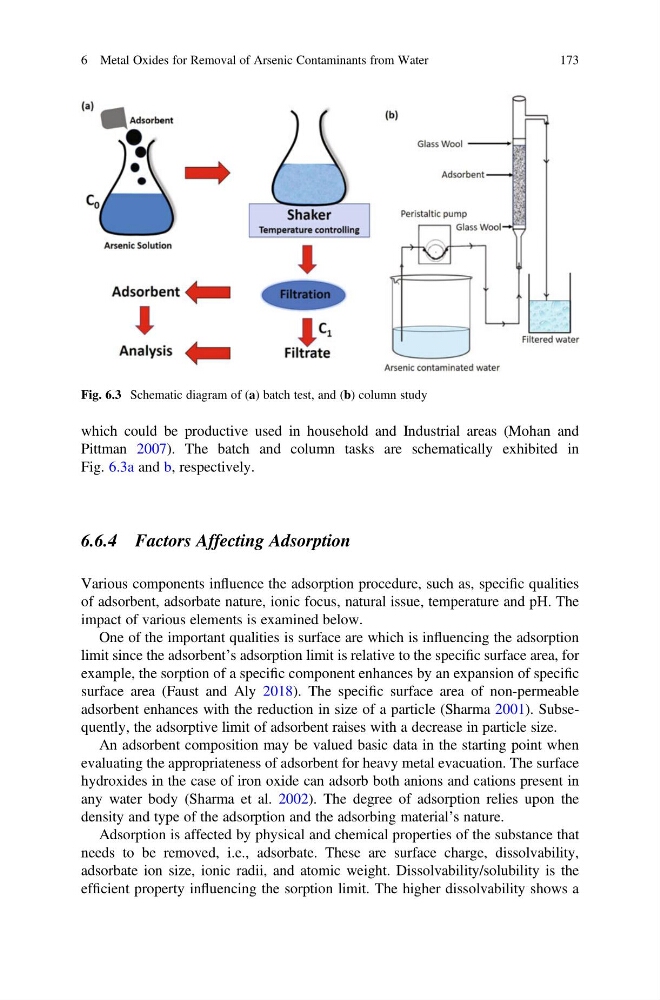
which could be productive used in household and Industrial areas (Mohan and
Pittman 2007). The batch and column tasks are schematically exhibited in
Fig. 6.3a and b, respectively.
6.6.4 Factors Affecting Adsorption
Various components influence the adsorption procedure, such as, specific qualities
of adsorbent, adsorbate nature, ionic focus, natural issue, temperature and pH. The
impact of various elements is examined below.
One of the important qualities is surface are which is influencing the adsorption
limit since the adsorbent’s adsorption limit is relative to the specific surface area, for
example, the sorption of a specific component enhances by an expansion of specific
surface area (Faust and Aly 2018). The specific surface area of non-permeable
adsorbent enhances with the reduction in size of a particle (Sharma 2001). Subsequently, the adsorptive limit of adsorbent raises with a decrease in particle size.
An adsorbent composition may be valued basic data in the starting point when
evaluating the appropriateness of adsorbent for heavy metal evacuation. The surface
hydroxides in the case of iron oxide can adsorb both anions and cations present in
any water body (Sharma et al. 2002). The degree of adsorption relies upon the
density and type of the adsorption and the adsorbing material’s nature.
Adsorption is affected by physical and chemical properties of the substance that
needs to be removed, i.e., adsorbate. These are surface charge, dissolvability,
adsorbate ion size, ionic radii, and atomic weight. Dissolvability/solubility is the
efficient property influencing the sorption limit. The higher dissolvability shows a
Fig. 6.3 Schematic diagram of (a) batch test, and (b) column study
6 Metal Oxides for Removal of Arsenic Contaminants from Water
173
Pittman 2007). The batch and column tasks are schematically exhibited in
Fig. 6.3a and b, respectively.
6.6.4 Factors Affecting Adsorption
Various components influence the adsorption procedure, such as, specific qualities
of adsorbent, adsorbate nature, ionic focus, natural issue, temperature and pH. The
impact of various elements is examined below.
One of the important qualities is surface are which is influencing the adsorption
limit since the adsorbent’s adsorption limit is relative to the specific surface area, for
example, the sorption of a specific component enhances by an expansion of specific
surface area (Faust and Aly 2018). The specific surface area of non-permeable
adsorbent enhances with the reduction in size of a particle (Sharma 2001). Subsequently, the adsorptive limit of adsorbent raises with a decrease in particle size.
An adsorbent composition may be valued basic data in the starting point when
evaluating the appropriateness of adsorbent for heavy metal evacuation. The surface
hydroxides in the case of iron oxide can adsorb both anions and cations present in
any water body (Sharma et al. 2002). The degree of adsorption relies upon the
density and type of the adsorption and the adsorbing material’s nature.
Adsorption is affected by physical and chemical properties of the substance that
needs to be removed, i.e., adsorbate. These are surface charge, dissolvability,
adsorbate ion size, ionic radii, and atomic weight. Dissolvability/solubility is the
efficient property influencing the sorption limit. The higher dissolvability shows a
Fig. 6.3 Schematic diagram of (a) batch test, and (b) column study
6 Metal Oxides for Removal of Arsenic Contaminants from Water
173