

q e ¼ KC
1 = n
e
ð6:1Þ
The linear form of equation is given below:
log q e ¼ log k þ
1
n
log C e
ð6:2Þ
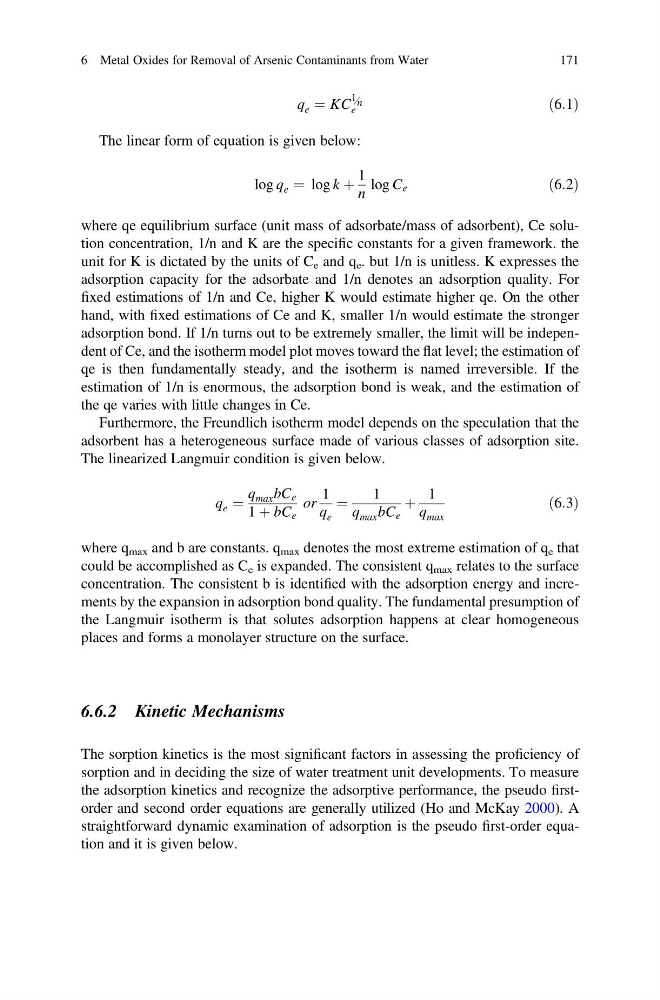
where qe equilibrium surface (unit mass of adsorbate/mass of adsorbent), Ce solution concentration, 1/n and K are the specific constants for a given framework. the
unit for K is dictated by the units of C e and q e . but 1/n is unitless. K expresses the
adsorption capacity for the adsorbate and 1/n denotes an adsorption quality. For
fixed estimations of 1/n and Ce, higher K would estimate higher qe. On the other
hand, with fixed estimations of Ce and K, smaller 1/n would estimate the stronger
adsorption bond. If 1/n turns out to be extremely smaller, the limit will be independent of Ce, and the isotherm model plot moves toward the flat level; the estimation of
qe is then fundamentally steady, and the isotherm is named irreversible. If the
estimation of 1/n is enormous, the adsorption bond is weak, and the estimation of
the qe varies with little changes in Ce.
Furthermore, the Freundlich isotherm model depends on the speculation that the
adsorbent has a heterogeneous surface made of various classes of adsorption site.
The linearized Langmuir condition is given below.
q e ¼
q max bC e
1 þ bC e
or
1
q e
¼
1
q max bC e
þ
1
q max
ð6:3Þ
where q max and b are constants. q max denotes the most extreme estimation of q e that
could be accomplished as C e is expanded. The consistent q max relates to the surface
concentration. The consistent b is identified with the adsorption energy and increments by the expansion in adsorption bond quality. The fundamental presumption of
the Langmuir isotherm is that solutes adsorption happens at clear homogeneous
places and forms a monolayer structure on the surface.
6.6.2 Kinetic Mechanisms
The sorption kinetics is the most significant factors in assessing the proficiency of
sorption and in deciding the size of water treatment unit developments. To measure
the adsorption kinetics and recognize the adsorptive performance, the pseudo firstorder and second order equations are generally utilized (Ho and McKay 2000). A
straightforward dynamic examination of adsorption is the pseudo first-order equation and it is given below.
6 Metal Oxides for Removal of Arsenic Contaminants from Water
171
1 = n
e
ð6:1Þ
The linear form of equation is given below:
log q e ¼ log k þ
1
n
log C e
ð6:2Þ
where qe equilibrium surface (unit mass of adsorbate/mass of adsorbent), Ce solution concentration, 1/n and K are the specific constants for a given framework. the
unit for K is dictated by the units of C e and q e . but 1/n is unitless. K expresses the
adsorption capacity for the adsorbate and 1/n denotes an adsorption quality. For
fixed estimations of 1/n and Ce, higher K would estimate higher qe. On the other
hand, with fixed estimations of Ce and K, smaller 1/n would estimate the stronger
adsorption bond. If 1/n turns out to be extremely smaller, the limit will be independent of Ce, and the isotherm model plot moves toward the flat level; the estimation of
qe is then fundamentally steady, and the isotherm is named irreversible. If the
estimation of 1/n is enormous, the adsorption bond is weak, and the estimation of
the qe varies with little changes in Ce.
Furthermore, the Freundlich isotherm model depends on the speculation that the
adsorbent has a heterogeneous surface made of various classes of adsorption site.
The linearized Langmuir condition is given below.
q e ¼
q max bC e
1 þ bC e
or
1
q e
¼
1
q max bC e
þ
1
q max
ð6:3Þ
where q max and b are constants. q max denotes the most extreme estimation of q e that
could be accomplished as C e is expanded. The consistent q max relates to the surface
concentration. The consistent b is identified with the adsorption energy and increments by the expansion in adsorption bond quality. The fundamental presumption of
the Langmuir isotherm is that solutes adsorption happens at clear homogeneous
places and forms a monolayer structure on the surface.
6.6.2 Kinetic Mechanisms
The sorption kinetics is the most significant factors in assessing the proficiency of
sorption and in deciding the size of water treatment unit developments. To measure
the adsorption kinetics and recognize the adsorptive performance, the pseudo firstorder and second order equations are generally utilized (Ho and McKay 2000). A
straightforward dynamic examination of adsorption is the pseudo first-order equation and it is given below.
6 Metal Oxides for Removal of Arsenic Contaminants from Water
171