

present in water. Generally, membranes are manufactured compounds contains
several billions of micro pores connected through particular boundaries, which
don’t stop the water to go through (Shih 2005). A main impetus, for example,
weight contrast between the penetrate and feed sides, is expected to pass through
the water by the layer (Van der Bruggen et al. 2003). For the most part, two types of
weight driven membrane filtrations are available: (1) low-weight film forms, for
example, ultrafiltration (UF) and microfiltration (MF); and (2) pressure membrane
forms, for example, nanofiltration (NF) and Reverse Osmosis (RO) (Mondal et al.
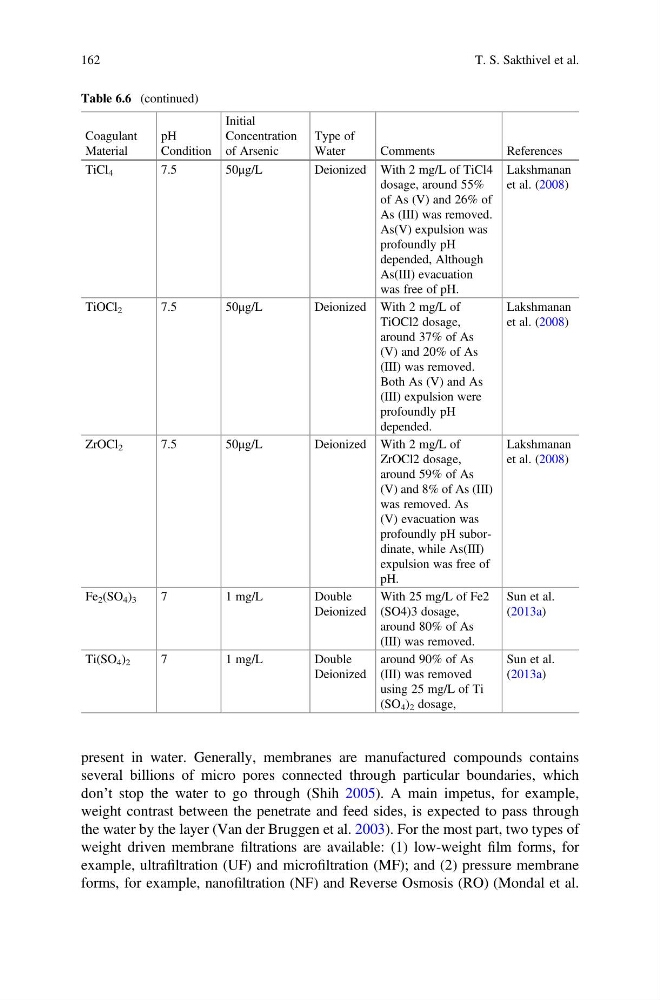
Table 6.6 (continued)
Coagulant
Material
pH
Condition
Initial
Concentration
of Arsenic
Type of
Water
Comments
References
TiCl 4
7.5
50μg/L
Deionized With 2 mg/L of TiCl4
dosage, around 55%
of As (V) and 26% of
As (III) was removed.
As(V) expulsion was
profoundly pH
depended, Although
As(III) evacuation
was free of pH.
Lakshmanan
et al. (2008)
TiOCl 2
7.5
50μg/L
Deionized With 2 mg/L of
TiOCl2 dosage,
around 37% of As
(V) and 20% of As
(III) was removed.
Both As (V) and As
(III) expulsion were
profoundly pH
depended.
Lakshmanan
et al. (2008)
ZrOCl 2
7.5
50μg/L
Deionized With 2 mg/L of
ZrOCl2 dosage,
around 59% of As
(V) and 8% of As (III)
was removed. As
(V) evacuation was
profoundly pH subordinate, while As(III)
expulsion was free of
pH.
Lakshmanan
et al. (2008)
Fe 2 (SO 4 ) 3
7
1 mg/L
Double
Deionized
With 25 mg/L of Fe2
(SO4)3 dosage,
around 80% of As
(III) was removed.
Sun et al.
(2013a)
Ti(SO 4 ) 2
7
1 mg/L
Double
Deionized
around 90% of As
(III) was removed
using 25 mg/L of Ti
(SO 4 ) 2 dosage,
Sun et al.
(2013a)
162
T. S. Sakthivel et al.
several billions of micro pores connected through particular boundaries, which
don’t stop the water to go through (Shih 2005). A main impetus, for example,
weight contrast between the penetrate and feed sides, is expected to pass through
the water by the layer (Van der Bruggen et al. 2003). For the most part, two types of
weight driven membrane filtrations are available: (1) low-weight film forms, for
example, ultrafiltration (UF) and microfiltration (MF); and (2) pressure membrane
forms, for example, nanofiltration (NF) and Reverse Osmosis (RO) (Mondal et al.
Table 6.6 (continued)
Coagulant
Material
pH
Condition
Initial
Concentration
of Arsenic
Type of
Water
Comments
References
TiCl 4
7.5
50μg/L
Deionized With 2 mg/L of TiCl4
dosage, around 55%
of As (V) and 26% of
As (III) was removed.
As(V) expulsion was
profoundly pH
depended, Although
As(III) evacuation
was free of pH.
Lakshmanan
et al. (2008)
TiOCl 2
7.5
50μg/L
Deionized With 2 mg/L of
TiOCl2 dosage,
around 37% of As
(V) and 20% of As
(III) was removed.
Both As (V) and As
(III) expulsion were
profoundly pH
depended.
Lakshmanan
et al. (2008)
ZrOCl 2
7.5
50μg/L
Deionized With 2 mg/L of
ZrOCl2 dosage,
around 59% of As
(V) and 8% of As (III)
was removed. As
(V) evacuation was
profoundly pH subordinate, while As(III)
expulsion was free of
pH.
Lakshmanan
et al. (2008)
Fe 2 (SO 4 ) 3
7
1 mg/L
Double
Deionized
With 25 mg/L of Fe2
(SO4)3 dosage,
around 80% of As
(III) was removed.
Sun et al.
(2013a)
Ti(SO 4 ) 2
7
1 mg/L
Double
Deionized
around 90% of As
(III) was removed
using 25 mg/L of Ti
(SO 4 ) 2 dosage,
Sun et al.
(2013a)
162
T. S. Sakthivel et al.