

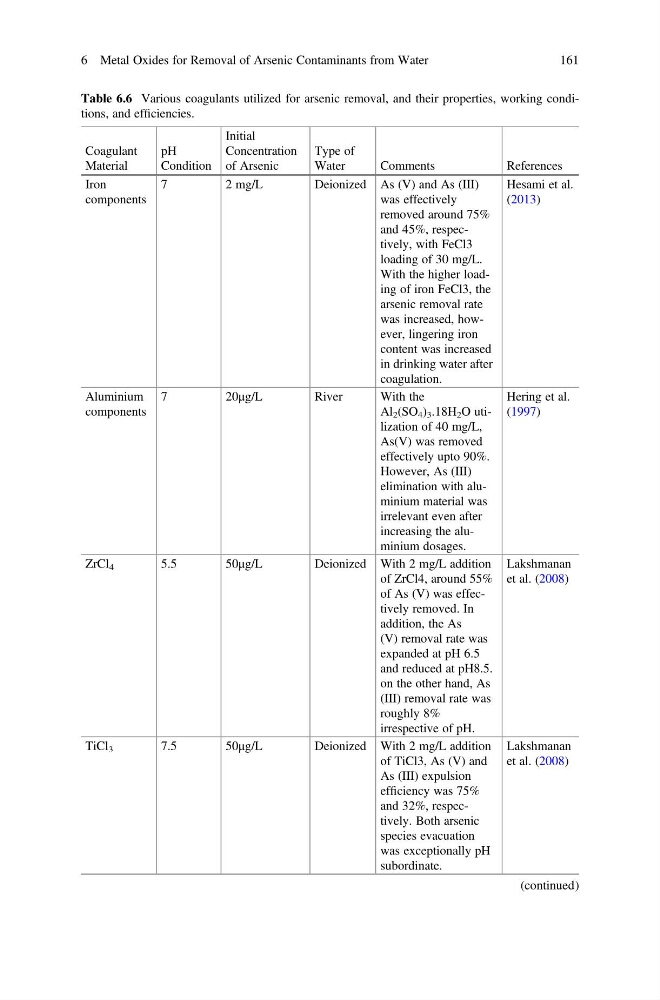
Table 6.6 Various coagulants utilized for arsenic removal, and their properties, working conditions, and efficiencies.
Coagulant
Material
pH
Condition
Initial
Concentration
of Arsenic
Type of
Water
Comments
References
Iron
components
7
2 mg/L
Deionized As (V) and As (III)
was effectively
removed around 75%
and 45%, respectively, with FeCl3
loading of 30 mg/L.
With the higher loading of iron FeCl3, the
arsenic removal rate
was increased, however, lingering iron
content was increased
in drinking water after
coagulation.
Hesami et al.
(2013)
Aluminium
components
7
2 0 μg/L
River
With the
Al 2 (SO 4 ) 3 .18H 2 O utilization of 40 mg/L,
As(V) was removed
effectively upto 90%.
However, As (III)
elimination with aluminium material was
irrelevant even after
increasing the aluminium dosages.
Hering et al.
(1997)
ZrCl 4
5.5
50μg/L
Deionized With 2 mg/L addition
of ZrCl4, around 55%
of As (V) was effectively removed. In
addition, the As
(V) removal rate was
expanded at pH 6.5
and reduced at pH8.5.
on the other hand, As
(III) removal rate was
roughly 8%
irrespective of pH.
Lakshmanan
et al. (2008)
TiCl 3
7.5
50μg/L
Deionized With 2 mg/L addition
of TiCl3, As (V) and
As (III) expulsion
efficiency was 75%
and 32%, respectively. Both arsenic
species evacuation
was exceptionally pH
subordinate.
Lakshmanan
et al. (2008)
(continued)
6 Metal Oxides for Removal of Arsenic Contaminants from Water
161
Coagulant
Material
pH
Condition
Initial
Concentration
of Arsenic
Type of
Water
Comments
References
Iron
components
7
2 mg/L
Deionized As (V) and As (III)
was effectively
removed around 75%
and 45%, respectively, with FeCl3
loading of 30 mg/L.
With the higher loading of iron FeCl3, the
arsenic removal rate
was increased, however, lingering iron
content was increased
in drinking water after
coagulation.
Hesami et al.
(2013)
Aluminium
components
7
2 0 μg/L
River
With the
Al 2 (SO 4 ) 3 .18H 2 O utilization of 40 mg/L,
As(V) was removed
effectively upto 90%.
However, As (III)
elimination with aluminium material was
irrelevant even after
increasing the aluminium dosages.
Hering et al.
(1997)
ZrCl 4
5.5
50μg/L
Deionized With 2 mg/L addition
of ZrCl4, around 55%
of As (V) was effectively removed. In
addition, the As
(V) removal rate was
expanded at pH 6.5
and reduced at pH8.5.
on the other hand, As
(III) removal rate was
roughly 8%
irrespective of pH.
Lakshmanan
et al. (2008)
TiCl 3
7.5
50μg/L
Deionized With 2 mg/L addition
of TiCl3, As (V) and
As (III) expulsion
efficiency was 75%
and 32%, respectively. Both arsenic
species evacuation
was exceptionally pH
subordinate.
Lakshmanan
et al. (2008)
(continued)
6 Metal Oxides for Removal of Arsenic Contaminants from Water
161