

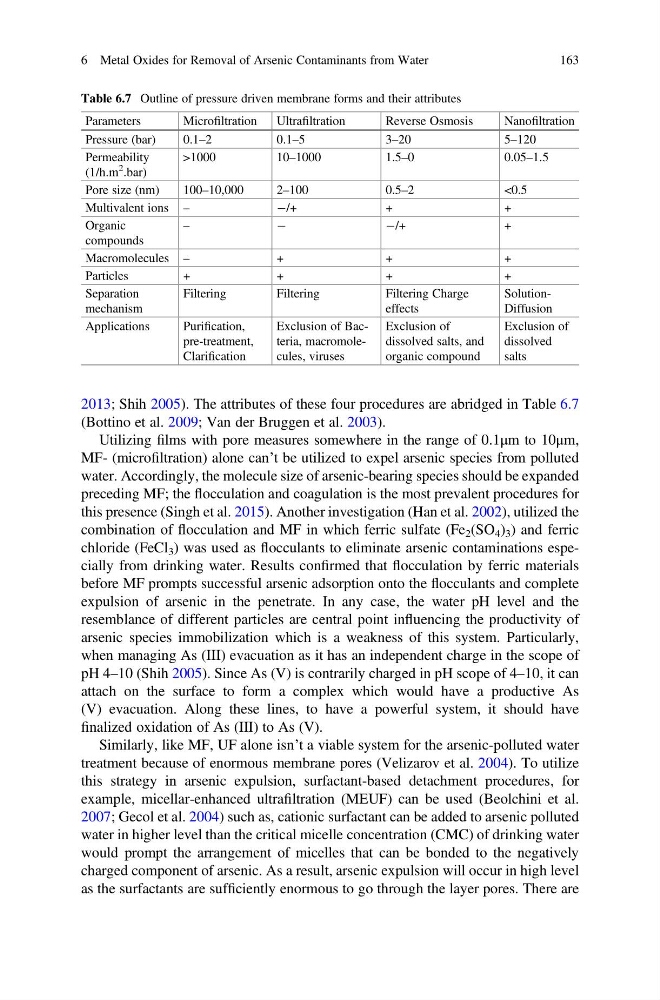
2013; Shih 2005). The attributes of these four procedures are abridged in Table 6.7
(Bottino et al. 2009; Van der Bruggen et al. 2003).
Utilizing films with pore measures somewhere in the range of 0.1μm to 10μm,
MF- (microfiltration) alone can’t be utilized to expel arsenic species from polluted
water. Accordingly, the molecule size of arsenic-bearing species should be expanded
preceding MF; the flocculation and coagulation is the most prevalent procedures for
this presence (Singh et al. 2015). Another investigation (Han et al. 2002), utilized the
combination of flocculation and MF in which ferric sulfate (Fe 2 (SO 4 ) 3 ) and ferric
chloride (FeCl 3 ) was used as flocculants to eliminate arsenic contaminations especially from drinking water. Results confirmed that flocculation by ferric materials
before MF prompts successful arsenic adsorption onto the flocculants and complete
expulsion of arsenic in the penetrate. In any case, the water pH level and the
resemblance of different particles are central point influencing the productivity of
arsenic species immobilization which is a weakness of this system. Particularly,
when managing As (III) evacuation as it has an independent charge in the scope of
pH 4–10 (Shih 2005). Since As (V) is contrarily charged in pH scope of 4–10, it can
attach on the surface to form a complex which would have a productive As
(V) evacuation. Along these lines, to have a powerful system, it should have
finalized oxidation of As (III) to As (V).
Similarly, like MF, UF alone isn’t a viable system for the arsenic-polluted water
treatment because of enormous membrane pores (Velizarov et al. 2004). To utilize
this strategy in arsenic expulsion, surfactant-based detachment procedures, for
example, micellar-enhanced ultrafiltration (MEUF) can be used (Beolchini et al.
2007; Gecol et al. 2004) such as, cationic surfactant can be added to arsenic polluted
water in higher level than the critical micelle concentration (CMC) of drinking water
would prompt the arrangement of micelles that can be bonded to the negatively
charged component of arsenic. As a result, arsenic expulsion will occur in high level
as the surfactants are sufficiently enormous to go through the layer pores. There are
Table 6.7 Outline of pressure driven membrane forms and their attributes
Parameters
Microfiltration
Ultrafiltration
Reverse Osmosis
Nanofiltration
Pressure (bar)
0.1–2
0.1–5
3 –20
5–120
Permeability
(1/h.m
2
.bar)
>1000
10–1000
1.5–0
0.05–1.5
Pore size (nm)
100–10,000
2–100
0.5–2
<0.5
Multivalent ions –
À/+
+
+
Organic
compounds
–
À
À /+
+
Macromolecules –
+
+
+
Particles
+
+
+
+
Separation
mechanism
Filtering
Filtering
Filtering Charge
effects
SolutionDiffusion
Applications
Purification,
pre-treatment,
Clarification
Exclusion of Bacteria, macromolecules, viruses
Exclusion of
dissolved salts, and
organic compound
Exclusion of
dissolved
salts
6 Metal Oxides for Removal of Arsenic Contaminants from Water
163
(Bottino et al. 2009; Van der Bruggen et al. 2003).
Utilizing films with pore measures somewhere in the range of 0.1μm to 10μm,
MF- (microfiltration) alone can’t be utilized to expel arsenic species from polluted
water. Accordingly, the molecule size of arsenic-bearing species should be expanded
preceding MF; the flocculation and coagulation is the most prevalent procedures for
this presence (Singh et al. 2015). Another investigation (Han et al. 2002), utilized the
combination of flocculation and MF in which ferric sulfate (Fe 2 (SO 4 ) 3 ) and ferric
chloride (FeCl 3 ) was used as flocculants to eliminate arsenic contaminations especially from drinking water. Results confirmed that flocculation by ferric materials
before MF prompts successful arsenic adsorption onto the flocculants and complete
expulsion of arsenic in the penetrate. In any case, the water pH level and the
resemblance of different particles are central point influencing the productivity of
arsenic species immobilization which is a weakness of this system. Particularly,
when managing As (III) evacuation as it has an independent charge in the scope of
pH 4–10 (Shih 2005). Since As (V) is contrarily charged in pH scope of 4–10, it can
attach on the surface to form a complex which would have a productive As
(V) evacuation. Along these lines, to have a powerful system, it should have
finalized oxidation of As (III) to As (V).
Similarly, like MF, UF alone isn’t a viable system for the arsenic-polluted water
treatment because of enormous membrane pores (Velizarov et al. 2004). To utilize
this strategy in arsenic expulsion, surfactant-based detachment procedures, for
example, micellar-enhanced ultrafiltration (MEUF) can be used (Beolchini et al.
2007; Gecol et al. 2004) such as, cationic surfactant can be added to arsenic polluted
water in higher level than the critical micelle concentration (CMC) of drinking water
would prompt the arrangement of micelles that can be bonded to the negatively
charged component of arsenic. As a result, arsenic expulsion will occur in high level
as the surfactants are sufficiently enormous to go through the layer pores. There are
Table 6.7 Outline of pressure driven membrane forms and their attributes
Parameters
Microfiltration
Ultrafiltration
Reverse Osmosis
Nanofiltration
Pressure (bar)
0.1–2
0.1–5
3 –20
5–120
Permeability
(1/h.m
2
.bar)
>1000
10–1000
1.5–0
0.05–1.5
Pore size (nm)
100–10,000
2–100
0.5–2
<0.5
Multivalent ions –
À/+
+
+
Organic
compounds
–
À
À /+
+
Macromolecules –
+
+
+
Particles
+
+
+
+
Separation
mechanism
Filtering
Filtering
Filtering Charge
effects
SolutionDiffusion
Applications
Purification,
pre-treatment,
Clarification
Exclusion of Bacteria, macromolecules, viruses
Exclusion of
dissolved salts, and
organic compound
Exclusion of
dissolved
salts
6 Metal Oxides for Removal of Arsenic Contaminants from Water
163