

Z-scheme photocatalyst format, which preserves redox couple ability. Experimental
results proved that h
+ and ⦁O 2
À are major radicals which contribute to NO removal,
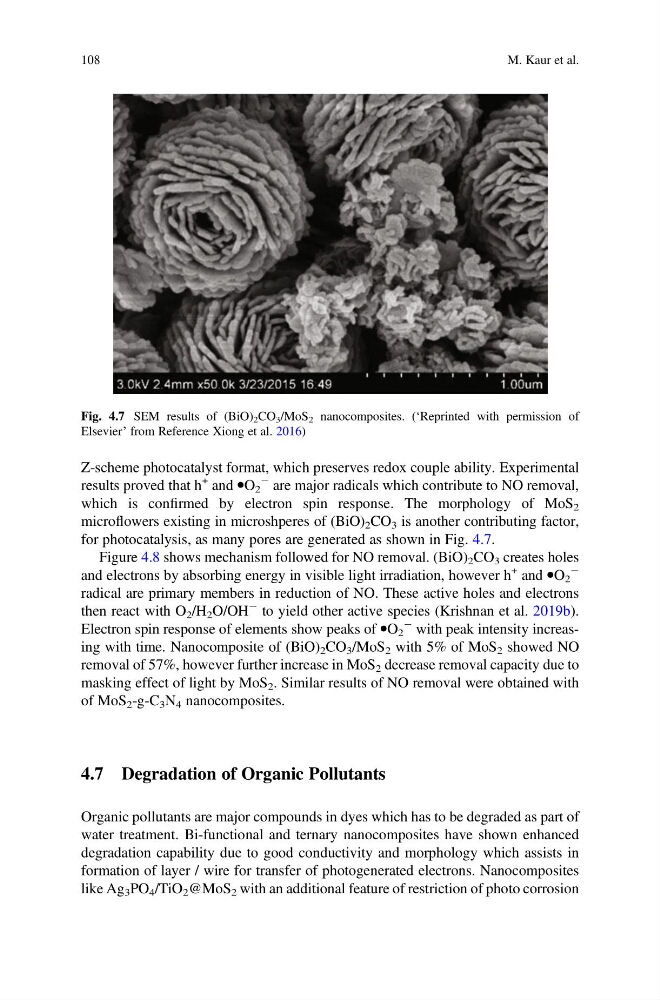
which is confirmed by electron spin response. The morphology of MoS 2
microflowers existing in microshperes of (BiO) 2 CO 3 is another contributing factor,
for photocatalysis, as many pores are generated as shown in Fig. 4.7.
Figure 4.8 shows mechanism followed for NO removal. (BiO) 2 CO 3 creates holes
and electrons by absorbing energy in visible light irradiation, however h
+ and ⦁O 2
À
radical are primary members in reduction of NO. These active holes and electrons
then react with O 2 /H 2 O/OH
À to yield other active species (Krishnan et al. 2019b).
Electron spin response of elements show peaks of ⦁O 2
À with peak intensity increasing with time. Nanocomposite of (BiO) 2 CO 3 /MoS 2 with 5% of MoS 2 showed NO
removal of 57%, however further increase in MoS 2 decrease removal capacity due to
masking effect of light by MoS 2 . Similar results of NO removal were obtained with
of MoS 2 -g-C 3 N 4 nanocomposites.
4.7 Degradation of Organic Pollutants
Organic pollutants are major compounds in dyes which has to be degraded as part of
water treatment. Bi-functional and ternary nanocomposites have shown enhanced
degradation capability due to good conductivity and morphology which assists in
formation of layer / wire for transfer of photogenerated electrons. Nanocomposites
like Ag 3 PO 4 /TiO 2 @MoS 2 with an additional feature of restriction of photo corrosion
Fig. 4.7 SEM results of (BiO) 2 CO 3 /MoS 2 nanocomposites. (‘Reprinted with permission of
Elsevier’ from Reference Xiong et al. 2016)
108
M. Kaur et al.
results proved that h
+ and ⦁O 2
À are major radicals which contribute to NO removal,
which is confirmed by electron spin response. The morphology of MoS 2
microflowers existing in microshperes of (BiO) 2 CO 3 is another contributing factor,
for photocatalysis, as many pores are generated as shown in Fig. 4.7.
Figure 4.8 shows mechanism followed for NO removal. (BiO) 2 CO 3 creates holes
and electrons by absorbing energy in visible light irradiation, however h
+ and ⦁O 2
À
radical are primary members in reduction of NO. These active holes and electrons
then react with O 2 /H 2 O/OH
À to yield other active species (Krishnan et al. 2019b).
Electron spin response of elements show peaks of ⦁O 2
À with peak intensity increasing with time. Nanocomposite of (BiO) 2 CO 3 /MoS 2 with 5% of MoS 2 showed NO
removal of 57%, however further increase in MoS 2 decrease removal capacity due to
masking effect of light by MoS 2 . Similar results of NO removal were obtained with
of MoS 2 -g-C 3 N 4 nanocomposites.
4.7 Degradation of Organic Pollutants
Organic pollutants are major compounds in dyes which has to be degraded as part of
water treatment. Bi-functional and ternary nanocomposites have shown enhanced
degradation capability due to good conductivity and morphology which assists in
formation of layer / wire for transfer of photogenerated electrons. Nanocomposites
like Ag 3 PO 4 /TiO 2 @MoS 2 with an additional feature of restriction of photo corrosion
Fig. 4.7 SEM results of (BiO) 2 CO 3 /MoS 2 nanocomposites. (‘Reprinted with permission of
Elsevier’ from Reference Xiong et al. 2016)
108
M. Kaur et al.