

of Ag
+ ensures highly effective degradation of oxytetracycline and reduction in
efficiency by only 10% even after 10 repetitions (Shao et al. 2017). Novacron red
Hunts- man dye (NRH) and methylene blue (MB) is reported to be degraded by
MoS 2 /ZnO nanocomposite. Figure 4.9 depicts the relation between the degradation
efficiency of MB and NRH for different loading of nanocomposite. The steady
decrease in intensity of NRH dye confirms the decomposition of dye. 1 g/L loading
of MoS 2 /ZnO nanocomposite showed degradation rate of 81.76% and 80.37% for
MB and NRH dye respectively.
Prominent dye like methyl orange (MO) was successfully degraded by TiO 2 /
MoS 2 @zeolite composite photocatalysts in xenon lamp as irradiation source. Analysis confirms that degradation follows a Langmuir–Hinshelwood kinetic model
(pseudo-first order reaction). Figure 4.10 shows the degradation of MO using
TiO 2 /MoS 2 @zeolite composite which compares the all elements of nanocomposites.
It shows the highest reaction rate constant of 2.304 h
À1 , which is higher than other
individual components. The enhancement is attributed to coupled structure of TiO 2 /
MoS 2 on the surface of zeolite making a positive synergetic effect. Additionally this
distribution makes a large contact area along with short diffusion time (W. Zhang
et al. 2015a).
Nitroaromatic chemicals can be rendered non-toxic by removing the nitro group
effectively. This would enhance its biodegradability in normal environment. MoS 2
and reduced graphene oxide (rGO) are combined to form hybrid nanosheets on
which CdS is grown for reducing 4-NP. The nanocomposites are found to be stable
and efficiently reduce 4-NP to aminophenol (4-AP), thus assisting in detoxification
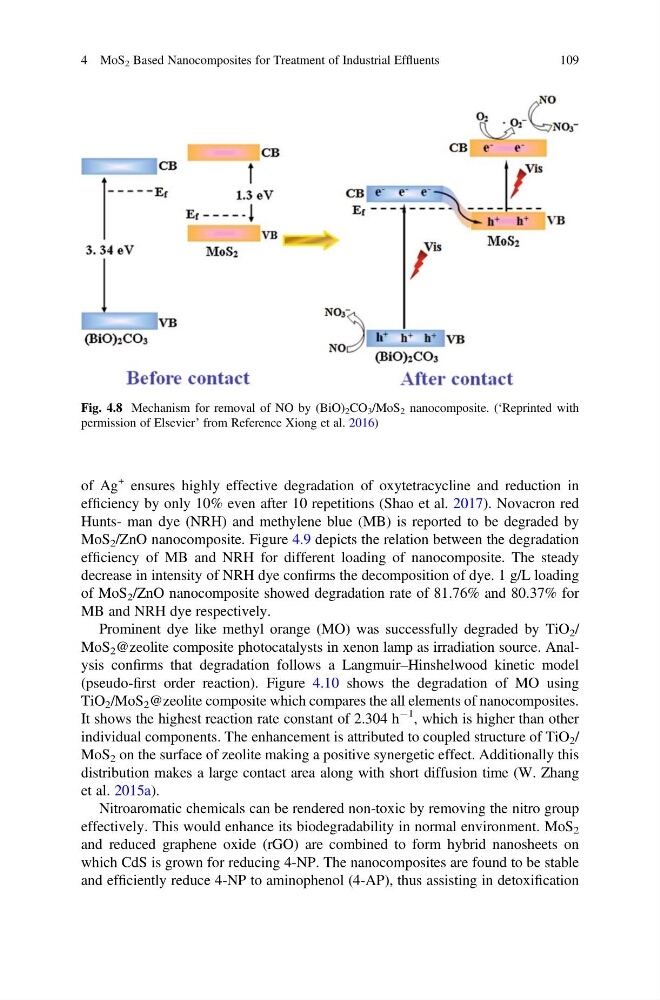
Fig. 4.8 Mechanism for removal of NO by (BiO) 2 CO 3 /MoS 2 nanocomposite. (‘Reprinted with
permission of Elsevier’ from Reference Xiong et al. 2016)
4 MoS 2 Based Nanocomposites for Treatment of Industrial Effluents
109
+ ensures highly effective degradation of oxytetracycline and reduction in
efficiency by only 10% even after 10 repetitions (Shao et al. 2017). Novacron red
Hunts- man dye (NRH) and methylene blue (MB) is reported to be degraded by
MoS 2 /ZnO nanocomposite. Figure 4.9 depicts the relation between the degradation
efficiency of MB and NRH for different loading of nanocomposite. The steady
decrease in intensity of NRH dye confirms the decomposition of dye. 1 g/L loading
of MoS 2 /ZnO nanocomposite showed degradation rate of 81.76% and 80.37% for
MB and NRH dye respectively.
Prominent dye like methyl orange (MO) was successfully degraded by TiO 2 /
MoS 2 @zeolite composite photocatalysts in xenon lamp as irradiation source. Analysis confirms that degradation follows a Langmuir–Hinshelwood kinetic model
(pseudo-first order reaction). Figure 4.10 shows the degradation of MO using
TiO 2 /MoS 2 @zeolite composite which compares the all elements of nanocomposites.
It shows the highest reaction rate constant of 2.304 h
À1 , which is higher than other
individual components. The enhancement is attributed to coupled structure of TiO 2 /
MoS 2 on the surface of zeolite making a positive synergetic effect. Additionally this
distribution makes a large contact area along with short diffusion time (W. Zhang
et al. 2015a).
Nitroaromatic chemicals can be rendered non-toxic by removing the nitro group
effectively. This would enhance its biodegradability in normal environment. MoS 2
and reduced graphene oxide (rGO) are combined to form hybrid nanosheets on
which CdS is grown for reducing 4-NP. The nanocomposites are found to be stable
and efficiently reduce 4-NP to aminophenol (4-AP), thus assisting in detoxification
Fig. 4.8 Mechanism for removal of NO by (BiO) 2 CO 3 /MoS 2 nanocomposite. (‘Reprinted with
permission of Elsevier’ from Reference Xiong et al. 2016)
4 MoS 2 Based Nanocomposites for Treatment of Industrial Effluents
109