

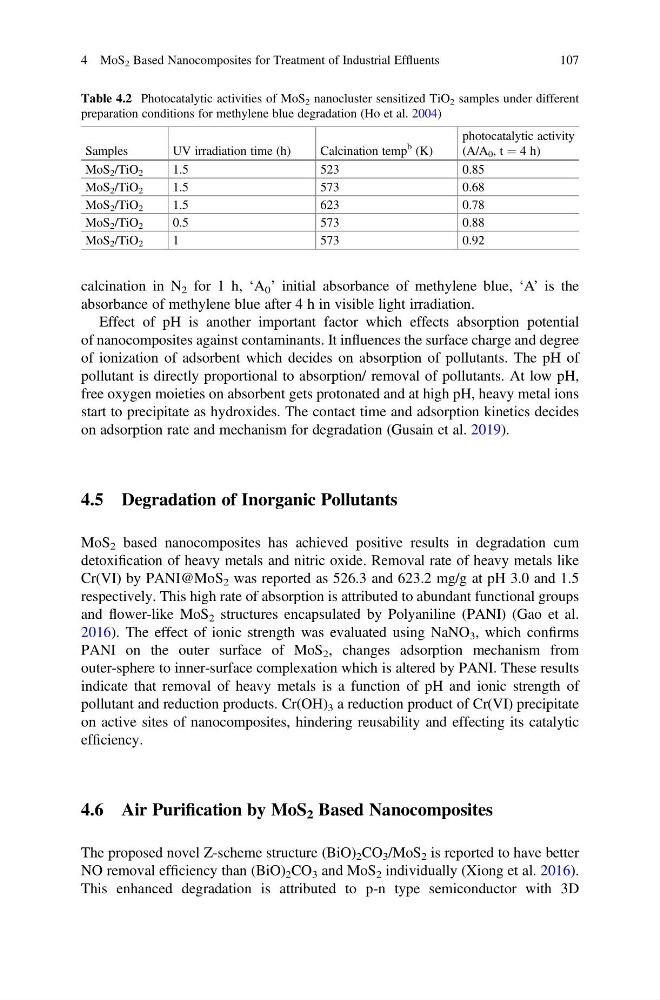
calcination in N 2 for 1 h, ‘A 0 ’ initial absorbance of methylene blue, ‘A’ is the
absorbance of methylene blue after 4 h in visible light irradiation.
Effect of pH is another important factor which effects absorption potential
of nanocomposites against contaminants. It influences the surface charge and degree
of ionization of adsorbent which decides on absorption of pollutants. The pH of
pollutant is directly proportional to absorption/ removal of pollutants. At low pH,
free oxygen moieties on absorbent gets protonated and at high pH, heavy metal ions
start to precipitate as hydroxides. The contact time and adsorption kinetics decides
on adsorption rate and mechanism for degradation (Gusain et al. 2019).
4.5 Degradation of Inorganic Pollutants
MoS 2 based nanocomposites has achieved positive results in degradation cum
detoxification of heavy metals and nitric oxide. Removal rate of heavy metals like
Cr(VI) by PANI@MoS 2 was reported as 526.3 and 623.2 mg/g at pH 3.0 and 1.5
respectively. This high rate of absorption is attributed to abundant functional groups
and flower-like MoS 2 structures encapsulated by Polyaniline (PANI) (Gao et al.
2016). The effect of ionic strength was evaluated using NaNO 3 , which confirms
PANI on the outer surface of MoS 2 , changes adsorption mechanism from
outer-sphere to inner-surface complexation which is altered by PANI. These results
indicate that removal of heavy metals is a function of pH and ionic strength of
pollutant and reduction products. Cr(OH) 3 a reduction product of Cr(VI) precipitate
on active sites of nanocomposites, hindering reusability and effecting its catalytic
efficiency.
4.6 Air Purification by MoS 2 Based Nanocomposites
The proposed novel Z-scheme structure (BiO) 2 CO 3 /MoS 2 is reported to have better
NO removal efficiency than (BiO) 2 CO 3 and MoS 2 individually (Xiong et al. 2016).
This enhanced degradation is attributed to p-n type semiconductor with 3D
Table 4.2 Photocatalytic activities of MoS 2 nanocluster sensitized TiO 2 samples under different
preparation conditions for methylene blue degradation (Ho et al. 2004)
Samples
UV irradiation time (h)
Calcination temp
b (K)
photocatalytic activity
(A/A 0 , t ¼ 4 h)
MoS 2 /TiO 2
1.5
523
0.85
MoS 2 /TiO 2
1.5
573
0.68
MoS 2 /TiO 2
1.5
623
0.78
MoS 2 /TiO 2
0.5
573
0.88
MoS 2 /TiO 2
1
573
0.92
4 MoS 2 Based Nanocomposites for Treatment of Industrial Effluents
107
absorbance of methylene blue after 4 h in visible light irradiation.
Effect of pH is another important factor which effects absorption potential
of nanocomposites against contaminants. It influences the surface charge and degree
of ionization of adsorbent which decides on absorption of pollutants. The pH of
pollutant is directly proportional to absorption/ removal of pollutants. At low pH,
free oxygen moieties on absorbent gets protonated and at high pH, heavy metal ions
start to precipitate as hydroxides. The contact time and adsorption kinetics decides
on adsorption rate and mechanism for degradation (Gusain et al. 2019).
4.5 Degradation of Inorganic Pollutants
MoS 2 based nanocomposites has achieved positive results in degradation cum
detoxification of heavy metals and nitric oxide. Removal rate of heavy metals like
Cr(VI) by PANI@MoS 2 was reported as 526.3 and 623.2 mg/g at pH 3.0 and 1.5
respectively. This high rate of absorption is attributed to abundant functional groups
and flower-like MoS 2 structures encapsulated by Polyaniline (PANI) (Gao et al.
2016). The effect of ionic strength was evaluated using NaNO 3 , which confirms
PANI on the outer surface of MoS 2 , changes adsorption mechanism from
outer-sphere to inner-surface complexation which is altered by PANI. These results
indicate that removal of heavy metals is a function of pH and ionic strength of
pollutant and reduction products. Cr(OH) 3 a reduction product of Cr(VI) precipitate
on active sites of nanocomposites, hindering reusability and effecting its catalytic
efficiency.
4.6 Air Purification by MoS 2 Based Nanocomposites
The proposed novel Z-scheme structure (BiO) 2 CO 3 /MoS 2 is reported to have better
NO removal efficiency than (BiO) 2 CO 3 and MoS 2 individually (Xiong et al. 2016).
This enhanced degradation is attributed to p-n type semiconductor with 3D
Table 4.2 Photocatalytic activities of MoS 2 nanocluster sensitized TiO 2 samples under different
preparation conditions for methylene blue degradation (Ho et al. 2004)
Samples
UV irradiation time (h)
Calcination temp
b (K)
photocatalytic activity
(A/A 0 , t ¼ 4 h)
MoS 2 /TiO 2
1.5
523
0.85
MoS 2 /TiO 2
1.5
573
0.68
MoS 2 /TiO 2
1.5
623
0.78
MoS 2 /TiO 2
0.5
573
0.88
MoS 2 /TiO 2
1
573
0.92
4 MoS 2 Based Nanocomposites for Treatment of Industrial Effluents
107