

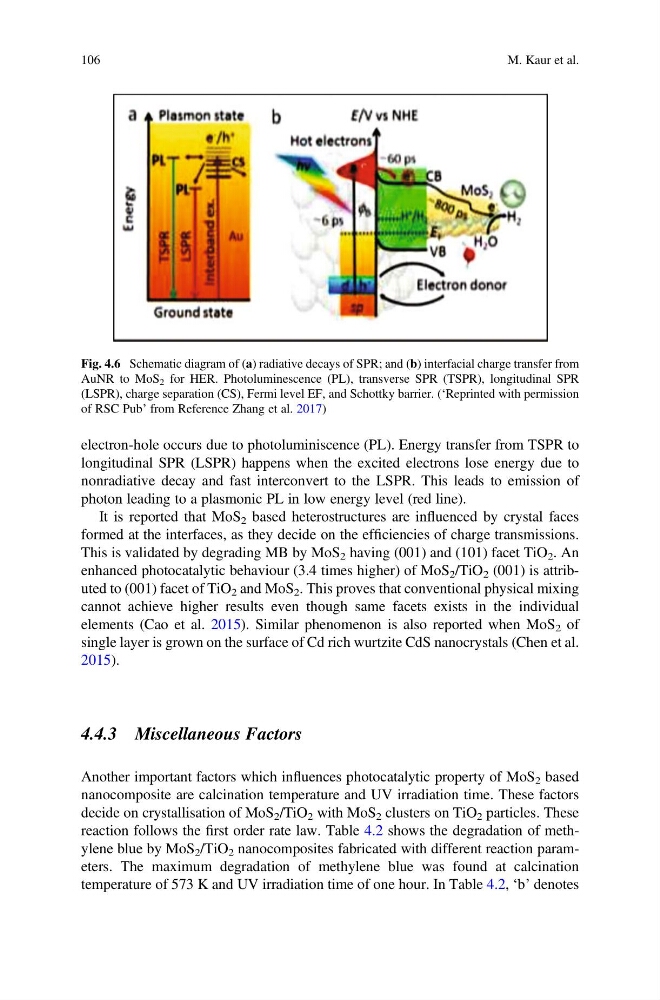
electron-hole occurs due to photoluminiscence (PL). Energy transfer from TSPR to
longitudinal SPR (LSPR) happens when the excited electrons lose energy due to
nonradiative decay and fast interconvert to the LSPR. This leads to emission of
photon leading to a plasmonic PL in low energy level (red line).
It is reported that MoS 2 based heterostructures are influenced by crystal faces
formed at the interfaces, as they decide on the efficiencies of charge transmissions.
This is validated by degrading MB by MoS 2 having (001) and (101) facet TiO 2 . An
enhanced photocatalytic behaviour (3.4 times higher) of MoS 2 /TiO 2 (001) is attributed to (001) facet of TiO 2 and MoS 2 . This proves that conventional physical mixing
cannot achieve higher results even though same facets exists in the individual
elements (Cao et al. 2015). Similar phenomenon is also reported when MoS 2 of
single layer is grown on the surface of Cd rich wurtzite CdS nanocrystals (Chen et al.
2015).
4.4.3 Miscellaneous Factors
Another important factors which influences photocatalytic property of MoS 2 based
nanocomposite are calcination temperature and UV irradiation time. These factors
decide on crystallisation of MoS 2 /TiO 2 with MoS 2 clusters on TiO 2 particles. These
reaction follows the first order rate law. Table 4.2 shows the degradation of methylene blue by MoS 2 /TiO 2 nanocomposites fabricated with different reaction parameters. The maximum degradation of methylene blue was found at calcination
temperature of 573 K and UV irradiation time of one hour. In Table 4.2, ‘b’ denotes
Fig. 4.6 Schematic diagram of (a) radiative decays of SPR; and (b) interfacial charge transfer from
AuNR to MoS 2 for HER. Photoluminescence (PL), transverse SPR (TSPR), longitudinal SPR
(LSPR), charge separation (CS), Fermi level EF, and Schottky barrier. (‘Reprinted with permission
of RSC Pub’ from Reference Zhang et al. 2017)
106
M. Kaur et al.
longitudinal SPR (LSPR) happens when the excited electrons lose energy due to
nonradiative decay and fast interconvert to the LSPR. This leads to emission of
photon leading to a plasmonic PL in low energy level (red line).
It is reported that MoS 2 based heterostructures are influenced by crystal faces
formed at the interfaces, as they decide on the efficiencies of charge transmissions.
This is validated by degrading MB by MoS 2 having (001) and (101) facet TiO 2 . An
enhanced photocatalytic behaviour (3.4 times higher) of MoS 2 /TiO 2 (001) is attributed to (001) facet of TiO 2 and MoS 2 . This proves that conventional physical mixing
cannot achieve higher results even though same facets exists in the individual
elements (Cao et al. 2015). Similar phenomenon is also reported when MoS 2 of
single layer is grown on the surface of Cd rich wurtzite CdS nanocrystals (Chen et al.
2015).
4.4.3 Miscellaneous Factors
Another important factors which influences photocatalytic property of MoS 2 based
nanocomposite are calcination temperature and UV irradiation time. These factors
decide on crystallisation of MoS 2 /TiO 2 with MoS 2 clusters on TiO 2 particles. These
reaction follows the first order rate law. Table 4.2 shows the degradation of methylene blue by MoS 2 /TiO 2 nanocomposites fabricated with different reaction parameters. The maximum degradation of methylene blue was found at calcination
temperature of 573 K and UV irradiation time of one hour. In Table 4.2, ‘b’ denotes
Fig. 4.6 Schematic diagram of (a) radiative decays of SPR; and (b) interfacial charge transfer from
AuNR to MoS 2 for HER. Photoluminescence (PL), transverse SPR (TSPR), longitudinal SPR
(LSPR), charge separation (CS), Fermi level EF, and Schottky barrier. (‘Reprinted with permission
of RSC Pub’ from Reference Zhang et al. 2017)
106
M. Kaur et al.