

morphology of co-catalyst also plays a prominent role in photocatalysis. When
elements supporting plasmonic response are used as co-catalyst, efficiency of
photocatalysis increases due to efficient interfacial electron transfer and electron
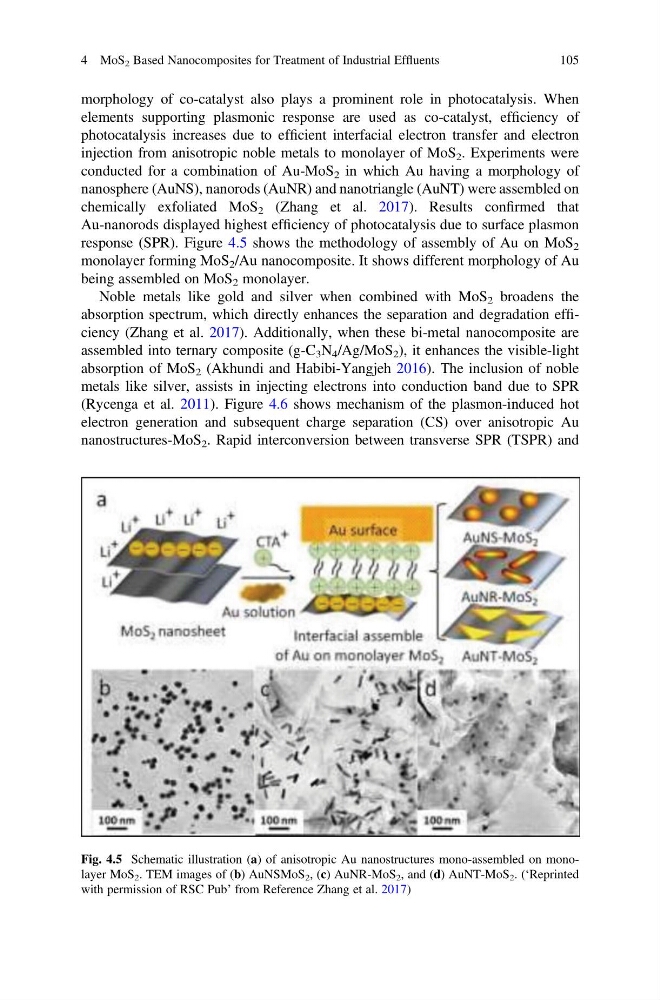
injection from anisotropic noble metals to monolayer of MoS 2 . Experiments were
conducted for a combination of Au-MoS 2 in which Au having a morphology of
nanosphere (AuNS), nanorods (AuNR) and nanotriangle (AuNT) were assembled on
chemically exfoliated MoS 2 (Zhang et al. 2017). Results confirmed that
Au-nanorods displayed highest efficiency of photocatalysis due to surface plasmon
response (SPR). Figure 4.5 shows the methodology of assembly of Au on MoS 2
monolayer forming MoS 2 /Au nanocomposite. It shows different morphology of Au
being assembled on MoS 2 monolayer.
Noble metals like gold and silver when combined with MoS 2 broadens the
absorption spectrum, which directly enhances the separation and degradation efficiency (Zhang et al. 2017). Additionally, when these bi-metal nanocomposite are
assembled into ternary composite (g-C 3 N 4 /Ag/MoS 2 ), it enhances the visible-light
absorption of MoS 2 (Akhundi and Habibi-Yangjeh 2016). The inclusion of noble
metals like silver, assists in injecting electrons into conduction band due to SPR
(Rycenga et al. 2011). Figure 4.6 shows mechanism of the plasmon-induced hot
electron generation and subsequent charge separation (CS) over anisotropic Au
nanostructures-MoS 2 . Rapid interconversion between transverse SPR (TSPR) and
Fig. 4.5 Schematic illustration (a) of anisotropic Au nanostructures mono-assembled on monolayer MoS 2 . TEM images of (b) AuNSMoS 2 , (c) AuNR-MoS 2 , and (d) AuNT-MoS 2 . (‘Reprinted
with permission of RSC Pub’ from Reference Zhang et al. 2017)
4 MoS 2 Based Nanocomposites for Treatment of Industrial Effluents
105
elements supporting plasmonic response are used as co-catalyst, efficiency of
photocatalysis increases due to efficient interfacial electron transfer and electron
injection from anisotropic noble metals to monolayer of MoS 2 . Experiments were
conducted for a combination of Au-MoS 2 in which Au having a morphology of
nanosphere (AuNS), nanorods (AuNR) and nanotriangle (AuNT) were assembled on
chemically exfoliated MoS 2 (Zhang et al. 2017). Results confirmed that
Au-nanorods displayed highest efficiency of photocatalysis due to surface plasmon
response (SPR). Figure 4.5 shows the methodology of assembly of Au on MoS 2
monolayer forming MoS 2 /Au nanocomposite. It shows different morphology of Au
being assembled on MoS 2 monolayer.
Noble metals like gold and silver when combined with MoS 2 broadens the
absorption spectrum, which directly enhances the separation and degradation efficiency (Zhang et al. 2017). Additionally, when these bi-metal nanocomposite are
assembled into ternary composite (g-C 3 N 4 /Ag/MoS 2 ), it enhances the visible-light
absorption of MoS 2 (Akhundi and Habibi-Yangjeh 2016). The inclusion of noble
metals like silver, assists in injecting electrons into conduction band due to SPR
(Rycenga et al. 2011). Figure 4.6 shows mechanism of the plasmon-induced hot
electron generation and subsequent charge separation (CS) over anisotropic Au
nanostructures-MoS 2 . Rapid interconversion between transverse SPR (TSPR) and
Fig. 4.5 Schematic illustration (a) of anisotropic Au nanostructures mono-assembled on monolayer MoS 2 . TEM images of (b) AuNSMoS 2 , (c) AuNR-MoS 2 , and (d) AuNT-MoS 2 . (‘Reprinted
with permission of RSC Pub’ from Reference Zhang et al. 2017)
4 MoS 2 Based Nanocomposites for Treatment of Industrial Effluents
105