

includes ABC efflux pumps in the process of biotransformation for the export of
drug material (Fig. 16.5).
These transporters for xenobiotics or drugs in eukaryotes generally operate in
liver but they are also present in extra-hepatic tissues such as lung, the adrenal gland,
intestine, and kidney. As tissues perform specific functions therefore according to
their epithelial role (absorption or secretion), the cellular location of the transporters
varies. In polarized cell, generally, the SLC transporters are located on blood-facing
side of a cell, whereas ABC carriers occur on lumen side or on both sides (Petzinger
and Geyer 2006).
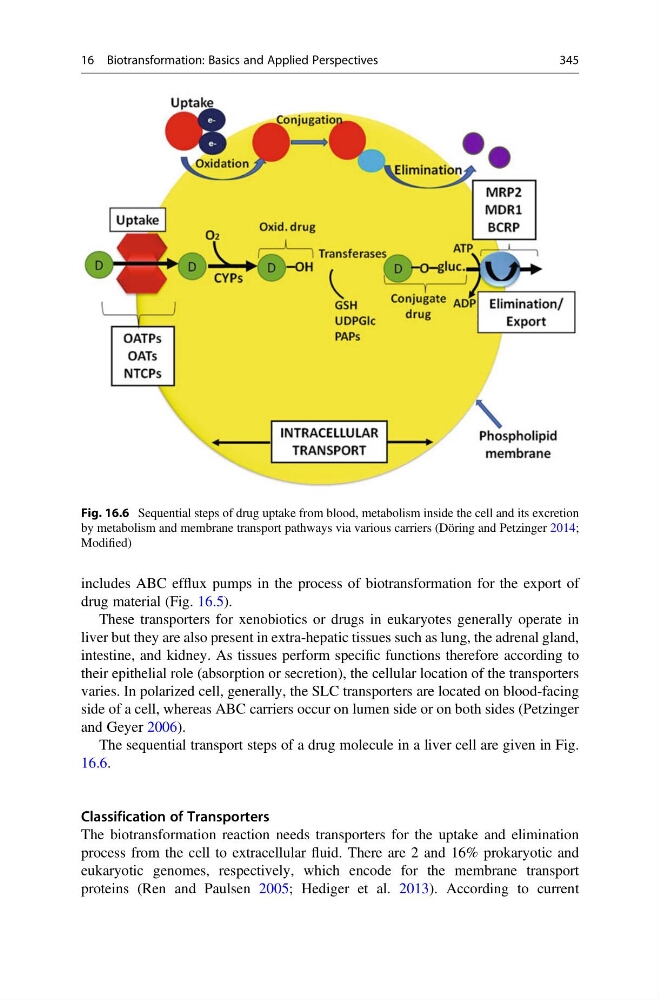
The sequential transport steps of a drug molecule in a liver cell are given in Fig.
16.6.
Classification of Transporters
The biotransformation reaction needs transporters for the uptake and elimination
process from the cell to extracellular fluid. There are 2 and 16% prokaryotic and
eukaryotic genomes, respectively, which encode for the membrane transport
proteins (Ren and Paulsen 2005; Hediger et al. 2013). According to current
Fig. 16.6 Sequential steps of drug uptake from blood, metabolism inside the cell and its excretion
by metabolism and membrane transport pathways via various carriers (Döring and Petzinger 2014;
Modified)
16 Biotransformation: Basics and Applied Perspectives
345
drug material (Fig. 16.5).
These transporters for xenobiotics or drugs in eukaryotes generally operate in
liver but they are also present in extra-hepatic tissues such as lung, the adrenal gland,
intestine, and kidney. As tissues perform specific functions therefore according to
their epithelial role (absorption or secretion), the cellular location of the transporters
varies. In polarized cell, generally, the SLC transporters are located on blood-facing
side of a cell, whereas ABC carriers occur on lumen side or on both sides (Petzinger
and Geyer 2006).
The sequential transport steps of a drug molecule in a liver cell are given in Fig.
16.6.
Classification of Transporters
The biotransformation reaction needs transporters for the uptake and elimination
process from the cell to extracellular fluid. There are 2 and 16% prokaryotic and
eukaryotic genomes, respectively, which encode for the membrane transport
proteins (Ren and Paulsen 2005; Hediger et al. 2013). According to current
Fig. 16.6 Sequential steps of drug uptake from blood, metabolism inside the cell and its excretion
by metabolism and membrane transport pathways via various carriers (Döring and Petzinger 2014;
Modified)
16 Biotransformation: Basics and Applied Perspectives
345