

knowledge, the transporters are divided into two types, i.e. phase 0 transporters and
phase III transporters.
Phase 0 Transporters
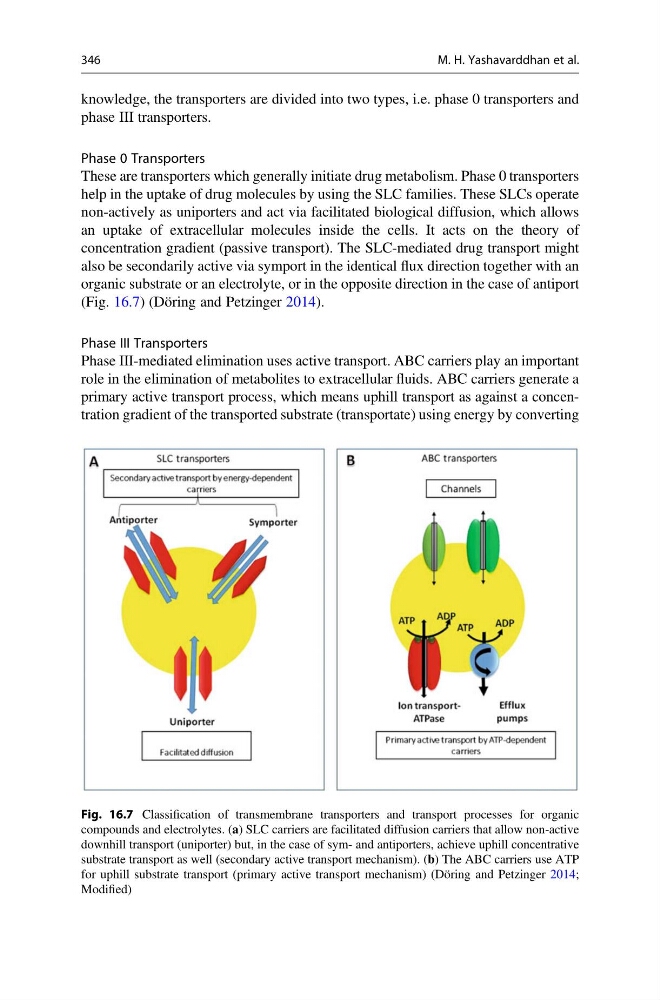
These are transporters which generally initiate drug metabolism. Phase 0 transporters
help in the uptake of drug molecules by using the SLC families. These SLCs operate
non-actively as uniporters and act via facilitated biological diffusion, which allows
an uptake of extracellular molecules inside the cells. It acts on the theory of
concentration gradient (passive transport). The SLC-mediated drug transport might
also be secondarily active via symport in the identical flux direction together with an
organic substrate or an electrolyte, or in the opposite direction in the case of antiport
(Fig. 16.7) (Döring and Petzinger 2014).
Phase III Transporters
Phase III-mediated elimination uses active transport. ABC carriers play an important
role in the elimination of metabolites to extracellular fluids. ABC carriers generate a
primary active transport process, which means uphill transport as against a concentration gradient of the transported substrate (transportate) using energy by converting
Fig. 16.7 Classification of transmembrane transporters and transport processes for organic
compounds and electrolytes. (a) SLC carriers are facilitated diffusion carriers that allow non-active
downhill transport (uniporter) but, in the case of sym- and antiporters, achieve uphill concentrative
substrate transport as well (secondary active transport mechanism). (b) The ABC carriers use ATP
for uphill substrate transport (primary active transport mechanism) (Döring and Petzinger 2014;
Modified)
346
M. H. Yashavarddhan et al.
phase III transporters.
Phase 0 Transporters
These are transporters which generally initiate drug metabolism. Phase 0 transporters
help in the uptake of drug molecules by using the SLC families. These SLCs operate
non-actively as uniporters and act via facilitated biological diffusion, which allows
an uptake of extracellular molecules inside the cells. It acts on the theory of
concentration gradient (passive transport). The SLC-mediated drug transport might
also be secondarily active via symport in the identical flux direction together with an
organic substrate or an electrolyte, or in the opposite direction in the case of antiport
(Fig. 16.7) (Döring and Petzinger 2014).
Phase III Transporters
Phase III-mediated elimination uses active transport. ABC carriers play an important
role in the elimination of metabolites to extracellular fluids. ABC carriers generate a
primary active transport process, which means uphill transport as against a concentration gradient of the transported substrate (transportate) using energy by converting
Fig. 16.7 Classification of transmembrane transporters and transport processes for organic
compounds and electrolytes. (a) SLC carriers are facilitated diffusion carriers that allow non-active
downhill transport (uniporter) but, in the case of sym- and antiporters, achieve uphill concentrative
substrate transport as well (secondary active transport mechanism). (b) The ABC carriers use ATP
for uphill substrate transport (primary active transport mechanism) (Döring and Petzinger 2014;
Modified)
346
M. H. Yashavarddhan et al.