

The common drug which undergoes sulfation is paracetamol. But as described,
only 40% of it is metabolized due to sulfation (Schonborn and Gwinnutt 2010).
16.3.2.3 Phase 0 and Phase III Concept or Transporters
The concept of two phase biotransformation reaction given by Professor RT William
has been extended to four phases with transporters. Transporters guide the
xenobiotics, drugs and their metabolites in entering and excreting out of the cells.
In general, the xenobiotics or drugs are not able to overcome the phospholipid
membrane barrier. Thus, these transporters help and guide the xenobiotics and
drugs to overcome the phospholipid barrier. These transporters belong to two main
clusters of transporter families, i.e. solute carrier (SLC) and the ATP binding cassette
(ABC) carriers (Döring and Petzinger 2014).
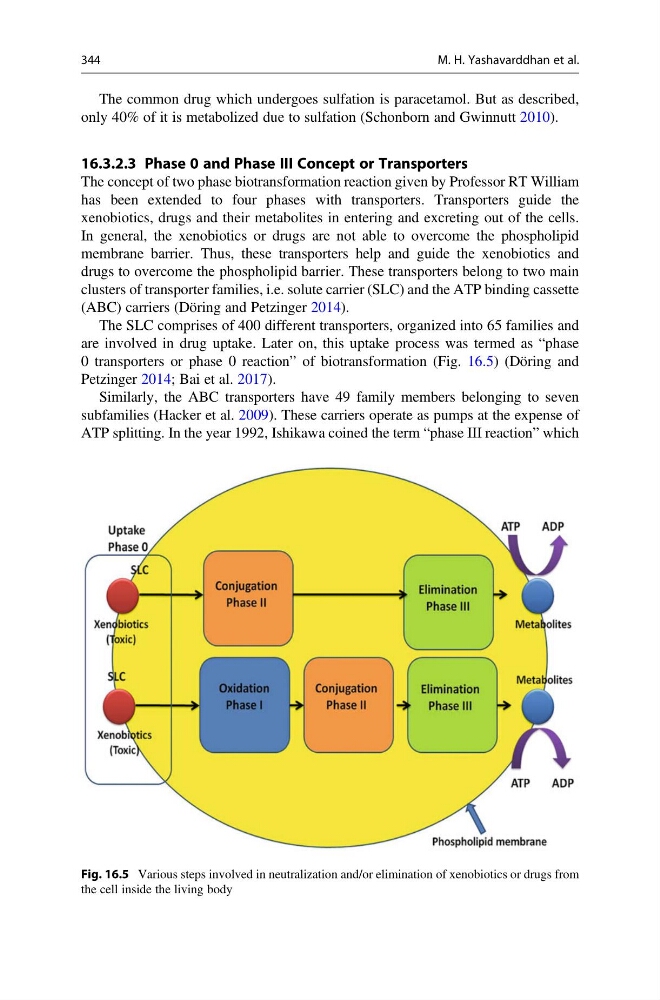
The SLC comprises of 400 different transporters, organized into 65 families and
are involved in drug uptake. Later on, this uptake process was termed as “phase
0 transporters or phase 0 reaction” of biotransformation (Fig. 16.5) (Döring and
Petzinger 2014; Bai et al. 2017).
Similarly, the ABC transporters have 49 family members belonging to seven
subfamilies (Hacker et al. 2009). These carriers operate as pumps at the expense of
ATP splitting. In the year 1992, Ishikawa coined the term “phase III reaction” which
Fig. 16.5 Various steps involved in neutralization and/or elimination of xenobiotics or drugs from
the cell inside the living body
344
M. H. Yashavarddhan et al.
only 40% of it is metabolized due to sulfation (Schonborn and Gwinnutt 2010).
16.3.2.3 Phase 0 and Phase III Concept or Transporters
The concept of two phase biotransformation reaction given by Professor RT William
has been extended to four phases with transporters. Transporters guide the
xenobiotics, drugs and their metabolites in entering and excreting out of the cells.
In general, the xenobiotics or drugs are not able to overcome the phospholipid
membrane barrier. Thus, these transporters help and guide the xenobiotics and
drugs to overcome the phospholipid barrier. These transporters belong to two main
clusters of transporter families, i.e. solute carrier (SLC) and the ATP binding cassette
(ABC) carriers (Döring and Petzinger 2014).
The SLC comprises of 400 different transporters, organized into 65 families and
are involved in drug uptake. Later on, this uptake process was termed as “phase
0 transporters or phase 0 reaction” of biotransformation (Fig. 16.5) (Döring and
Petzinger 2014; Bai et al. 2017).
Similarly, the ABC transporters have 49 family members belonging to seven
subfamilies (Hacker et al. 2009). These carriers operate as pumps at the expense of
ATP splitting. In the year 1992, Ishikawa coined the term “phase III reaction” which
Fig. 16.5 Various steps involved in neutralization and/or elimination of xenobiotics or drugs from
the cell inside the living body
344
M. H. Yashavarddhan et al.