

The substrate having nitrogen, oxygen, or sulfur bond is the site for the
glucuronidation reactions and is applied to a wide array of xenobiotics as well as
endogenous substances, such as thyroid hormones, steroid hormones, and bilirubin,
etc. In glucuronidation reaction pathway, the conjugates xenobiotics are at a high
capacity and the conjugation usually decreases the level of toxicity. However, there
are some notable exceptions, for example, carcinogenic substances. These
conjugates are generally hydrophilic in nature and are eliminated out by kidney or
bile, depending upon the size of the conjugate (David et al. 2005; Jancova et al.
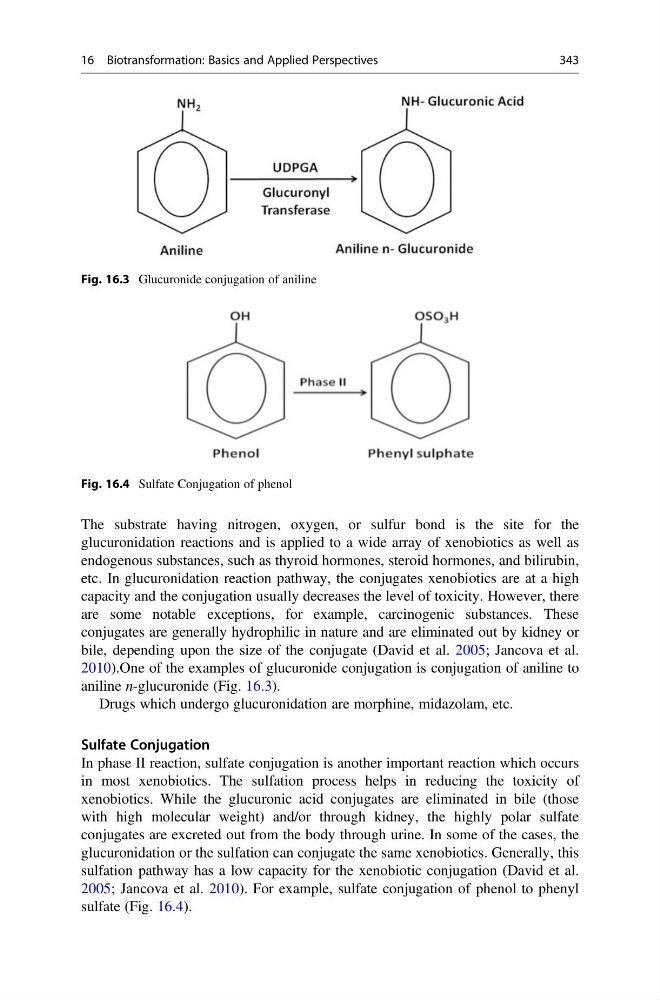
2010).One of the examples of glucuronide conjugation is conjugation of aniline to
aniline n-glucuronide (Fig. 16.3).
Drugs which undergo glucuronidation are morphine, midazolam, etc.
Sulfate Conjugation
In phase II reaction, sulfate conjugation is another important reaction which occurs
in most xenobiotics. The sulfation process helps in reducing the toxicity of
xenobiotics. While the glucuronic acid conjugates are eliminated in bile (those
with high molecular weight) and/or through kidney, the highly polar sulfate
conjugates are excreted out from the body through urine. In some of the cases, the
glucuronidation or the sulfation can conjugate the same xenobiotics. Generally, this
sulfation pathway has a low capacity for the xenobiotic conjugation (David et al.
2005; Jancova et al. 2010). For example, sulfate conjugation of phenol to phenyl
sulfate (Fig. 16.4).
Fig. 16.3 Glucuronide conjugation of aniline
Fig. 16.4 Sulfate Conjugation of phenol
16 Biotransformation: Basics and Applied Perspectives
343
glucuronidation reactions and is applied to a wide array of xenobiotics as well as
endogenous substances, such as thyroid hormones, steroid hormones, and bilirubin,
etc. In glucuronidation reaction pathway, the conjugates xenobiotics are at a high
capacity and the conjugation usually decreases the level of toxicity. However, there
are some notable exceptions, for example, carcinogenic substances. These
conjugates are generally hydrophilic in nature and are eliminated out by kidney or
bile, depending upon the size of the conjugate (David et al. 2005; Jancova et al.
2010).One of the examples of glucuronide conjugation is conjugation of aniline to
aniline n-glucuronide (Fig. 16.3).
Drugs which undergo glucuronidation are morphine, midazolam, etc.
Sulfate Conjugation
In phase II reaction, sulfate conjugation is another important reaction which occurs
in most xenobiotics. The sulfation process helps in reducing the toxicity of
xenobiotics. While the glucuronic acid conjugates are eliminated in bile (those
with high molecular weight) and/or through kidney, the highly polar sulfate
conjugates are excreted out from the body through urine. In some of the cases, the
glucuronidation or the sulfation can conjugate the same xenobiotics. Generally, this
sulfation pathway has a low capacity for the xenobiotic conjugation (David et al.
2005; Jancova et al. 2010). For example, sulfate conjugation of phenol to phenyl
sulfate (Fig. 16.4).
Fig. 16.3 Glucuronide conjugation of aniline
Fig. 16.4 Sulfate Conjugation of phenol
16 Biotransformation: Basics and Applied Perspectives
343