

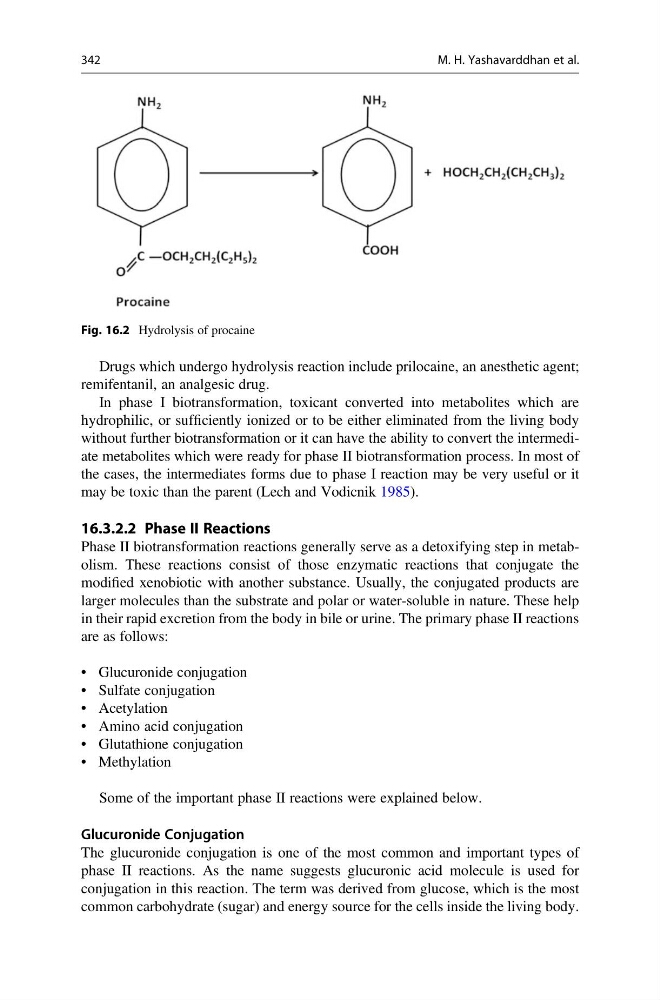
Drugs which undergo hydrolysis reaction include prilocaine, an anesthetic agent;
remifentanil, an analgesic drug.
In phase I biotransformation, toxicant converted into metabolites which are
hydrophilic, or sufficiently ionized or to be either eliminated from the living body
without further biotransformation or it can have the ability to convert the intermediate metabolites which were ready for phase II biotransformation process. In most of
the cases, the intermediates forms due to phase I reaction may be very useful or it
may be toxic than the parent (Lech and Vodicnik 1985).
16.3.2.2 Phase II Reactions
Phase II biotransformation reactions generally serve as a detoxifying step in metabolism. These reactions consist of those enzymatic reactions that conjugate the
modified xenobiotic with another substance. Usually, the conjugated products are
larger molecules than the substrate and polar or water-soluble in nature. These help
in their rapid excretion from the body in bile or urine. The primary phase II reactions
are as follows:
• Glucuronide conjugation
• Sulfate conjugation
• Acetylation
• Amino acid conjugation
• Glutathione conjugation
• Methylation
Some of the important phase II reactions were explained below.
Glucuronide Conjugation
The glucuronide conjugation is one of the most common and important types of
phase II reactions. As the name suggests glucuronic acid molecule is used for
conjugation in this reaction. The term was derived from glucose, which is the most
common carbohydrate (sugar) and energy source for the cells inside the living body.
Fig. 16.2 Hydrolysis of procaine
342
M. H. Yashavarddhan et al.
remifentanil, an analgesic drug.
In phase I biotransformation, toxicant converted into metabolites which are
hydrophilic, or sufficiently ionized or to be either eliminated from the living body
without further biotransformation or it can have the ability to convert the intermediate metabolites which were ready for phase II biotransformation process. In most of
the cases, the intermediates forms due to phase I reaction may be very useful or it
may be toxic than the parent (Lech and Vodicnik 1985).
16.3.2.2 Phase II Reactions
Phase II biotransformation reactions generally serve as a detoxifying step in metabolism. These reactions consist of those enzymatic reactions that conjugate the
modified xenobiotic with another substance. Usually, the conjugated products are
larger molecules than the substrate and polar or water-soluble in nature. These help
in their rapid excretion from the body in bile or urine. The primary phase II reactions
are as follows:
• Glucuronide conjugation
• Sulfate conjugation
• Acetylation
• Amino acid conjugation
• Glutathione conjugation
• Methylation
Some of the important phase II reactions were explained below.
Glucuronide Conjugation
The glucuronide conjugation is one of the most common and important types of
phase II reactions. As the name suggests glucuronic acid molecule is used for
conjugation in this reaction. The term was derived from glucose, which is the most
common carbohydrate (sugar) and energy source for the cells inside the living body.
Fig. 16.2 Hydrolysis of procaine
342
M. H. Yashavarddhan et al.