

efficiently uptake the organic contaminants as a source of carbon. Some earlier
studies have reported toxicological impacts of carbamazepine on microalgae and
its removal (Zhang et al. 2012a, b; Matamoros et al. 2016). Xiong et al. (2017a, b)
reported that Chlamydomonas mexicana can co-metabolize the ciprofloxacin and
increase the rate of degradation from 13% to 56% within 11 days. Moreover, a study
reported that 7-amino acid was completely removed by the process of hydrolysis,
photolysis, and adsorption on the surface of microalgae (Guo et al. 2016). Sulfamethoxazole can be removed by algal species (e.g., Nannochloris) which is rarely
degradable by bacteria and fungi (Bai and Acharya 2016).
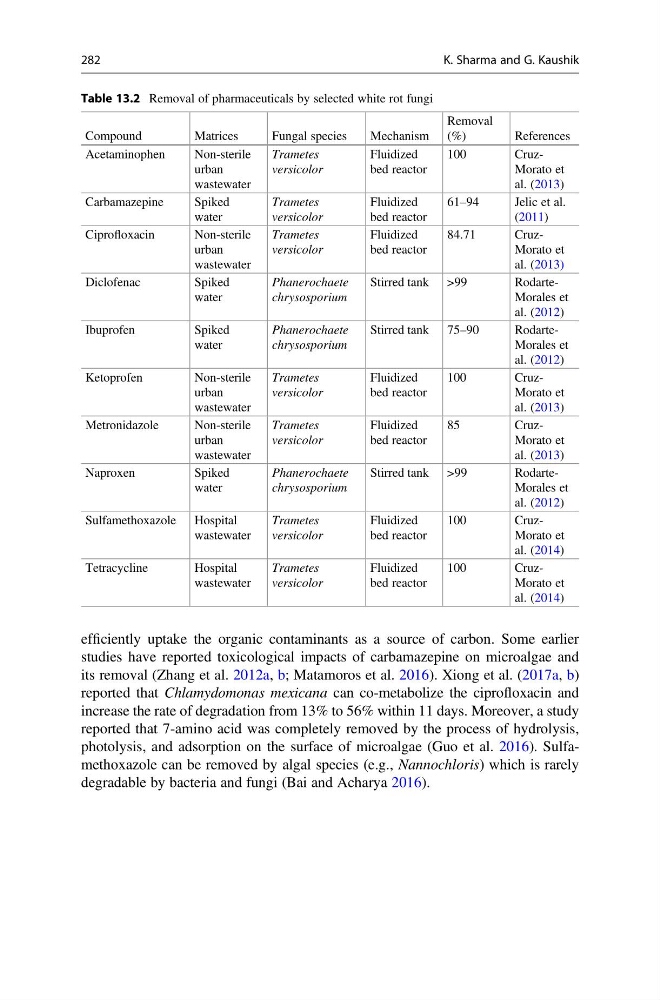
Table 13.2 Removal of pharmaceuticals by selected white rot fungi
Compound
Matrices
Fungal species
Mechanism
Removal
(%)
References
Acetaminophen
Non-sterile
urban
wastewater
Trametes
versicolor
Fluidized
bed reactor
100
CruzMorato et
al. (2013)
Carbamazepine
Spiked
water
Trametes
versicolor
Fluidized
bed reactor
61–94
Jelic et al.
(2011)
Ciprofloxacin
Non-sterile
urban
wastewater
Trametes
versicolor
Fluidized
bed reactor
84.71
CruzMorato et
al. (2013)
Diclofenac
Spiked
water
Phanerochaete
chrysosporium
Stirred tank >99
RodarteMorales et
al. (2012)
Ibuprofen
Spiked
water
Phanerochaete
chrysosporium
Stirred tank 75–90
RodarteMorales et
al. (2012)
Ketoprofen
Non-sterile
urban
wastewater
Trametes
versicolor
Fluidized
bed reactor
100
CruzMorato et
al. (2013)
Metronidazole
Non-sterile
urban
wastewater
Trametes
versicolor
Fluidized
bed reactor
85
CruzMorato et
al. (2013)
Naproxen
Spiked
water
Phanerochaete
chrysosporium
Stirred tank >99
RodarteMorales et
al. (2012)
Sulfamethoxazole Hospital
wastewater
Trametes
versicolor
Fluidized
bed reactor
100
CruzMorato et
al. (2014)
Tetracycline
Hospital
wastewater
Trametes
versicolor
Fluidized
bed reactor
100
CruzMorato et
al. (2014)
282
K. Sharma and G. Kaushik
studies have reported toxicological impacts of carbamazepine on microalgae and
its removal (Zhang et al. 2012a, b; Matamoros et al. 2016). Xiong et al. (2017a, b)
reported that Chlamydomonas mexicana can co-metabolize the ciprofloxacin and
increase the rate of degradation from 13% to 56% within 11 days. Moreover, a study
reported that 7-amino acid was completely removed by the process of hydrolysis,
photolysis, and adsorption on the surface of microalgae (Guo et al. 2016). Sulfamethoxazole can be removed by algal species (e.g., Nannochloris) which is rarely
degradable by bacteria and fungi (Bai and Acharya 2016).
Table 13.2 Removal of pharmaceuticals by selected white rot fungi
Compound
Matrices
Fungal species
Mechanism
Removal
(%)
References
Acetaminophen
Non-sterile
urban
wastewater
Trametes
versicolor
Fluidized
bed reactor
100
CruzMorato et
al. (2013)
Carbamazepine
Spiked
water
Trametes
versicolor
Fluidized
bed reactor
61–94
Jelic et al.
(2011)
Ciprofloxacin
Non-sterile
urban
wastewater
Trametes
versicolor
Fluidized
bed reactor
84.71
CruzMorato et
al. (2013)
Diclofenac
Spiked
water
Phanerochaete
chrysosporium
Stirred tank >99
RodarteMorales et
al. (2012)
Ibuprofen
Spiked
water
Phanerochaete
chrysosporium
Stirred tank 75–90
RodarteMorales et
al. (2012)
Ketoprofen
Non-sterile
urban
wastewater
Trametes
versicolor
Fluidized
bed reactor
100
CruzMorato et
al. (2013)
Metronidazole
Non-sterile
urban
wastewater
Trametes
versicolor
Fluidized
bed reactor
85
CruzMorato et
al. (2013)
Naproxen
Spiked
water
Phanerochaete
chrysosporium
Stirred tank >99
RodarteMorales et
al. (2012)
Sulfamethoxazole Hospital
wastewater
Trametes
versicolor
Fluidized
bed reactor
100
CruzMorato et
al. (2014)
Tetracycline
Hospital
wastewater
Trametes
versicolor
Fluidized
bed reactor
100
CruzMorato et
al. (2014)
282
K. Sharma and G. Kaushik