

13.6 Strategies for Future Research
Efficient treatment of pharmaceutical waste is a huge challenge because of their
complex structures, hazardous characteristics. Due to their poor disposal techniques
in environment drugs are released to municipal wastewater systems. Thus it creates
the potential threat by addition of increased level of antibiotics in natural systems.
Pharmaceutical active compounds cause their risk to the ecosystem by their constant
accumulation and the probability to grow pharmaceutical resistant microbial strains.
So, it is very essential to protect environmental matrices from the discharge of
pharmaceutical waste. Many wastewater treatment technologies are not adequate
to degrade wastewater. For effective management there are five main strategies:
planning, organizing, leading, coordinating, and monitoring. However, the waste
management process includes various steps such as segregation, collection of waste,
transportation, storage, disposal, waste minimization, and reuse (Townend and
Cheeseman 2005).
The most efficient strategy for pharmaceutical waste management is zero discharge approach. It is a green process which focuses on no generation of any waste.
Although zero discharge of waste is very difficult the production of the pharmaceutical compounds by green technology which is called as green chemistry approach is
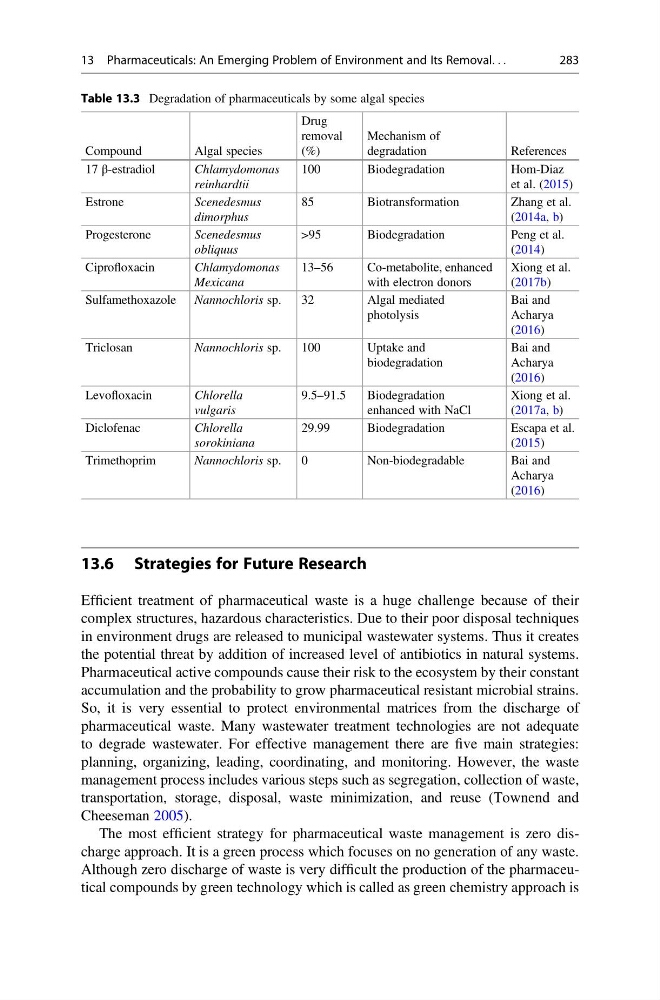
Table 13.3 Degradation of pharmaceuticals by some algal species
Compound
Algal species
Drug
removal
(%)
Mechanism of
degradation
References
17 β-estradiol
Chlamydomonas
reinhardtii
100
Biodegradation
Hom-Diaz
et al. (2015)
Estrone
Scenedesmus
dimorphus
85
Biotransformation
Zhang et al.
(2014a, b)
Progesterone
Scenedesmus
obliquus
>95
Biodegradation
Peng et al.
(2014)
Ciprofloxacin
Chlamydomonas
Mexicana
13–56
Co-metabolite, enhanced
with electron donors
Xiong et al.
(2017b)
Sulfamethoxazole Nannochloris sp.
32
Algal mediated
photolysis
Bai and
Acharya
(2016)
Triclosan
Nannochloris sp.
100
Uptake and
biodegradation
Bai and
Acharya
(2016)
Levofloxacin
Chlorella
vulgaris
9.5–91.5
Biodegradation
enhanced with NaCl
Xiong et al.
(2017a, b)
Diclofenac
Chlorella
sorokiniana
29.99
Biodegradation
Escapa et al.
(2015)
Trimethoprim
Nannochloris sp.
0
Non-biodegradable
Bai and
Acharya
(2016)
13 Pharmaceuticals: An Emerging Problem of Environment and Its Removal. . .
283
Efficient treatment of pharmaceutical waste is a huge challenge because of their
complex structures, hazardous characteristics. Due to their poor disposal techniques
in environment drugs are released to municipal wastewater systems. Thus it creates
the potential threat by addition of increased level of antibiotics in natural systems.
Pharmaceutical active compounds cause their risk to the ecosystem by their constant
accumulation and the probability to grow pharmaceutical resistant microbial strains.
So, it is very essential to protect environmental matrices from the discharge of
pharmaceutical waste. Many wastewater treatment technologies are not adequate
to degrade wastewater. For effective management there are five main strategies:
planning, organizing, leading, coordinating, and monitoring. However, the waste
management process includes various steps such as segregation, collection of waste,
transportation, storage, disposal, waste minimization, and reuse (Townend and
Cheeseman 2005).
The most efficient strategy for pharmaceutical waste management is zero discharge approach. It is a green process which focuses on no generation of any waste.
Although zero discharge of waste is very difficult the production of the pharmaceutical compounds by green technology which is called as green chemistry approach is
Table 13.3 Degradation of pharmaceuticals by some algal species
Compound
Algal species
Drug
removal
(%)
Mechanism of
degradation
References
17 β-estradiol
Chlamydomonas
reinhardtii
100
Biodegradation
Hom-Diaz
et al. (2015)
Estrone
Scenedesmus
dimorphus
85
Biotransformation
Zhang et al.
(2014a, b)
Progesterone
Scenedesmus
obliquus
>95
Biodegradation
Peng et al.
(2014)
Ciprofloxacin
Chlamydomonas
Mexicana
13–56
Co-metabolite, enhanced
with electron donors
Xiong et al.
(2017b)
Sulfamethoxazole Nannochloris sp.
32
Algal mediated
photolysis
Bai and
Acharya
(2016)
Triclosan
Nannochloris sp.
100
Uptake and
biodegradation
Bai and
Acharya
(2016)
Levofloxacin
Chlorella
vulgaris
9.5–91.5
Biodegradation
enhanced with NaCl
Xiong et al.
(2017a, b)
Diclofenac
Chlorella
sorokiniana
29.99
Biodegradation
Escapa et al.
(2015)
Trimethoprim
Nannochloris sp.
0
Non-biodegradable
Bai and
Acharya
(2016)
13 Pharmaceuticals: An Emerging Problem of Environment and Its Removal. . .
283