

immunosensor (Shankaran et al. 2007; Bhatta et al. 2012). The development of
immunosensor for bacteria and pathogen detection has gained a great deal of
attention due to its application in the point-of-care measurement (POC) (Braiek
et al. 2012; Holford et al. 2012).
9.2.4.5 Nanosensor
Nanosensor is defined as a modified version of a biosensor or chemical sensor
employing nanomaterial in an analytical device, helping in detection of toxic
contaminants in environmental toxicant at very sensitive levels. Nanomaterial is
defined as material with at least one dimension smaller than 100 nm. Owing to their
incredibly small size, nanomaterials can be very versatile in many terms of their
detection and monitoring. Nanoparticle-based biosensors are considered as potential
tools for rapid, specific, and highly sensitive detection of the analyte of interest
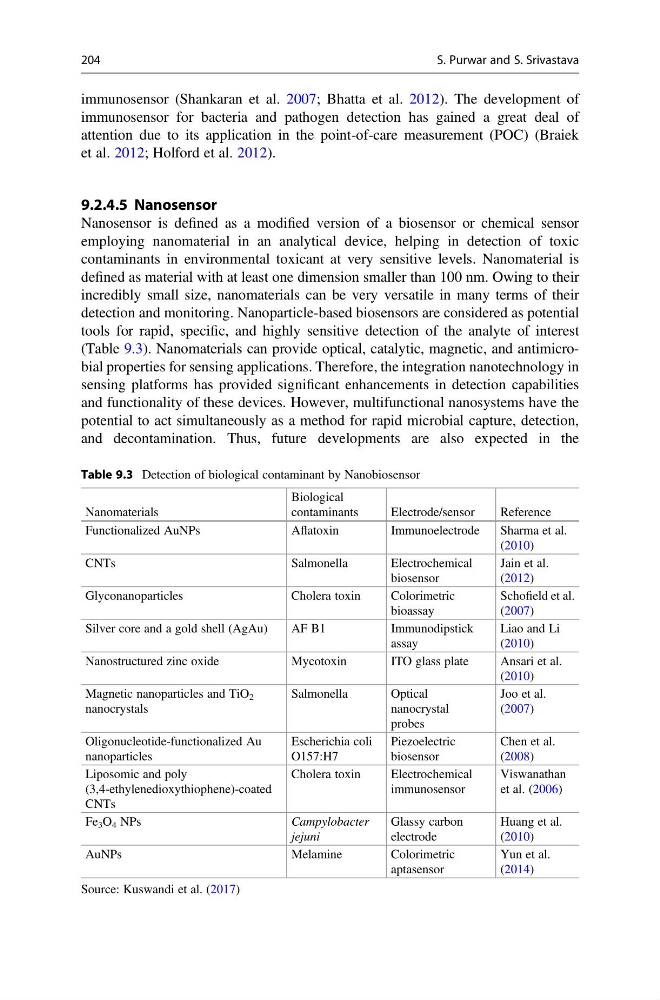
(Table 9.3). Nanomaterials can provide optical, catalytic, magnetic, and antimicrobial properties for sensing applications. Therefore, the integration nanotechnology in
sensing platforms has provided significant enhancements in detection capabilities
and functionality of these devices. However, multifunctional nanosystems have the
potential to act simultaneously as a method for rapid microbial capture, detection,
and decontamination. Thus, future developments are also expected in the
Table 9.3 Detection of biological contaminant by Nanobiosensor
Nanomaterials
Biological
contaminants
Electrode/sensor
Reference
Functionalized AuNPs
Aflatoxin
Immunoelectrode
Sharma et al.
(2010)
CNTs
Salmonella
Electrochemical
biosensor
Jain et al.
(2012)
Glyconanoparticles
Cholera toxin
Colorimetric
bioassay
Schofield et al.
(2007)
Silver core and a gold shell (AgAu)
AF B1
Immunodipstick
assay
Liao and Li
(2010)
Nanostructured zinc oxide
Mycotoxin
ITO glass plate
Ansari et al.
(2010)
Magnetic nanoparticles and TiO 2
nanocrystals
Salmonella
Optical
nanocrystal
probes
Joo et al.
(2007)
Oligonucleotide-functionalized Au
nanoparticles
Escherichia coli
O157:H7
Piezoelectric
biosensor
Chen et al.
(2008)
Liposomic and poly
(3,4-ethylenedioxythiophene)-coated
CNTs
Cholera toxin
Electrochemical
immunosensor
Viswanathan
et al. (2006)
Fe 3 O 4 NPs
Campylobacter
jejuni
Glassy carbon
electrode
Huang et al.
(2010)
AuNPs
Melamine
Colorimetric
aptasensor
Yun et al.
(2014)
Source: Kuswandi et al. (2017)
204
S. Purwar and S. Srivastava
immunosensor for bacteria and pathogen detection has gained a great deal of
attention due to its application in the point-of-care measurement (POC) (Braiek
et al. 2012; Holford et al. 2012).
9.2.4.5 Nanosensor
Nanosensor is defined as a modified version of a biosensor or chemical sensor
employing nanomaterial in an analytical device, helping in detection of toxic
contaminants in environmental toxicant at very sensitive levels. Nanomaterial is
defined as material with at least one dimension smaller than 100 nm. Owing to their
incredibly small size, nanomaterials can be very versatile in many terms of their
detection and monitoring. Nanoparticle-based biosensors are considered as potential
tools for rapid, specific, and highly sensitive detection of the analyte of interest
(Table 9.3). Nanomaterials can provide optical, catalytic, magnetic, and antimicrobial properties for sensing applications. Therefore, the integration nanotechnology in
sensing platforms has provided significant enhancements in detection capabilities
and functionality of these devices. However, multifunctional nanosystems have the
potential to act simultaneously as a method for rapid microbial capture, detection,
and decontamination. Thus, future developments are also expected in the
Table 9.3 Detection of biological contaminant by Nanobiosensor
Nanomaterials
Biological
contaminants
Electrode/sensor
Reference
Functionalized AuNPs
Aflatoxin
Immunoelectrode
Sharma et al.
(2010)
CNTs
Salmonella
Electrochemical
biosensor
Jain et al.
(2012)
Glyconanoparticles
Cholera toxin
Colorimetric
bioassay
Schofield et al.
(2007)
Silver core and a gold shell (AgAu)
AF B1
Immunodipstick
assay
Liao and Li
(2010)
Nanostructured zinc oxide
Mycotoxin
ITO glass plate
Ansari et al.
(2010)
Magnetic nanoparticles and TiO 2
nanocrystals
Salmonella
Optical
nanocrystal
probes
Joo et al.
(2007)
Oligonucleotide-functionalized Au
nanoparticles
Escherichia coli
O157:H7
Piezoelectric
biosensor
Chen et al.
(2008)
Liposomic and poly
(3,4-ethylenedioxythiophene)-coated
CNTs
Cholera toxin
Electrochemical
immunosensor
Viswanathan
et al. (2006)
Fe 3 O 4 NPs
Campylobacter
jejuni
Glassy carbon
electrode
Huang et al.
(2010)
AuNPs
Melamine
Colorimetric
aptasensor
Yun et al.
(2014)
Source: Kuswandi et al. (2017)
204
S. Purwar and S. Srivastava