

can both be excited with a 405 nm LED, and the two emission wavelengths can be
detected separately. The proposed optical dual sensor can be used for the simultaneous sensing of carbon di oxide concentrations in environmental applications.
9.2.4.4 Immunosensor
An antibody-based biosensor was applied for the first time to detection in the 1950s,
opening the doors to the possibility of immunodiagnosis (Donahue and Albitar
2010). Since then, there have been vigorous efforts made to develop immunosensor
that is composed of antigen/antibody as bioreceptor as a tool for clinical diagnostics
(Conroy et al. 2009; Orazio 2011). Hence, an immunosensor is highly specific,
stable, and versatile. The specificity of an antibody toward the binding side of its
antigen is a function of its amino acids (Fowler et al. 2008). Those days, there are
two types of detection methods, which are frequently used in immunosensor, that is,
optical and electrochemical. However optical detection transduction method has
suffered from poor sensitivity when coupled with radioimmunoassay, the short
half-life of radioactive agents, concerns of health hazards, and disposal problems.
Electrochemical detection overcomes problems associated with other modes of
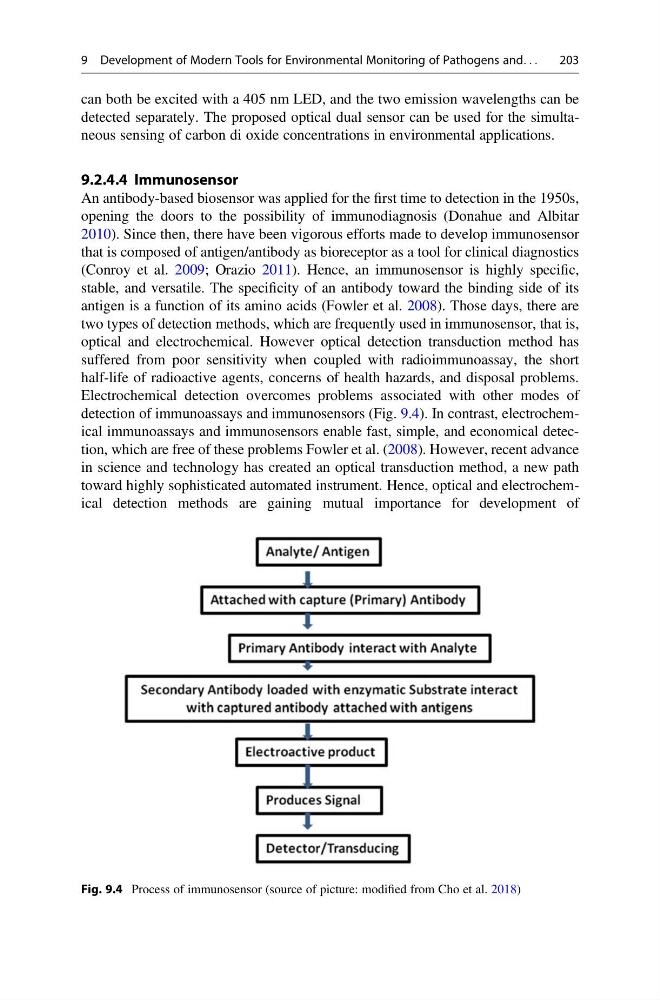
detection of immunoassays and immunosensors (Fig. 9.4). In contrast, electrochemical immunoassays and immunosensors enable fast, simple, and economical detection, which are free of these problems Fowler et al. (2008). However, recent advance
in science and technology has created an optical transduction method, a new path
toward highly sophisticated automated instrument. Hence, optical and electrochemical detection methods are gaining mutual importance for development of
Fig. 9.4 Process of immunosensor (source of picture: modified from Cho et al. 2018)
9 Development of Modern Tools for Environmental Monitoring of Pathogens and. . .
203
detected separately. The proposed optical dual sensor can be used for the simultaneous sensing of carbon di oxide concentrations in environmental applications.
9.2.4.4 Immunosensor
An antibody-based biosensor was applied for the first time to detection in the 1950s,
opening the doors to the possibility of immunodiagnosis (Donahue and Albitar
2010). Since then, there have been vigorous efforts made to develop immunosensor
that is composed of antigen/antibody as bioreceptor as a tool for clinical diagnostics
(Conroy et al. 2009; Orazio 2011). Hence, an immunosensor is highly specific,
stable, and versatile. The specificity of an antibody toward the binding side of its
antigen is a function of its amino acids (Fowler et al. 2008). Those days, there are
two types of detection methods, which are frequently used in immunosensor, that is,
optical and electrochemical. However optical detection transduction method has
suffered from poor sensitivity when coupled with radioimmunoassay, the short
half-life of radioactive agents, concerns of health hazards, and disposal problems.
Electrochemical detection overcomes problems associated with other modes of
detection of immunoassays and immunosensors (Fig. 9.4). In contrast, electrochemical immunoassays and immunosensors enable fast, simple, and economical detection, which are free of these problems Fowler et al. (2008). However, recent advance
in science and technology has created an optical transduction method, a new path
toward highly sophisticated automated instrument. Hence, optical and electrochemical detection methods are gaining mutual importance for development of
Fig. 9.4 Process of immunosensor (source of picture: modified from Cho et al. 2018)
9 Development of Modern Tools for Environmental Monitoring of Pathogens and. . .
203