

exist at all level of microbial remediation—differences in the isolates, their rate of
metabolism, their adaptation, nutrient uptake, and so on. It has been an established
fact that bioinformatics based study helps in reducing the time involved, reduces the
number of steps by in silico based analysis, thereby further reducing the cost factor,
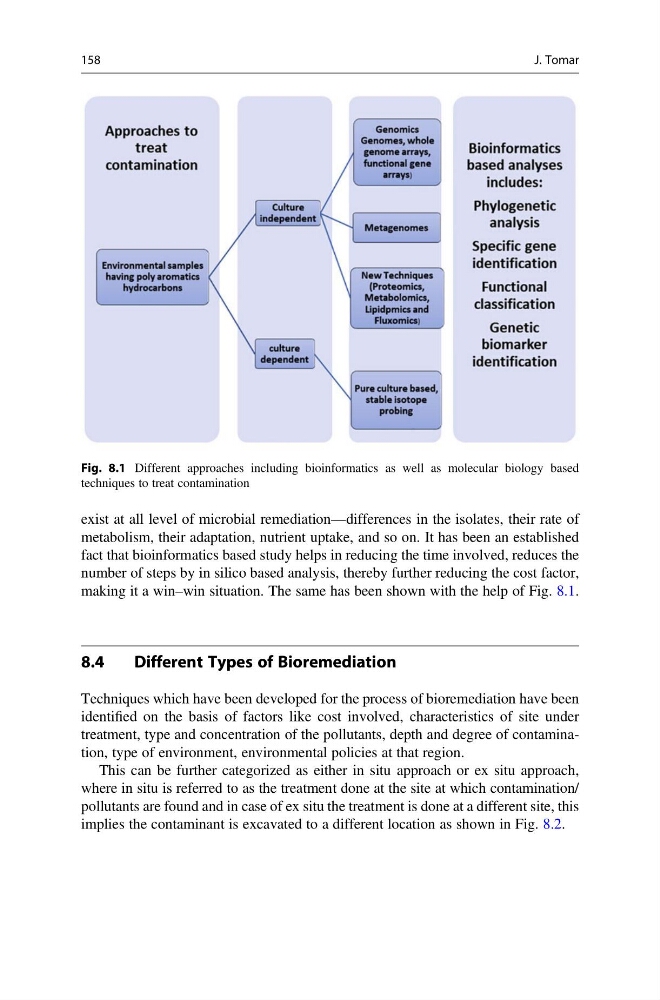
making it a win–win situation. The same has been shown with the help of Fig. 8.1.
8.4
Different Types of Bioremediation
Techniques which have been developed for the process of bioremediation have been
identified on the basis of factors like cost involved, characteristics of site under
treatment, type and concentration of the pollutants, depth and degree of contamination, type of environment, environmental policies at that region.
This can be further categorized as either in situ approach or ex situ approach,
where in situ is referred to as the treatment done at the site at which contamination/
pollutants are found and in case of ex situ the treatment is done at a different site, this
implies the contaminant is excavated to a different location as shown in Fig. 8.2.
Fig. 8.1 Different approaches including bioinformatics as well as molecular biology based
techniques to treat contamination
158
J. Tomar
metabolism, their adaptation, nutrient uptake, and so on. It has been an established
fact that bioinformatics based study helps in reducing the time involved, reduces the
number of steps by in silico based analysis, thereby further reducing the cost factor,
making it a win–win situation. The same has been shown with the help of Fig. 8.1.
8.4
Different Types of Bioremediation
Techniques which have been developed for the process of bioremediation have been
identified on the basis of factors like cost involved, characteristics of site under
treatment, type and concentration of the pollutants, depth and degree of contamination, type of environment, environmental policies at that region.
This can be further categorized as either in situ approach or ex situ approach,
where in situ is referred to as the treatment done at the site at which contamination/
pollutants are found and in case of ex situ the treatment is done at a different site, this
implies the contaminant is excavated to a different location as shown in Fig. 8.2.
Fig. 8.1 Different approaches including bioinformatics as well as molecular biology based
techniques to treat contamination
158
J. Tomar