

oxidation by laccase they become strong oxidizing intermediates to degrade
nonphenolic units and also prevent polymerization of small reactive compounds
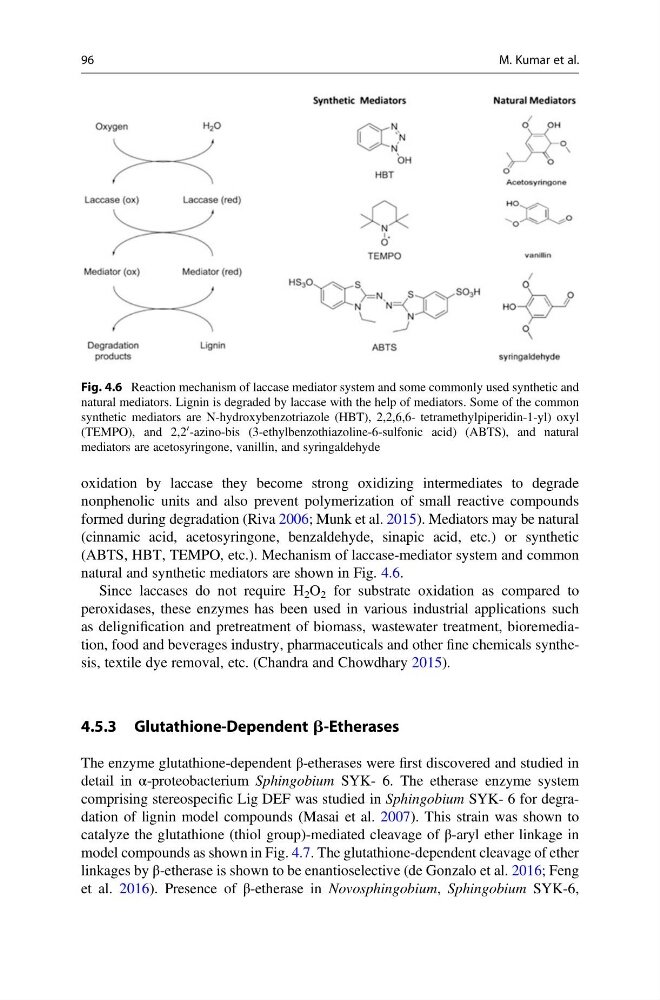
formed during degradation (Riva 2006; Munk et al. 2015). Mediators may be natural
(cinnamic acid, acetosyringone, benzaldehyde, sinapic acid, etc.) or synthetic
(ABTS, HBT, TEMPO, etc.). Mechanism of laccase-mediator system and common
natural and synthetic mediators are shown in Fig. 4.6.
Since laccases do not require H 2 O 2 for substrate oxidation as compared to
peroxidases, these enzymes has been used in various industrial applications such
as delignification and pretreatment of biomass, wastewater treatment, bioremediation, food and beverages industry, pharmaceuticals and other fine chemicals synthesis, textile dye removal, etc. (Chandra and Chowdhary 2015).
4.5.3 Glutathione-Dependent b-Etherases
The enzyme glutathione-dependent β-etherases were first discovered and studied in
detail in α-proteobacterium Sphingobium SYK- 6. The etherase enzyme system
comprising stereospecific Lig DEF was studied in Sphingobium SYK- 6 for degradation of lignin model compounds (Masai et al. 2007). This strain was shown to
catalyze the glutathione (thiol group)-mediated cleavage of β-aryl ether linkage in
model compounds as shown in Fig. 4.7. The glutathione-dependent cleavage of ether
linkages by β-etherase is shown to be enantioselective (de Gonzalo et al. 2016; Feng
et al. 2016). Presence of β-etherase in Novosphingobium, Sphingobium SYK-6,
Fig. 4.6 Reaction mechanism of laccase mediator system and some commonly used synthetic and
natural mediators. Lignin is degraded by laccase with the help of mediators. Some of the common
synthetic mediators are N-hydroxybenzotriazole (HBT), 2,2,6,6- tetramethylpiperidin-1-yl) oxyl
(TEMPO), and 2,2
0 -azino-bis (3-ethylbenzothiazoline-6-sulfonic acid) (ABTS), and natural
mediators are acetosyringone, vanillin, and syringaldehyde
96
M. Kumar et al.
nonphenolic units and also prevent polymerization of small reactive compounds
formed during degradation (Riva 2006; Munk et al. 2015). Mediators may be natural
(cinnamic acid, acetosyringone, benzaldehyde, sinapic acid, etc.) or synthetic
(ABTS, HBT, TEMPO, etc.). Mechanism of laccase-mediator system and common
natural and synthetic mediators are shown in Fig. 4.6.
Since laccases do not require H 2 O 2 for substrate oxidation as compared to
peroxidases, these enzymes has been used in various industrial applications such
as delignification and pretreatment of biomass, wastewater treatment, bioremediation, food and beverages industry, pharmaceuticals and other fine chemicals synthesis, textile dye removal, etc. (Chandra and Chowdhary 2015).
4.5.3 Glutathione-Dependent b-Etherases
The enzyme glutathione-dependent β-etherases were first discovered and studied in
detail in α-proteobacterium Sphingobium SYK- 6. The etherase enzyme system
comprising stereospecific Lig DEF was studied in Sphingobium SYK- 6 for degradation of lignin model compounds (Masai et al. 2007). This strain was shown to
catalyze the glutathione (thiol group)-mediated cleavage of β-aryl ether linkage in
model compounds as shown in Fig. 4.7. The glutathione-dependent cleavage of ether
linkages by β-etherase is shown to be enantioselective (de Gonzalo et al. 2016; Feng
et al. 2016). Presence of β-etherase in Novosphingobium, Sphingobium SYK-6,
Fig. 4.6 Reaction mechanism of laccase mediator system and some commonly used synthetic and
natural mediators. Lignin is degraded by laccase with the help of mediators. Some of the common
synthetic mediators are N-hydroxybenzotriazole (HBT), 2,2,6,6- tetramethylpiperidin-1-yl) oxyl
(TEMPO), and 2,2
0 -azino-bis (3-ethylbenzothiazoline-6-sulfonic acid) (ABTS), and natural
mediators are acetosyringone, vanillin, and syringaldehyde
96
M. Kumar et al.