

Novosphingobium sp. PP1Y, and Thiobacillus denitrificans ATC25259 has been
reviewed (de Gonzalo et al. 2016; Feng et al. 2016).
4.5.4 Superoxide Dismutases
Superoxidases are generally intracellular enzymes that protect cells from oxidative
damage by converting superoxide anions into molecular oxygen and H 2 O 2 . Recently
two extracellular manganese-dependent superoxide dismutases (MnSOD1 and
MnSOD2) have been discovered from Sphingobacterium sp. T2 with lignindegrading properties (Rashid et al. 2015). These two enzymes are shown to be
highly active and can oxidize Organosolv, Kraft lignin, and lignin model substrates
into various compounds. The degradation products were obtained from oxidative
cleavage of aryl-Cα, Cα-Cβ bond, and O-demethylation activity (Rashid et al. 2015).
4.5.5 Catalase-Peroxidases
An extracellular catalase-peroxidase was discovered recently in Amycolatopsis
sp.75iv2 while growing on lignocellulosic substrate. This is a heme-containing
enzyme and showed oxidation of various phenolic model compounds; however,
methylated derivatives were not utilized as substrate (Brown et al. 2011). Further
research is needed to establish the occurrence of catalase-peroxidases in other strains
and their activity to modify polymeric lignin.
4.5.6 Dehydrogenases
The dehydrogenases have been discovered recently in some bacteria capable of
transforming lignin or lignin model compound. The enzyme dehydrogenase from
strain SG61-1 L has been characterized for degradation of ether linkages in lignin
model compound guaiacylglycerol-guaiacyl ether (GGE) and showed very efficient
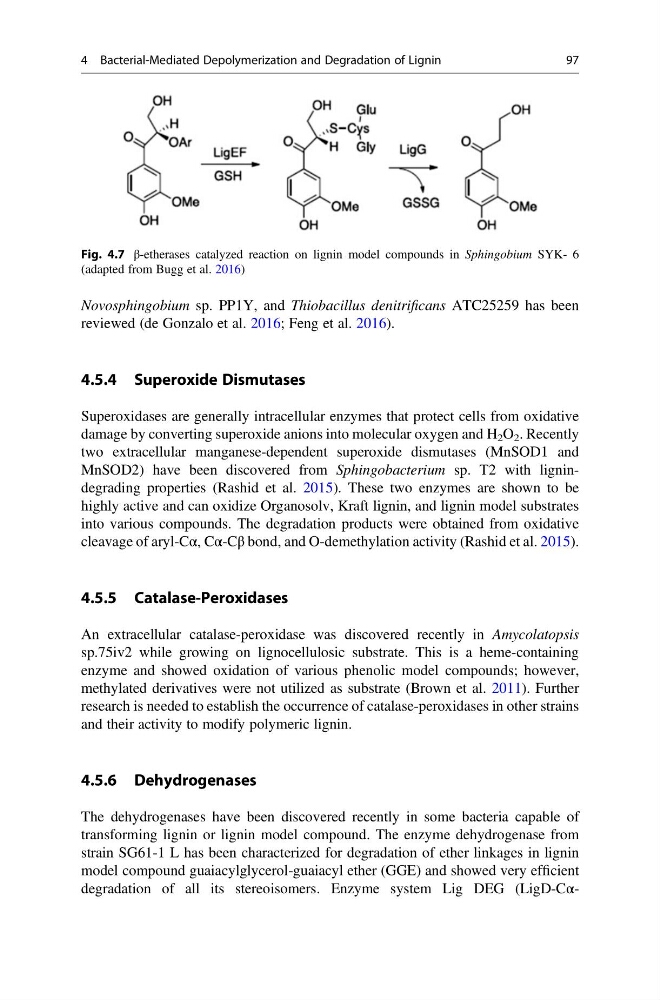
degradation of all its stereoisomers. Enzyme system Lig DEG (LigD-CαFig. 4.7 β-etherases catalyzed reaction on lignin model compounds in Sphingobium SYK- 6
(adapted from Bugg et al. 2016)
4 Bacterial-Mediated Depolymerization and Degradation of Lignin
97
reviewed (de Gonzalo et al. 2016; Feng et al. 2016).
4.5.4 Superoxide Dismutases
Superoxidases are generally intracellular enzymes that protect cells from oxidative
damage by converting superoxide anions into molecular oxygen and H 2 O 2 . Recently
two extracellular manganese-dependent superoxide dismutases (MnSOD1 and
MnSOD2) have been discovered from Sphingobacterium sp. T2 with lignindegrading properties (Rashid et al. 2015). These two enzymes are shown to be
highly active and can oxidize Organosolv, Kraft lignin, and lignin model substrates
into various compounds. The degradation products were obtained from oxidative
cleavage of aryl-Cα, Cα-Cβ bond, and O-demethylation activity (Rashid et al. 2015).
4.5.5 Catalase-Peroxidases
An extracellular catalase-peroxidase was discovered recently in Amycolatopsis
sp.75iv2 while growing on lignocellulosic substrate. This is a heme-containing
enzyme and showed oxidation of various phenolic model compounds; however,
methylated derivatives were not utilized as substrate (Brown et al. 2011). Further
research is needed to establish the occurrence of catalase-peroxidases in other strains
and their activity to modify polymeric lignin.
4.5.6 Dehydrogenases
The dehydrogenases have been discovered recently in some bacteria capable of
transforming lignin or lignin model compound. The enzyme dehydrogenase from
strain SG61-1 L has been characterized for degradation of ether linkages in lignin
model compound guaiacylglycerol-guaiacyl ether (GGE) and showed very efficient
degradation of all its stereoisomers. Enzyme system Lig DEG (LigD-CαFig. 4.7 β-etherases catalyzed reaction on lignin model compounds in Sphingobium SYK- 6
(adapted from Bugg et al. 2016)
4 Bacterial-Mediated Depolymerization and Degradation of Lignin
97