

62
A. Hysa
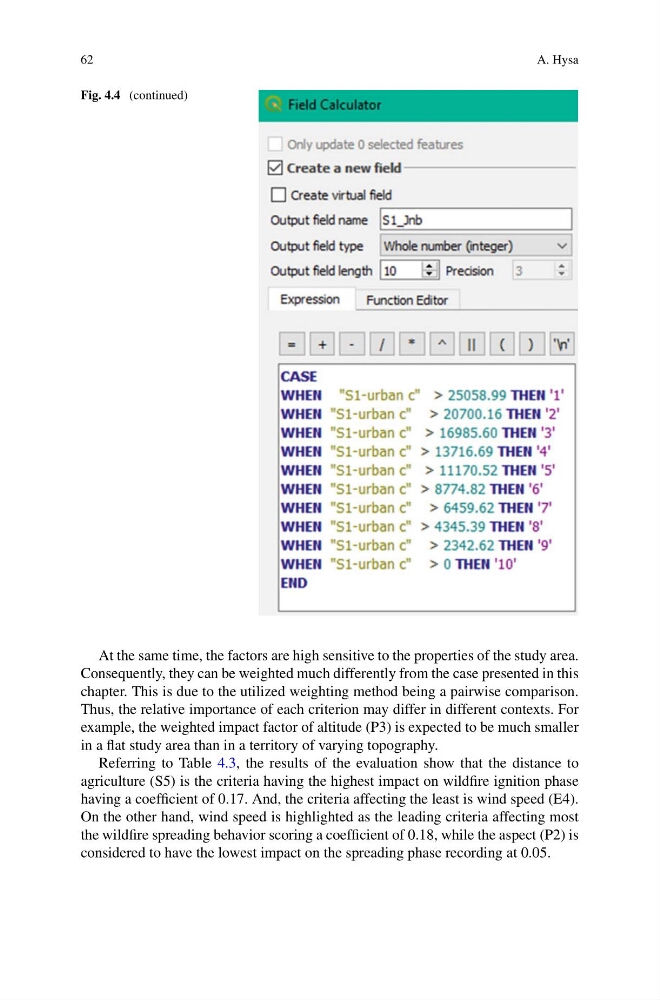
Fig. 4.4 (continued)
At the same time, the factors are high sensitive to the properties of the study area.
Consequently, they can be weighted much differently from the case presented in this
chapter. This is due to the utilized weighting method being a pairwise comparison.
Thus, the relative importance of each criterion may differ in different contexts. For
example, the weighted impact factor of altitude (P3) is expected to be much smaller
in a flat study area than in a territory of varying topography.
Referring to Table 4.3, the results of the evaluation show that the distance to
agriculture (S5) is the criteria having the highest impact on wildfire ignition phase
having a coefficient of 0.17. And, the criteria affecting the least is wind speed (E4).
On the other hand, wind speed is highlighted as the leading criteria affecting most
the wildfire spreading behavior scoring a coefficient of 0.18, while the aspect (P2) is
considered to have the lowest impact on the spreading phase recording at 0.05.
A. Hysa
Fig. 4.4 (continued)
At the same time, the factors are high sensitive to the properties of the study area.
Consequently, they can be weighted much differently from the case presented in this
chapter. This is due to the utilized weighting method being a pairwise comparison.
Thus, the relative importance of each criterion may differ in different contexts. For
example, the weighted impact factor of altitude (P3) is expected to be much smaller
in a flat study area than in a territory of varying topography.
Referring to Table 4.3, the results of the evaluation show that the distance to
agriculture (S5) is the criteria having the highest impact on wildfire ignition phase
having a coefficient of 0.17. And, the criteria affecting the least is wind speed (E4).
On the other hand, wind speed is highlighted as the leading criteria affecting most
the wildfire spreading behavior scoring a coefficient of 0.18, while the aspect (P2) is
considered to have the lowest impact on the spreading phase recording at 0.05.