

226
H. Dwinantoaji et al.
In this case, they approached the local women’s organizations in Kemijen, including
Family Welfare Movement (PKK), Dasa Wisma and Posyandu. Every month, these
women’s organizations held a regular meeting in order to increase knowledge and
educate women in the neighborhood. The board explained the reason they choose the
local women’s organizations as follows: (1) generally, women have a responsibility
to keep their family and children; (2) women also have a responsibility to manage
their family’s finance; (3) women hold a responsibility to keep the cleanness of their
neighborhood (e.g., the person usually throw garbage into the river is a woman); (4)
women usually work to gather neighborhood’s data voluntarily; and (5) empower
women to participate in maintaining the environment in their neighborhood.
Health cadres were built on the PKK. They are selected by their communities
based on a set of characteristics, including educational achievement, how integrated
they are within the community, personality, dedication to service, and willingness to
commit to the time requirements to support services at the integrated health services
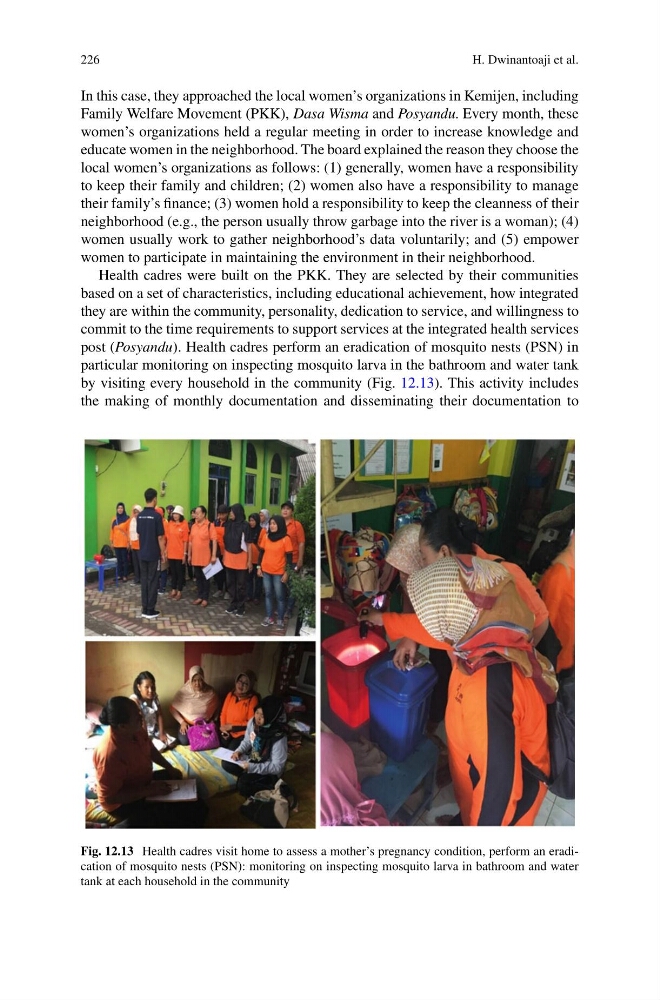
post (Posyandu). Health cadres perform an eradication of mosquito nests (PSN) in
particular monitoring on inspecting mosquito larva in the bathroom and water tank
by visiting every household in the community (Fig. 12.13). This activity includes
the making of monthly documentation and disseminating their documentation to
Fig. 12.13 Health cadres visit home to assess a mother’s pregnancy condition, perform an eradication of mosquito nests (PSN): monitoring on inspecting mosquito larva in bathroom and water
tank at each household in the community
H. Dwinantoaji et al.
In this case, they approached the local women’s organizations in Kemijen, including
Family Welfare Movement (PKK), Dasa Wisma and Posyandu. Every month, these
women’s organizations held a regular meeting in order to increase knowledge and
educate women in the neighborhood. The board explained the reason they choose the
local women’s organizations as follows: (1) generally, women have a responsibility
to keep their family and children; (2) women also have a responsibility to manage
their family’s finance; (3) women hold a responsibility to keep the cleanness of their
neighborhood (e.g., the person usually throw garbage into the river is a woman); (4)
women usually work to gather neighborhood’s data voluntarily; and (5) empower
women to participate in maintaining the environment in their neighborhood.
Health cadres were built on the PKK. They are selected by their communities
based on a set of characteristics, including educational achievement, how integrated
they are within the community, personality, dedication to service, and willingness to
commit to the time requirements to support services at the integrated health services
post (Posyandu). Health cadres perform an eradication of mosquito nests (PSN) in
particular monitoring on inspecting mosquito larva in the bathroom and water tank
by visiting every household in the community (Fig. 12.13). This activity includes
the making of monthly documentation and disseminating their documentation to
Fig. 12.13 Health cadres visit home to assess a mother’s pregnancy condition, perform an eradication of mosquito nests (PSN): monitoring on inspecting mosquito larva in bathroom and water
tank at each household in the community