

12 Climate Change Adaptation Strategies in Primary Health Care
225
include preparation for heat waves, coastal inundation, or rapid urbanization. Hence,
rural people migrating into these settings may face heightened environmental and
health insecurity. In other regions, early monitoring for vector-borne diseases or
waterborne illnesses may be an important role for PHC providers. Primary care may
also have a role in the mitigation of climate change through encouraging environmentally sustainable healthcare services (McMichael et al. 2007; Bell and Towle
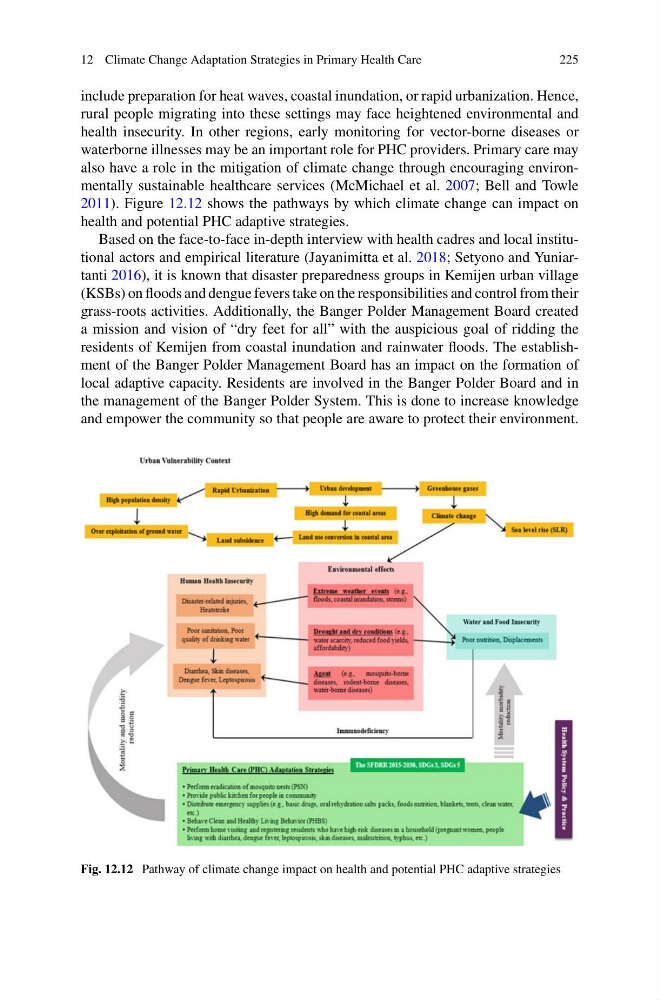
2011). Figure 12.12 shows the pathways by which climate change can impact on
health and potential PHC adaptive strategies.
Based on the face-to-face in-depth interview with health cadres and local institutional actors and empirical literature (Jayanimitta et al. 2018; Setyono and Yuniartanti 2016), it is known that disaster preparedness groups in Kemijen urban village
(KSBs) on floods and dengue fevers take on the responsibilities and control from their
grass-roots activities. Additionally, the Banger Polder Management Board created
a mission and vision of “dry feet for all” with the auspicious goal of ridding the
residents of Kemijen from coastal inundation and rainwater floods. The establishment of the Banger Polder Management Board has an impact on the formation of
local adaptive capacity. Residents are involved in the Banger Polder Board and in
the management of the Banger Polder System. This is done to increase knowledge
and empower the community so that people are aware to protect their environment.
Fig. 12.12 Pathway of climate change impact on health and potential PHC adaptive strategies
225
include preparation for heat waves, coastal inundation, or rapid urbanization. Hence,
rural people migrating into these settings may face heightened environmental and
health insecurity. In other regions, early monitoring for vector-borne diseases or
waterborne illnesses may be an important role for PHC providers. Primary care may
also have a role in the mitigation of climate change through encouraging environmentally sustainable healthcare services (McMichael et al. 2007; Bell and Towle
2011). Figure 12.12 shows the pathways by which climate change can impact on
health and potential PHC adaptive strategies.
Based on the face-to-face in-depth interview with health cadres and local institutional actors and empirical literature (Jayanimitta et al. 2018; Setyono and Yuniartanti 2016), it is known that disaster preparedness groups in Kemijen urban village
(KSBs) on floods and dengue fevers take on the responsibilities and control from their
grass-roots activities. Additionally, the Banger Polder Management Board created
a mission and vision of “dry feet for all” with the auspicious goal of ridding the
residents of Kemijen from coastal inundation and rainwater floods. The establishment of the Banger Polder Management Board has an impact on the formation of
local adaptive capacity. Residents are involved in the Banger Polder Board and in
the management of the Banger Polder System. This is done to increase knowledge
and empower the community so that people are aware to protect their environment.
Fig. 12.12 Pathway of climate change impact on health and potential PHC adaptive strategies