

224
H. Dwinantoaji et al.
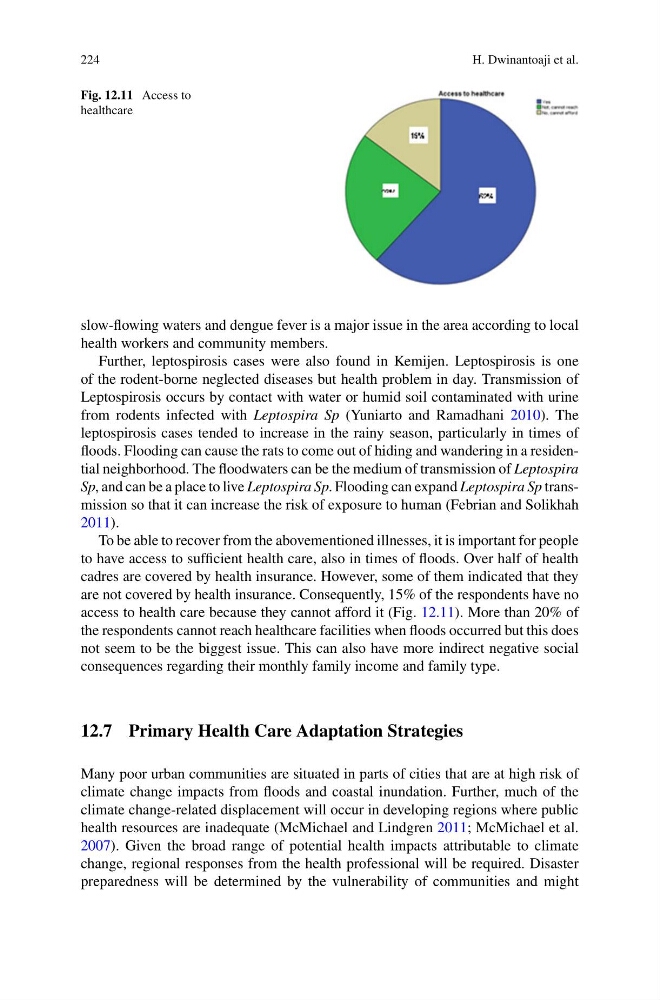
Fig. 12.11 Access to
healthcare
slow-flowing waters and dengue fever is a major issue in the area according to local
health workers and community members.
Further, leptospirosis cases were also found in Kemijen. Leptospirosis is one
of the rodent-borne neglected diseases but health problem in day. Transmission of
Leptospirosis occurs by contact with water or humid soil contaminated with urine
from rodents infected with Leptospira Sp (Yuniarto and Ramadhani 2010). The
leptospirosis cases tended to increase in the rainy season, particularly in times of
floods. Flooding can cause the rats to come out of hiding and wandering in a residential neighborhood. The floodwaters can be the medium of transmission of Leptospira
Sp, and can be a place to live Leptospira Sp. Flooding can expand Leptospira Sp transmission so that it can increase the risk of exposure to human (Febrian and Solikhah
2011).
To be able to recover from the abovementioned illnesses, it is important for people
to have access to sufficient health care, also in times of floods. Over half of health
cadres are covered by health insurance. However, some of them indicated that they
are not covered by health insurance. Consequently, 15% of the respondents have no
access to health care because they cannot afford it (Fig. 12.11). More than 20% of
the respondents cannot reach healthcare facilities when floods occurred but this does
not seem to be the biggest issue. This can also have more indirect negative social
consequences regarding their monthly family income and family type.
12.7 Primary Health Care Adaptation Strategies
Many poor urban communities are situated in parts of cities that are at high risk of
climate change impacts from floods and coastal inundation. Further, much of the
climate change-related displacement will occur in developing regions where public
health resources are inadequate (McMichael and Lindgren 2011; McMichael et al.
2007). Given the broad range of potential health impacts attributable to climate
change, regional responses from the health professional will be required. Disaster
preparedness will be determined by the vulnerability of communities and might
H. Dwinantoaji et al.
Fig. 12.11 Access to
healthcare
slow-flowing waters and dengue fever is a major issue in the area according to local
health workers and community members.
Further, leptospirosis cases were also found in Kemijen. Leptospirosis is one
of the rodent-borne neglected diseases but health problem in day. Transmission of
Leptospirosis occurs by contact with water or humid soil contaminated with urine
from rodents infected with Leptospira Sp (Yuniarto and Ramadhani 2010). The
leptospirosis cases tended to increase in the rainy season, particularly in times of
floods. Flooding can cause the rats to come out of hiding and wandering in a residential neighborhood. The floodwaters can be the medium of transmission of Leptospira
Sp, and can be a place to live Leptospira Sp. Flooding can expand Leptospira Sp transmission so that it can increase the risk of exposure to human (Febrian and Solikhah
2011).
To be able to recover from the abovementioned illnesses, it is important for people
to have access to sufficient health care, also in times of floods. Over half of health
cadres are covered by health insurance. However, some of them indicated that they
are not covered by health insurance. Consequently, 15% of the respondents have no
access to health care because they cannot afford it (Fig. 12.11). More than 20% of
the respondents cannot reach healthcare facilities when floods occurred but this does
not seem to be the biggest issue. This can also have more indirect negative social
consequences regarding their monthly family income and family type.
12.7 Primary Health Care Adaptation Strategies
Many poor urban communities are situated in parts of cities that are at high risk of
climate change impacts from floods and coastal inundation. Further, much of the
climate change-related displacement will occur in developing regions where public
health resources are inadequate (McMichael and Lindgren 2011; McMichael et al.
2007). Given the broad range of potential health impacts attributable to climate
change, regional responses from the health professional will be required. Disaster
preparedness will be determined by the vulnerability of communities and might