

the soil profile, as they contain a cambic horizon (B
horizon). They also contain very clear modern formations
of calcium carbonate concentrations in the form of spots,
scars, and veins spread throughout the soil profile.
Among its most important characteristics is its color,
which is cinnamonic. As for their other properties, these
soils are deep to moderately deep, the texture ranges from
sandy loam to loam, the soils are mostly low in salinity
and gypsum, But, they differ in the extent to which they
contain calcium carbonate (medium to high). These soils
are poor in organic matter and nutrients such as nitrogen,
phosphorus, and trace elements, but rich in basic nutrients
such as potassium, calcium, and magnesium (Table 4.14
and Fig. 4.15) (Ben Mahmoud 2013; Sherif 1995).
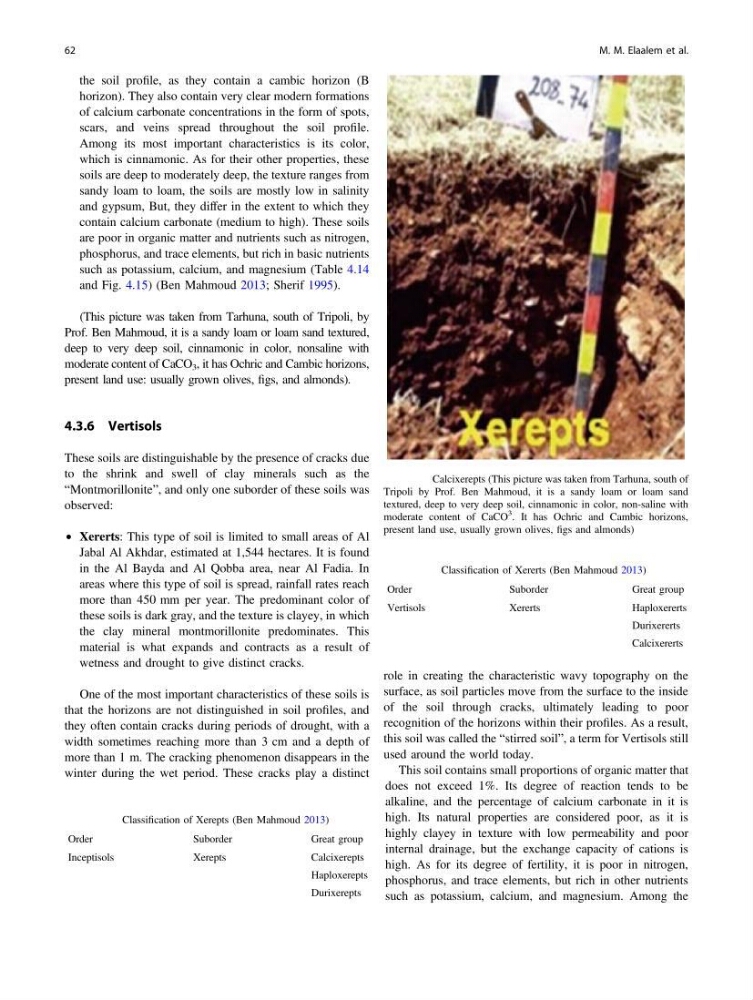
(This picture was taken from Tarhuna, south of Tripoli, by
Prof. Ben Mahmoud, it is a sandy loam or loam sand textured,
deep to very deep soil, cinnamonic in color, nonsaline with
moderate content of CaCO 3 , it has Ochric and Cambic horizons,
present land use: usually grown olives, figs, and almonds).
4.3.6 Vertisols
These soils are distinguishable by the presence of cracks due
to the shrink and swell of clay minerals such as the
“Montmorillonite”, and only one suborder of these soils was
observed:
• Xererts: This type of soil is limited to small areas of Al
Jabal Al Akhdar, estimated at 1,544 hectares. It is found
in the Al Bayda and Al Qobba area, near Al Fadia. In
areas where this type of soil is spread, rainfall rates reach
more than 450 mm per year. The predominant color of
these soils is dark gray, and the texture is clayey, in which
the clay mineral montmorillonite predominates. This
material is what expands and contracts as a result of
wetness and drought to give distinct cracks.
One of the most important characteristics of these soils is
that the horizons are not distinguished in soil profiles, and
they often contain cracks during periods of drought, with a
width sometimes reaching more than 3 cm and a depth of
more than 1 m. The cracking phenomenon disappears in the
winter during the wet period. These cracks play a distinct
role in creating the characteristic wavy topography on the
surface, as soil particles move from the surface to the inside
of the soil through cracks, ultimately leading to poor
recognition of the horizons within their profiles. As a result,
this soil was called the “stirred soil”, a term for Vertisols still
used around the world today.
This soil contains small proportions of organic matter that
does not exceed 1%. Its degree of reaction tends to be
alkaline, and the percentage of calcium carbonate in it is
high. Its natural properties are considered poor, as it is
highly clayey in texture with low permeability and poor
internal drainage, but the exchange capacity of cations is
high. As for its degree of fertility, it is poor in nitrogen,
phosphorus, and trace elements, but rich in other nutrients
such as potassium, calcium, and magnesium. Among the
Table 4.14 Classification of Xerepts (Ben Mahmoud 2013)
Order
Suborder
Great group
Inceptisols
Xerepts
Calcixerepts
Haploxerepts
Durixerepts
Fig. 4.15 Calcixerepts (This picture was taken from Tarhuna, south of
Tripoli by Prof. Ben Mahmoud, it is a sandy loam or loam sand
textured, deep to very deep soil, cinnamonic in color, non-saline with
moderate content of CaCO
3
. It has Ochric and Cambic horizons,
present land use, usually grown olives, figs and almonds)
Table 4.15 Classification of Xererts (Ben Mahmoud 2013)
Order
Suborder
Great group
Vertisols
Xererts
Haploxererts
Durixererts
Calcixererts
62
M. M. Elaalem et al.
horizon). They also contain very clear modern formations
of calcium carbonate concentrations in the form of spots,
scars, and veins spread throughout the soil profile.
Among its most important characteristics is its color,
which is cinnamonic. As for their other properties, these
soils are deep to moderately deep, the texture ranges from
sandy loam to loam, the soils are mostly low in salinity
and gypsum, But, they differ in the extent to which they
contain calcium carbonate (medium to high). These soils
are poor in organic matter and nutrients such as nitrogen,
phosphorus, and trace elements, but rich in basic nutrients
such as potassium, calcium, and magnesium (Table 4.14
and Fig. 4.15) (Ben Mahmoud 2013; Sherif 1995).
(This picture was taken from Tarhuna, south of Tripoli, by
Prof. Ben Mahmoud, it is a sandy loam or loam sand textured,
deep to very deep soil, cinnamonic in color, nonsaline with
moderate content of CaCO 3 , it has Ochric and Cambic horizons,
present land use: usually grown olives, figs, and almonds).
4.3.6 Vertisols
These soils are distinguishable by the presence of cracks due
to the shrink and swell of clay minerals such as the
“Montmorillonite”, and only one suborder of these soils was
observed:
• Xererts: This type of soil is limited to small areas of Al
Jabal Al Akhdar, estimated at 1,544 hectares. It is found
in the Al Bayda and Al Qobba area, near Al Fadia. In
areas where this type of soil is spread, rainfall rates reach
more than 450 mm per year. The predominant color of
these soils is dark gray, and the texture is clayey, in which
the clay mineral montmorillonite predominates. This
material is what expands and contracts as a result of
wetness and drought to give distinct cracks.
One of the most important characteristics of these soils is
that the horizons are not distinguished in soil profiles, and
they often contain cracks during periods of drought, with a
width sometimes reaching more than 3 cm and a depth of
more than 1 m. The cracking phenomenon disappears in the
winter during the wet period. These cracks play a distinct
role in creating the characteristic wavy topography on the
surface, as soil particles move from the surface to the inside
of the soil through cracks, ultimately leading to poor
recognition of the horizons within their profiles. As a result,
this soil was called the “stirred soil”, a term for Vertisols still
used around the world today.
This soil contains small proportions of organic matter that
does not exceed 1%. Its degree of reaction tends to be
alkaline, and the percentage of calcium carbonate in it is
high. Its natural properties are considered poor, as it is
highly clayey in texture with low permeability and poor
internal drainage, but the exchange capacity of cations is
high. As for its degree of fertility, it is poor in nitrogen,
phosphorus, and trace elements, but rich in other nutrients
such as potassium, calcium, and magnesium. Among the
Table 4.14 Classification of Xerepts (Ben Mahmoud 2013)
Order
Suborder
Great group
Inceptisols
Xerepts
Calcixerepts
Haploxerepts
Durixerepts
Fig. 4.15 Calcixerepts (This picture was taken from Tarhuna, south of
Tripoli by Prof. Ben Mahmoud, it is a sandy loam or loam sand
textured, deep to very deep soil, cinnamonic in color, non-saline with
moderate content of CaCO
3
. It has Ochric and Cambic horizons,
present land use, usually grown olives, figs and almonds)
Table 4.15 Classification of Xererts (Ben Mahmoud 2013)
Order
Suborder
Great group
Vertisols
Xererts
Haploxererts
Durixererts
Calcixererts
62
M. M. Elaalem et al.